
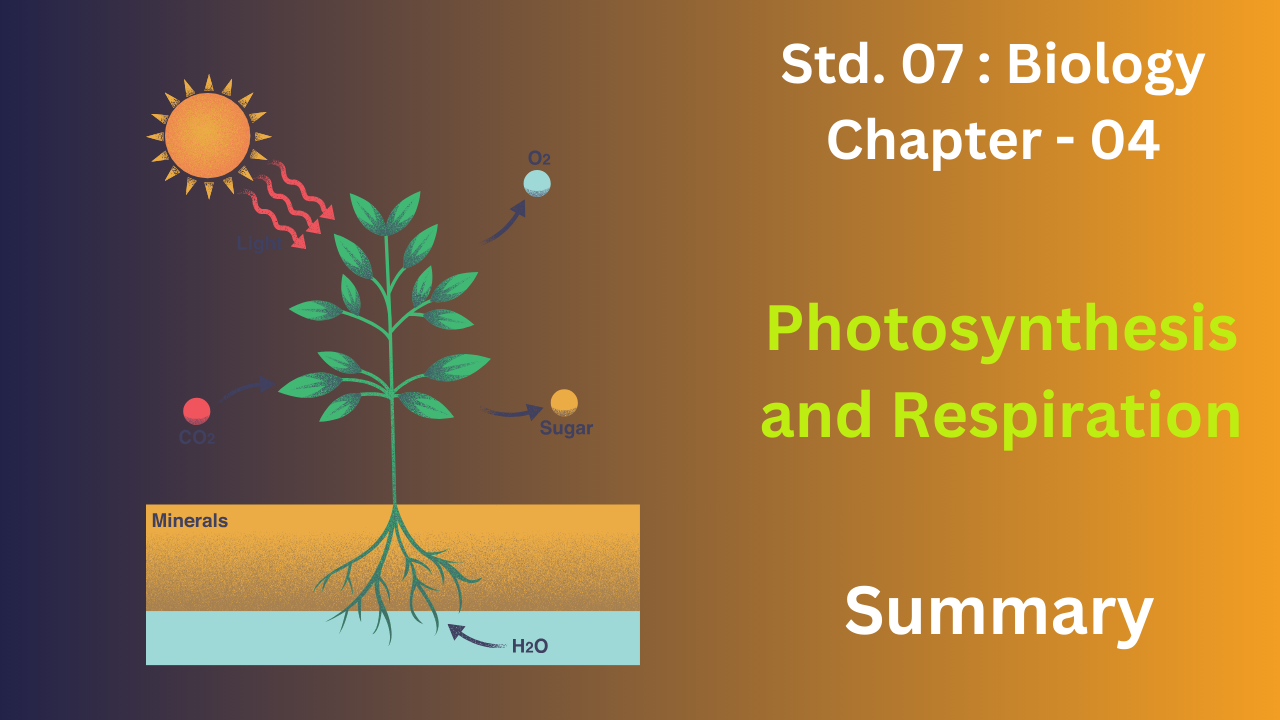
Photosynthesis is the fundamental process by which green plants, using chlorophyll in their leaves, manufacture their own food. This remarkable chemical reaction occurs in the presence of sunlight, where the plant takes in simple inorganic substances—carbon dioxide from the air through stomata and water from the soil through its roots. Using the trapped energy of sunlight, these raw materials are converted into glucose, a complex organic compound that serves as food for the plant. A crucial by-product of this process is oxygen, which is released back into the atmosphere, making it vital for life on Earth. Essentially, photosynthesis is a building-up process that stores solar energy as chemical energy in food, forming the base of the food chain for nearly all living organisms.
In contrast, respiration is the process through which all living organisms, including plants, break down this food to release the stored energy needed for their life activities. It occurs continuously in the cells of plants and animals. Unlike photosynthesis, respiration uses oxygen to break down glucose (food) into simpler substances like carbon dioxide and water, while releasing energy in a usable form. This energy is not just for movement; it is essential for internal functions like growth, repair, and maintaining bodily processes. Therefore, while photosynthesis builds up food and stores energy using carbon dioxide and releasing oxygen, respiration breaks down food and releases energy using oxygen and producing carbon dioxide. Together, these two complementary processes maintain the delicate balance of oxygen and carbon dioxide in our atmosphere, supporting life on our planet.
Review Questions
Multiple Choice Questions
1. Put a tick (✓ ) against the most appropriate alternative in the following statements.
(i) Carbohydrates are stored by plants in the form of:
(a) Vitamins
(b) Proteins
(c) Fats
(d) Glucose
(ii) Stomata are present on the surface of:
(a) Leaves
(b) Roots
(c) Stem
(d) Flower petals
(iii) Which one of the following is an end-product of photosynthesis ?
(a) Fructose
(b) Glucose
(c) Cellulose
(d) Lactose
Short Answer Questions
1. Why do leaves generally look green ?
Ans:
The vibrant green hue we see in leaves stems from how chlorophyll interacts with sunlight. To power photosynthesis, this pigment readily captures specific wavelengths of light, primarily in the blue and red portions of the spectrum. The green wavelength, however, is not absorbed but reflected away. This reflected green light travels to our eyes, and through the process of visual perception, we register the characteristic color. Although leaves contain additional pigments, the overwhelming abundance of chlorophyll throughout the growing season usually dominates their appearance. This changes in autumn when cooler temperatures and reduced daylight cause chlorophyll to degrade. As its green fades, the once-masked yellows, oranges, and reds of other compounds become visible.
2. Which four of the following are needed for photosyn-thesis in a leaf:
(i) Carbon dioxide:
(ii) Oxygen:
(iii) Nitrates :
(iv) Water:
(v) Chlorophyll:
(vi) Soil:
(vii) Light:
Ans:
The four things needed for photosynthesis in a leaf from the list are:
(i) Carbon dioxide
(iv) Water
(v) Chlorophyll
(vii) Light
3. What is the source of energy for photosynthesis ?
Ans:
Here’s a more detailed explanation:
This pigment possesses the unique capability to absorb light energy, particularly within the blue and red wavelengths of the visible light spectrum.
The captured light energy then serves as the driving force for the intricate series of chemical reactions that constitute photosynthesis. During this process, carbon dioxide and water are transformed into glucose, a sugar molecule that serves as the plant’s primary source of energy and building material, and oxygen, which is released as a byproduct.
Therefore, in essence, plants harness light energy and convert it into chemical energy stored within the bonds of glucose molecules through the process of photosynthesis.
4. Which gas is taken in and which one is given out by the leaf in bright sunlight ?
(i) Taken in :
(ii) Given out:
Ans:
(i) Taken in: Carbon dioxide (CO₂)
Leaves absorb carbon dioxide from the ambient air through microscopic pores located on their surface, termed stomata. This atmospheric gas is a crucial input material required for the biochemical reactions of photosynthesis.
(ii) Given out: Oxygen (O₂)
Oxygen is produced as a secondary product during the initial, light-dependent phase of photosynthesis, which involves the splitting of water molecules. This generated oxygen is then released into the external environment through the stomatal pores.
It’s important to acknowledge that plants also perform respiration, a metabolic process that involves the uptake of oxygen and the release of carbon dioxide, occurring continuously regardless of the presence or absence of light. However, when leaves are exposed to intense sunlight, the rate at which photosynthesis occurs generally exceeds the rate of respiration. As a result, the overall gas exchange observed in a leaf under bright sunlight conditions is characterized by a significant consumption of carbon dioxide and a substantial release of oxygen.
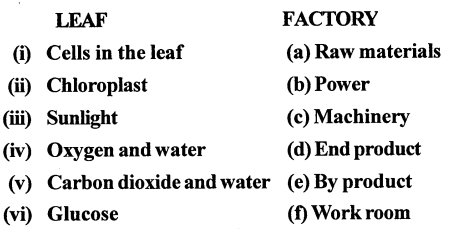
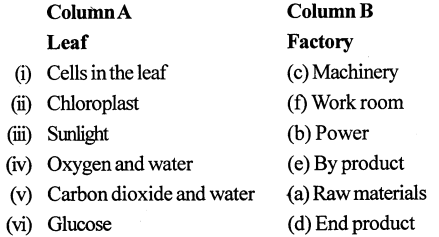
5. Suppose we compare the leaf with a factory, match the items in Column A with those in Column B.
ColumnA Column B
Answer:
6. State whether the following statements are True or False:
(i) Green plants prepare their food by using two raw materials, oxygen and water.
False. Green plants prepare their food by using raw materials, CO, chlorophyll and water.
(ii) The chlorophyll enables the plants to use light energy.
True
(iii) The free oxygen in the atmospheric air is the result of photosynthesis.
True
(iv) Photosynthesis occurs only in chlorophyll-containing parts of the plant.
True
7. Differentiate between aerobic and anaerobic respiration. Write the overall chemical equations of the two kinds of respiration in plants.
(i) Aerobic:
(ii) Anaerobic:
Ans:
In plants, aerobic respiration serves as the primary energy-unlocking mechanism, dependent upon the presence of oxygen. Through a coordinated sequence of metabolic steps, glucose undergoes full dismantling, with carbon dioxide and water generated as final products. The initial stage, glycolysis, unfolds in the cellular cytoplasm. Subsequent stages, encompassing the Krebs cycle and the electron transport chain, proceed inside the specialized compartments of the mitochondria. This comprehensive oxidation of a single glucose molecule harvests a substantial yield of adenosine triphosphate (ATP), the fundamental unit of cellular energy.
In contrast, anaerobic respiration represents an emergency metabolic shortcut employed when oxygen is scarce. Within plant tissues, the predominant response is alcoholic fermentation. This cytoplasmic process only partially decomposes glucose, resulting in the formation of ethanol and carbon dioxide, while releasing a comparatively minor amount of ATP. Though less common, certain plant cells may resort to lactic acid fermentation under particular duress. The core differences between these pathways are therefore defined by oxygen dependence, the degree to which glucose is metabolized, the chemical byproducts created, and the net energy gain for the cell.
Question 8.
Explain how photosynthesis is different from respiration.
Ans:
Photosynthesis and respiration are essential yet contrasting biological processes. Photosynthesis, occurring in chloroplasts, captures light energy to synthesize glucose from CO₂ and water, releasing O₂ and storing energy. Respiration, primarily in mitochondria, breaks down glucose with O₂ to yield usable energy (ATP), releasing CO₂ and water. Photosynthesis is energy-storing and oxygen-producing, while respiration is energy-releasing and carbon dioxide-producing. Their products and reactants are reciprocally linked, maintaining a critical balance of energy and gases vital for sustaining life on Earth.
Question 9.
Do the plants respire all day and night or only during the night ?
Ans:
Plants carry out respiration continuously, not solely during nighttime hours. Respiration is the metabolic process through which plants break down stored organic substances to release energy in the form of ATP, which is vital for supporting all their cellular functions, a need that persists constantly.
Photosynthesis, the process of manufacturing food (glucose) utilizing light energy, water, and carbon dioxide, is exclusively active during daylight when light is accessible. While both photosynthesis and respiration involve gas exchange, their overall impact on gas exchange differs depending on light availability. During the day, given adequate light, the rate of photosynthesis generally exceeds that of respiration, leading to a net intake of carbon dioxide and a net output of oxygen.
Consequently, plants absorb oxygen and emit carbon dioxide throughout the night to fulfill their continuous energy requirements. Therefore, energy generation via respiration is an uninterrupted and essential function in plants, operating independently of the daily light-dark cycle.
Question 10.
What happens to the energy liberated during respiration?
Ans:
The energy liberated through the process of respiration is not dissipated without purpose; rather, it is predominantly conserved and transformed into the chemical energy of adenosine triphosphate (ATP). ATP functions as the immediate and readily accessible energy currency of the cell, providing the necessary power for a multitude of cellular activities, including muscle contraction, active transport of molecules across membranes, the synthesis of complex biomolecules, and processes related to cell growth and division. This energy conversion occurs through the phosphorylation of adenosine diphosphate (ADP) using the energy derived from the breakdown of glucose and other organic substrates. While the primary fate of the liberated energy is ATP synthesis, a portion is also inevitably released as thermal energy (heat) due to the inherent inefficiencies of metabolic reactions, contributing to the maintenance of body temperature in homeothermic organisms. Therefore, respiration efficiently converts the potential chemical energy stored in food into a usable form of energy that drives virtually all energy-requiring processes within the cell.
Long Answer Questions
Question 1.
In order to carry out photosynthesis, what are the substances that a plant must take in ? Also mention their sources.
Ans:
Carbon Dioxide (CO₂):
- Source: The surrounding atmosphere. Plants acquire carbon dioxide through minute openings present on the surface of their leaves, known as stomata. These stomatal pores facilitate the exchange of gases between the plant’s internal tissues and the external air.
Water (H₂O):
- Source: Primarily the soil medium. Water is absorbed from the soil by the plant’s root system, specifically through root hairs, which significantly enhance the surface area available for water uptake. The absorbed water is then transported upwards throughout the plant via the vascular tissue called xylem, reaching the leaves where photosynthesis takes place.
Light Energy:
- Source: Predominantly solar radiation from the sun. Plants possess specialized pigments, with chlorophyll being the most crucial, located within organelles called chloroplasts inside their leaf cells. Chlorophyll has the ability to absorb light energy, particularly within the blue and red regions of the visible light spectrum. This captured light energy provides the necessary impetus for the chemical reactions that constitute photosynthesis.
Question 2.
What is the role of chlorophyll in photosynthesis ?
Ans:
Chlorophyll, the green pigment found in plant chloroplasts, is the key molecule responsible for initiating photosynthesis. Its primary function is to absorb light energy from the sun, most effectively in the blue and red regions of the visible spectrum. Upon absorbing light, chlorophyll molecules become energized, triggering a series of electron transfer reactions within the thylakoid membranes. This energy conversion process leads to the production of ATP (adenosine triphosphate) and NADPH (nicotinamide adenine dinucleotide phosphate), energy-carrying molecules crucial for the subsequent synthesis of glucose. Furthermore, the energized chlorophyll facilitates the splitting of water molecules, releasing electrons, protons, and oxygen as a byproduct. In essence, chlorophyll acts as a light-harvesting antenna and a primary energy converter, enabling the transformation of light energy into the chemical energy that sustains plant life and forms the foundation of most food chains.
Question 3.
Do plants need oxygen ? If so, what is its source ?
Ans:
Plants, much like all aerobic life forms, have a crucial requirement for oxygen to carry out respiration. This metabolic process breaks down sugars to produce adenosine triphosphate (ATP), the energy-carrying molecule essential for sustaining all their life functions, including growth and the uptake of nutrients. The main source of this oxygen is the surrounding atmosphere. Leaves facilitate the absorption of oxygen through tiny pores on their surface called stomata, while woody stems use lenticels for gas exchange, including oxygen intake. Roots, located underground, obtain oxygen from the air pockets present within the soil. Even though photosynthesis, which occurs during daylight, produces oxygen as a byproduct, every living cell within a plant needs a continuous supply of oxygen for respiration, making its acquisition from the environment indispensable for their survival and proper physiological operation.