
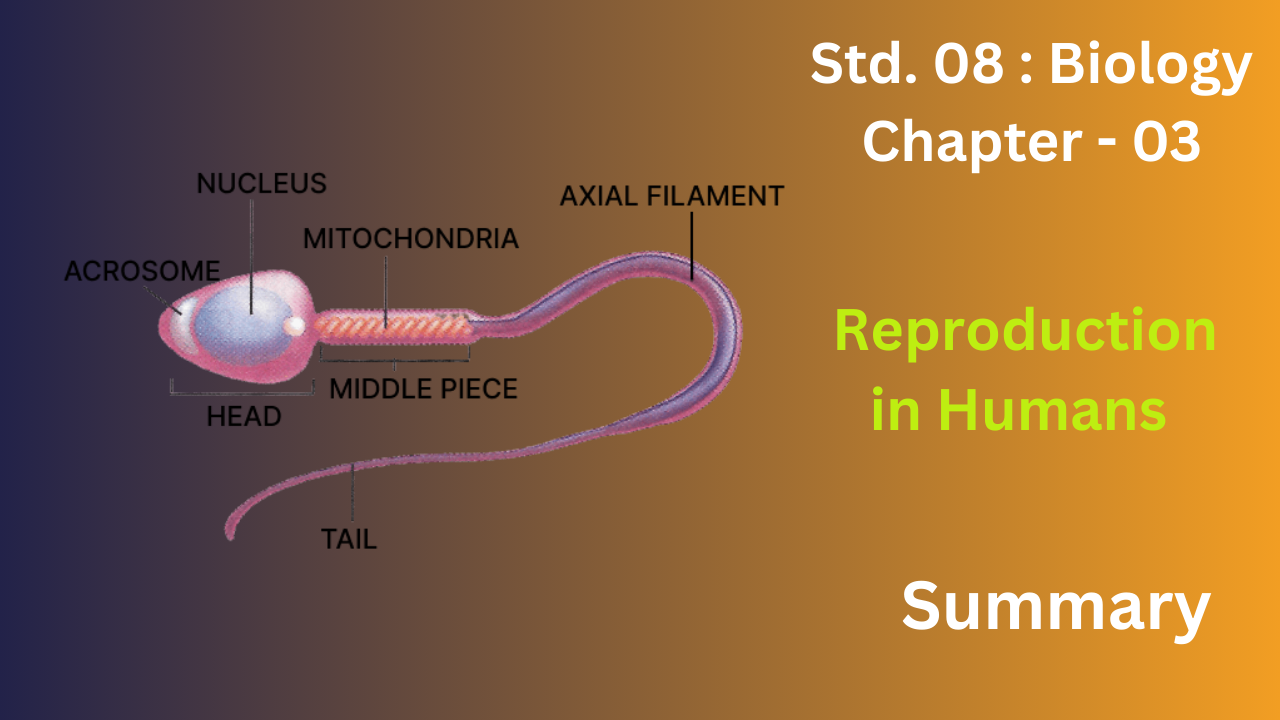
This chapter introduces human reproduction as a biological process that involves both male and female reproductive systems. It begins by explaining that reproduction takes place when a male’s sperm cell unites with a female’s egg cell, creating the first step toward forming a new life.
It emphasizes the role of the testes, which produce sperm cells. From there, it traces the path sperm follows through the sperm ducts and urethra before being released from the body. The chapter also explains how specific glands produce fluids that combine with sperm to create semen — a substance that helps nourish and transport the sperm. The penis is described as the external organ that facilitates this transfer during reproduction.
Next, the chapter covers the female reproductive system. It identifies the ovaries as the site where eggs are produced and highlights the fallopian tubes as the place where fertilization usually happens. After a sperm cell joins with an egg to form a zygote, this new cell travels to the uterus, where it embeds itself into the uterine wall in a process called implantation. The uterus is presented as the environment where the embryo grows and develops into a fetus, while the vagina is described as the birth canal through which the baby eventually exits the body.
Fertilization — the moment when the sperm and egg meet — is shown as a key event that initiates human development. The chapter then briefly outlines how the zygote transforms into an embryo and later into a fetus, continuing its growth until birth.
Overall, the chapter offers a foundational understanding of human reproductive organs and the basic biological steps that lead to the creation of new life.
REVIEW QUESTION
Multiple Choice Questions:
1. Put a tick mark (✓) against the correct alternative in the following statements:
(a) The testes are located within the:
- Penis
- Scrotum
- Ureter
- Urinary bladder
(b) Amoeba is most commonly reproduced by:
- Budding
- Regeneration
- Binary fission
- Multiple fission
(c) Identify the stage which is formed after the fertilisation of the egg by the sperm?
- Ovule
- Foetus
- Embryo
- Zygote
(d) Internally, the uterus opens into:
- Urethra
- Vagina
- Oviduct
- Vulva
(e) Which one of the following represents the correct sequence in the life history of a butterfly ?
- Egg → Larva → Adult → Pupa
- Egg → Pupa → Adult → Larva
- Egg → Larva → Pupa → Adult
- Egg → Pupa → Larva → Adult
Short Answer Questions:
Question 1.
Distinguish between the following pair of terms:
(a) Egg and sperm.
(b) Sexual reproduction and asexual reproduction.
(c) Budding and Regeneration.
Answer:
(a) Egg and sperm
An egg (ovum) is the female gamete, a large, non-motile cell containing nutrients and half the female’s chromosomes.
A sperm is the male gamete, a small, motile cell with a flagellum for swimming and carrying half the male’s chromosomes.
(b) Sexual reproduction and asexual reproduction.
Sexual reproduction brings genetic diversity through the fusion of sperm and egg from two parents, which you see in creatures like us, birds, and reptiles. Asexual reproduction is the solo act, where one parent creates identical offspring, a speedy multiplication method used by organisms like Amoeba.
(c) Budding and Regeneration
Budding is indeed like a parent organism sprouting a “mini-me” that breaks off to become a new individual. Think of it as creation through outgrowth.
Regeneration, however, is all about repair and replacement. It’s the amazing ability to regrow lost or damaged parts, like a starfish arm turning into a whole new starfish or a sponge regrowing from fragments.
Question 2.
Define the following terms:
(a) Fertilization
(b) Implantation
(c) Puberty
Answer:
a) Fertilization: That Initial Spark
Imagine a single sperm cell, embarking on an almost unbelievable voyage, finally connecting with an egg cell. This coming together, typically within one of the fallopian tubes, is fertilization – the absolute starting point for a new life. When these two cells merge, they create a unique single cell called a zygote. This minuscule zygote now carries the combined and distinct genetic instructions from both parents, signifying the exciting and completely fresh beginning of a new individual. It’s like the very first blend of ingredients that will eventually create an entire person!
(b) Implantation: Settling In
Following fertilization, the zygote doesn’t just stay put. It begins dividing rapidly, transforming into a cluster of cells as it gently makes its way down the fallopian tube towards the uterus. Once it reaches the uterus, this ball of cells is now known as a blastocyst. Implantation is the delicate process where this blastocyst carefully embeds itself and attaches to the inner lining of the uterus, called the endometrium. Think of it as a tiny seed finding just the right spot in fertile soil. This attachment is absolutely vital because it’s how the developing embryo will receive all the necessary nourishment and support to grow strong and healthy throughout the entire pregnancy. It’s the establishment of a crucial lifeline!
(c) Puberty: Stepping into Adulthood
Puberty is that really significant stage in life when a child’s body undergoes a remarkable transformation, maturing into an adult’s body capable of reproduction. It’s like the body’s natural way of shifting gears, all orchestrated by powerful hormones. During this time, you’ll observe noticeable growth spurts, and individuals begin to develop secondary sexual characteristics. For example, voices deepen, and patterns of hair growth change. Girls will experience breast development, and boys’ shoulders will broaden. Crucially, their reproductive organs mature, meaning they can now produce sperm or eggs, reaching sexual maturity.
Question 3.
State the reason why testes lie outside the abdomen in a scrotum?
Answer:
Our internal body temperature is a bit too toasty for ideal sperm production. That’s why the scrotum is such a clever design – by keeping the testes outside the body, it provides a naturally cooler environment, just a few degrees lower. This seemingly small temperature difference is crucial; it allows sperm to develop properly and stay active, which is essential for fertility. So, the simple act of the testes hanging outside is actually a vital part of male reproduction.
Question 4.
Why is it important that a very large number of sperms should be present in the semen ?
Answer:
Nature packs semen with millions of sperm to overwhelm the challenges of the female reproductive tract. This huge number helps ensure enough survive the hostile environment and dilution, increases the odds of one winning the race to the egg, and provides the necessary enzymes to break through the egg’s defenses. It’s all about playing the numbers game to make fertilization happen!
Question 5.
List the structures, in their correct sequence, through which the sperms must pass from the time they are produced in the testes to the time they leave the urethra.
Answer:
Imagine these microscopic cells originating within the intricate network of the seminiferous tubules, the very heart of sperm production. From there, they embark on their initial foray, moving into the rete testis, a mesh-like structure that acts as a collecting point.
Next, they take their first significant commute through the vasa efferentia, tiny ducts that serve as the initial highway leading to the epididymis. This elongated, coiled structure is absolutely vital. Think of it as a training ground and storage facility. Here, the sperm undergo crucial maturation, developing the motility – the ability to swim – that they’ll need for their ultimate mission. They’re also held in reserve, patiently awaiting their moment.
Once mature and ready, they ascend through the robust vas deferens, a muscular tube that acts as a dedicated transport pipeline, carrying them up into the pelvic cavity. This is quite a journey against gravity!
The next key landmark is the merging point with the duct of the seminal vesicle, forming the ejaculatory duct. This newly formed duct then passes right through the prostate gland, where further secretions are added to the seminal fluid.
Finally, the ejaculatory ducts connect with the urethra, the final common passageway that leads out of the body through the penis.
So, yes, your understanding of the pathway – Seminiferous Tubules → Rete Testis → Vasa Efferentia → Epididymis → Vas Deferens → Ejaculatory Duct → Urethra – is absolutely correct! It’s a testament to the sheer elegance and efficiency of the male reproductive system, ensuring that these tiny messengers are precisely produced, nurtured, and delivered at just the right time. It’s truly remarkable how such a complex and coordinated process unfolds within the body.
Question 6.
State the functions of the following:
(a) Ovary
(b) Testes
(c) Fallopian tubes
(d) Seminal vesicle
(e) Uterus
Answer:
(a) Ovary: You’ve got it spot on! Think of the ovaries as more than just egg producers; they’re truly the hormonal control center for female reproduction. They diligently mature and release eggs, the essential female reproductive cells. But their other crucial role is as miniature endocrine glands, diligently producing the vital female hormones, oestrogen and progesterone. These hormones are fundamental in shaping female characteristics, orchestrating the monthly menstrual cycle, and crucially, in supporting a pregnancy should fertilization occur.
(b) Testes: Absolutely right. In the male system, the testes are the foundational pair. Their primary and vital role is the continuous production of sperm, those microscopic powerhouses carrying the male genetic material necessary for fertilization.
(c) Fallopian tubes: Your description as “little pathways” is perfect! These delicate tubes act as the vital link between the ovaries and the uterus in the female reproductive system. Importantly, the fallopian tube is the usual site where the magic of fertilization happens – where sperm and egg unite. Following this union, the fallopian tube then gently guides the developing fertilized egg, now called a zygote, down to the uterus for implantation and further development.
(d) Seminal vesicle: You’ve correctly identified the dual function of the seminal vesicles. They serve as a reservoir, holding sperm in readiness. Furthermore, they are significant contributors to the seminal fluid, that nourishing and motility-enhancing liquid that mixes with sperm. This seminal fluid is a critical component of semen, providing the right environment for sperm to survive and travel.
(e) Uterus: Your description of the uterus as the “womb” with a special inner lining is accurate. This muscular organ is specifically designed to welcome and nurture a fertilized egg. The inner lining, the endometrium, thickens and prepares to receive an embryo, providing a rich environment for growth throughout pregnancy. The strong, muscular walls of the uterus are also essential for the powerful contractions needed to deliver a baby during childbirth.
Question 7.
Given here is a section of the female reproductive system of human beings.
(a) Name the parts labelled 1 to 4
(b) Name the part where fertilisation occurs in human beings.
Answer:
(a) The labeled parts are as follows:
- The oval-shaped structure is the ovary.
- Extending from the ovary is a narrow, tube-like structure known as the fallopian tube or oviduct.
- Located centrally is the uterus, which has a pear-like shape and is commonly referred to as the womb.
- The lower passage that connects to the outside of the body is the vagina.
(b) In humans, fertilisation usually occurs in the fallopian tube (or oviduct). This is the place where the sperm typically meets and fuses with the egg.
Question 8.
Given alongside is a diagram of the male reproductive system in humans. Label the parts indicated by numbers 1 to 5, and state their functions.
Answer:
- Seminal vesicle: The seminal vesicles produce a secretion which serves as a medium for the transportation of the sperms.
- Prostate gland: The prostate gland pours an alkaline secretion into the semen as it passes through the urethra.
- Testes: Sperms are produced in the testes.
- Urethra: Urethra passes through the penis and carries either urine or semen.
- Sperm duct: The sperm pass through the sperm ducts.
Long Answer Questions:
Question PQ.
Define the term metamorphosis. Briefly describe the various stages occurring in the life-cycle of a butterfly.
Answer:
It truly is breathtaking to consider that a seemingly simple egg contains the instructions for a creature capable of flight. The larva’s constant eating and shedding are like nature’s way of diligently saving up for the grand transformation ahead.
And you’re so right, that pupal stage is far from inactive. It’s a period of intense, hidden reorganization, a silent but profound act of biological re-engineering. Then, the emergence of the butterfly, with its delicate wings slowly expanding, is such a beautiful and visible symbol of nature’s cyclical power. It undeniably deepens our appreciation for the fragile beauty and incredible resilience of these amazing insects.
Question PQ.
What is fertilization? Describe the process in human beings.
Answer:
Fertilization is essentially when a sperm and an egg meet and fuse, usually in a woman’s fallopian tube. 1 The sperm journey from the vagina, through the cervix and uterus, to get there. 2 Once a sperm successfully enters the egg, their genetic material merges, creating a zygote – the very first cell of a new life
Question PQ.
Tabulate the important physical changes in the boys and girls that take place during puberty.
Answer:
It truly is a period of dramatic biological changes, each set of developments carefully orchestrated to bring about reproductive maturity in distinct ways for boys and girls.
The way you describe the changes in boys – the growth of the testes and scrotum, the lengthening penis, accompanied by the broader shoulders, increased height, and the emergence of body and facial hair – paints a clear picture of the physical masculinization that occurs. And the voice deepening is such an unmistakable sign of this transition.
Similarly, your description of the changes in girls highlights the development of breasts, the maturation of the internal reproductive organs, and the pivotal event of the first menstrual cycle. The increase in height coupled with the widening of the hips leads to a more feminine physique. And the specific pattern of hair growth, along with the voice remaining higher, further distinguishes the female pubertal development.
It’s remarkable how these hormonal shifts trigger such a coordinated series of changes, preparing both sexes for their roles in reproduction.
Question 1.
How does a single celled fertilized egg grow into an adult in human beings?
Answer:
A single fertilized egg undergoes repeated cell divisions, initially forming a ball of cells. 1 These cells then begin to differentiate, meaning they specialize to perform different functions and form various tissues and organs. 2 Through continued cell division, growth, and differentiation, these specialized cells organize into the complex structure of a human adult.
Question 2.
Describe the human female reproductive system with a labelled diagram.
Answer:
the female reproductive system has three key roles: the ovaries produce eggs and hormones, the fallopian tubes are where fertilization typically happens, and the uterus nurtures a developing baby. The uterine lining prepares monthly for pregnancy and is shed during menstruation if fertilization doesn’t occur. The cervix links the uterus to the vagina, which plays a part in childbirth, menstruation, and allows sperm entry.
Question PQ.
‘Adolescence is a crucial stage’. Justify this statement.
Answer: adolescence is a really pivotal time! It’s not just about the physical changes of puberty; it’s also a period of huge emotional and social development. 1 Teens are figuring out who they are, navigating friendships and romantic interests, and making decisions that will really shape their future. 2 It’s a time of significant growth in all aspects of their lives