
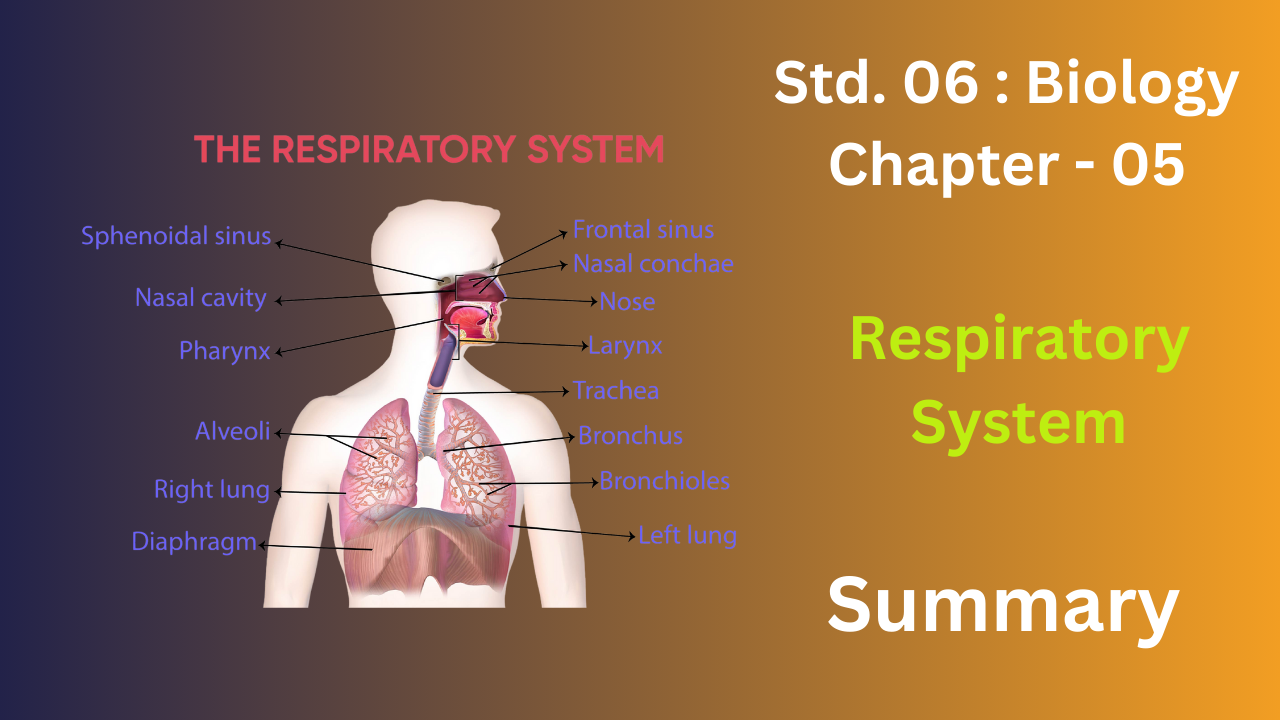
This chapter explains how we get the air we need to live.. It also helps us get rid of carbon dioxide, a waste gas.
You’ll learn about the parts involved: your nose (for taking in air and filtering out junk), the trachea (windpipe that carries air to your lungs), the lungs themselves (where the magic happens in tiny air sacs), the bronchi (branches of the windpipe in the lungs), and the diaphragm (a muscle that helps you breathe).
The chapter also covers how breathing works: when you inhale, your chest expands to suck air in, and when you exhale, it shrinks to push air out. Finally, it explains how oxygen goes from the air in your lungs into your blood, and how carbon dioxide moves from your blood into your lungs to be breathed out.
Review Questions
Multiple Choice Questions
1. Put a tick (✓) against the most appropriate alternative in the following statements.
(i) In humans, taken in of the air through nostrils into the nasal cavity is called
(a) Inhalation
(b) Exhalation
(b) Cellular respiration
(d) Internal respiration
(ii) The front opening of the windpipe is guarded by —
(a) Glottis
(b) Epiglottis
(c) Epiglottis
(d) Trachea
(iii) The process during which food is oxidised and energy is released is called
(a) Cellular respiration
(b) Excretion
(c) Digestion
(d) Transpiration
Short Answer Questions
1. Answer briefly the following:
- Why do our body cells require oxygen ?
Ans. Body cells require oxygen for the breakdown of glucose and release energy for carrying out various life functions. - What is the difference between breathing and respiration?
Ans. Breathing is a simple physical process of drawing in air through the nostrils and expelling it out.
Respiration is a chemical process which involves the breakdown of food and release energy. - Name the by-product formed during the oxidation of food.
Ans. The by- products formed are
1. carbon-di-oxide
2. water - Name the agency which transports oxygen to all parts of the body.
Ans. Blood . - What is the role of epiglottis during swallowing ?
Ans. Epiglottis closes the windpipe at the time of swallowing.
Question 2.
Describe in brief the function of ribs and diaphragm in breathing.
Answer:Breathing in happens when your diaphragm muscle moves down and your rib cage expands. 1 This makes more space in your chest, so air gets sucked into your lungs. 2 Breathing out is the opposite: your diaphragm relaxes and moves up, and your rib cage gets smaller, pushing air out of your lungs. 3 So, your ribs and diaphragm work like a pump to move air in and out.
Question 3.
Name the gas which is expelled out during expiration. Where is it originally produced in our body ?
Answer:When you exhale, the primary gas you’re releasing is carbon dioxide. This CO2 is a byproduct that your cells produce as they generate energy through cellular respiration.
Question 4.
Name the following:
- Respiratory process
Ans:anaerobic respiration
- in which oxygen is not utilized.
Ans. Cellular respiration - Respiratory process in which oxygen is utilized.
Ans. Gaseous transport - The microscopic air-sacs of the lungs.
Ans. Alveoli - The two membranes which protect the lungs.
Ans. Outer pleura, inner pleura
Long Answer Questions:
Question 1.
Why is a respiratory system necessary ?
Answer:Our need to breathe is fundamental to life because it’s how we take in the oxygen that fuels every single cell in our bodies. Imagine your cells as tiny engines constantly working; oxygen is their essential fuel. Without a steady supply, these engines would grind to a halt, and our cells would quickly perish.
Simultaneously, as our cells work, they produce carbon dioxide, a waste product similar to exhaust. If this builds up, it becomes harmful. Our respiratory system acts as a ventilation system, allowing us to expel this carbon dioxide, maintaining a healthy internal balance.
Essentially, breathing is our vital gas exchange – inhaling the life-giving oxygen and exhaling the toxic carbon dioxide. This continuous process is absolutely crucial for all our bodily functions to keep running smoothly.
Question 2.
What factors are most likely to affect the breathing rate ?
Answer:Your breathing speeds up when your body needs more air, like when you’re active or at high altitudes with less oxygen. It also increases to get rid of excess carbon dioxide. Feelings like stress, a fever, and certain health issues can also make you breathe faster.
Question 3.
What happens to the energy liberated during respiration?
Answer:The energy released during respiration fuels all the essential activities of our bodies, from muscle movement and nerve impulses to growth and repair. It’s the power source for life’s processes!
Question 4.
What do you understand by inhalation and exhalation ? How are they different from each other ?
Answer:Breathing in (inhalation) and breathing out (exhalation) are two sides of the same coin. When you inhale, air rushes into your lungs because your diaphragm moves down and your ribs expand, making more space and lowering the pressure inside. This brings in oxygen-rich air. Exhalation is the reverse: your diaphragm relaxes, your ribs move in, the space shrinks, and the higher pressure pushes air, now richer in carbon dioxide, out. 2 So, inhalation is about getting oxygen in, and exhalation is about getting carbon dioxide out.
Question 5.
What do you understand by the term respiratory diseases ? Name any three common respiratory diseases.
Answer:Respiratory diseases mess with your lungs and breathing. Common ones include asthma, where airways narrow causing wheezing and breathlessness; bronchitis, an airway inflammation leading to a stubborn cough and mucus; and pneumonia, a lung infection that can fill air sacs with fluid.
Question 6.
State the cause and treatment for the following diseases
- Tuberculosis
- Pneumonia
- Bronchitis
Answer:Tuberculosis (TB): Caused by a bacteria. Needs a long treatment with multiple antibiotics from a doctor, usually lasting many months.
Pneumonia:Treatment depends on the cause; antibiotics for bacteria, rest for viruses, antifungals for fungi. Sometimes I need hospital care and oxygen.
Bronchitis: Inflammation of the breathing tubes. Can be short-term (usually from viruses, like a cold) or long-term (often from smoking). Short-term usually just needs rest. Long-term focuses on easing symptoms, often with inhalers, and stopping smoking.