
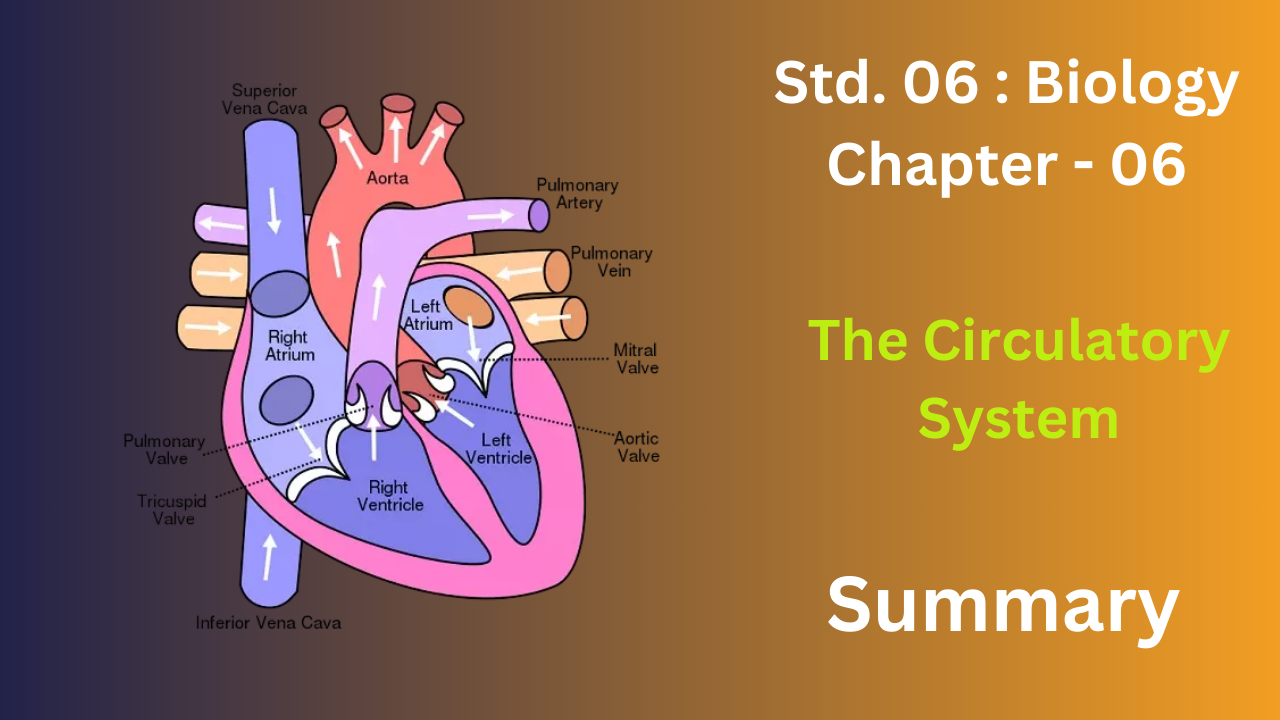
Your heart is the strong engine, tirelessly pumping blood – the delivery trucks carrying supplies and the garbage trucks removing waste – through a network of roads called blood vessels.
These “roads” come in three main types: arteries that carry fresh, oxygen-rich blood away from the heart, veins that bring the used blood back, and tiny capillaries where the crucial exchange of supplies (like oxygen and nutrients) and waste happens directly with your cells.
This continuous movement, called circulation, is essential for life. It ensures every cell gets what it needs to function and that waste is efficiently removed. So, it’s all about the heart’s pumping action, the blood’s journey through the vessels, and its critical role in keeping everything running smoothly!
Multiple Choice Questions:
1. Put a tick mark (✓) against the correct alternative in the following statements:
(a) Function of WBCs is to
(i) Transport oxygen
(ii) Help in clotting of blood
(iii) Provide immunity
(iv) Provide storage of food.
(b) Blood Capillary is a
(i) Broad tube
(ii) Artery with thick wall
(iii) Vein with large lumen
(iv) Narrow tube made up of endothelium only.
(c) Nucleus is absent in
(i) RBCs
(ii) VBCs
(iii) All blood cells
(iv) Liver cells.
(d) The only artery which carries deoxygenated blood is called,
(i) Hepatic artery
(ii) Pulmonary artery
(iii) Aorta
(iv) Renal artery
(e) Sphygmomanometer measures
(i) Pulse rate
(ii) Heart beat
(iii) Blood pressure
(iv) Brain activity
(f) Pulmonary vein carries
(i) Oxygenated blood
(ii) Deoxygenated blood
(iii) Glucose-rich blood
(iv) C02 laden blood
g) The blood tastes saltish due to the dissolved:
(i) Sodium chloride
(ii) Potassium chloride
(iii) Ammonium nitrate
(iv) Sodium nitrate
Short Answer Questions:
1. Differentiate between the following pair of terms:
Question 1(a)
Platelets and WBC
Answer:Think of your blood having different tiny helpers. Platelets are like the body’s tiny construction crew, rushing to patch up any cuts or injuries to stop bleeding. White blood cells (WBCs), on the other hand, are like the body’s defense force, fighting off infections and keeping you healthy by attacking germs and other invaders. So, platelets are for fixing damage, and WBCs are for fighting off bad guys!
Question 1(b)
Pulmonary artery and pulmonary vein
Answer:the pulmonary artery as a delivery truck heading from your heart straight to your lungs. It’s carrying blood that’s low on oxygen and needs a refill. Once the blood gets its oxygen in the lungs, the pulmonary vein acts like the return truck, bringing that fresh, oxygen-rich blood right back to your heart so it can be pumped out to the rest of your body. So, arteries to the lungs, veins from the lungs – easy peasy!
Question 1(c)
Vena Cava and Aorta
Answer:The vena cava brings blood back to the heart for a refill of oxygen, while the aorta sends that oxygen-rich blood out on its journey to nourish the rest of the body. One’s the return trip, the other’s the big send-off!
Question 1(d)
RBC and WBC
Answer:Red Blood Cells (RBCs) are like tiny delivery trucks in your blood. They’re shaped like little discs and are filled with a special passenger called hemoglobin. Their main mission is to pick up oxygen from your lungs and drop it off at every corner of your body.
White Blood Cells (WBCs) are your body’s defense force. They patrol your bloodstream, looking for trouble like bacteria and viruses. When they find an invader, they jump into action to destroy it. Unlike the oxygen carriers, there are different kinds of WBCs, each with its own special way of fighting off different threats.
Question 2.
Give any three differences between an artery and a vein:
Answer:Think of arteries as busy one-way streets carrying blood full of life away from your heart. 1 They’re under higher pressure, like a hose directly connected to the pump. Veins, on the other hand, are like return lanes, bringing the blood back to your heart at a lower pressure. 2 To help this return trip, especially against gravity in your limbs, veins have special one-way doors called valves that prevent any backward flow. 3 Arteries don’t usually need these valves because the heart’s strong push keeps the blood moving in the right direction
Question 3.
Blood consists of two parts — a liquid part and a cellular part. Name these parts and briefly write about them.
Answer:Imagine your blood as a river with two main components: the water and some little boats floating along.
The “water” is called plasma. It’s a yellowish fluid that carries all sorts of important cargo around your body, like salts, sugars, proteins, hormones, and even waste.
The “boats” are the blood cells, and there are three main types, each with its own job:
- Red Blood Cells (RBCs): These are like the oxygen delivery trucks. They pick up oxygen in your lungs and drop it off wherever it’s needed in your body. That’s why blood looks red!
- White Blood Cells (WBCs): Think of these as the body’s security guards. They patrol your bloodstream, looking for any invaders like germs and helping to fight them off. There are different kinds of WBCs, each with special skills.
- Platelets: These are like tiny repair crews. When you get a cut, they rush to the scene and stick together to plug the hole and stop the bleeding.
So, blood is a busy fluid carrying life-sustaining cargo and a dedicated defense and repair team!
Question 4.
What is the role of haemoglobin in the blood ?
Answer:Basically, your red blood cells are like tiny delivery vehicles, and inside them are these crucial little helpers called hemoglobin. Hemoglobin acts like a magnet for oxygen, grabbing it in your lungs. Then, the red blood cells travel throughout your body, dropping off that vital oxygen to keep everything working. On their return trip, they also pick up carbon dioxide waste and carry it back to your lungs so you can breathe it out. So, hemoglobin is the key player that ensures your body gets the oxygen it needs and gets rid of waste, keeping you healthy and energized!
5. Fill in the blanks with suitable words given below:
- The colour of a red blood cell is due to————.
Ans : haemoglobin
- The two lower chambers of the heart are called————.
Ans : ventricles
- The blood plasma contains a dissolved substance such as————–.
Ans : nutrients, proteins, waste products and hormones
- The ————- artery takes the blood from the ventricles to the lungs.
Ans : pulmonary
- The instrument used to find out the blood pressure is known as a————.
Ans : sphygmomanometer
- The blood loaded with carbon dioxide from the body comes into the—————- of the heart.
Ans : right auricle
- The oxygen-rich blood from the lungs comes into the ———– of the heart.
Ans : left ventricle
- The oxygen-rich blood is pumped into different parts of the body through the———-.
Ans : aorta
- The carbon dioxide loaded blood from the right ventricle is pumped into the lungs through the———.
Ans : pulmonary artery
- The liquid part of coagulated blood is known as——–.
Ans : serum
Question 6.
In which organ of our body does blood get oxygenated?
Answer:When you breathe in, they pull in fresh air, and the oxygen in that air hops right onto your red blood cells – think of it as your blood grabbing its fuel! Then, your heart works like the engine, pumping this oxygen-rich blood all around your body, making sure every bit gets the energy it needs to keep running. So yeah, your lungs are absolutely key for getting that crucial oxygen into your bloodstream!
Question 7.
Which side of the heart (left or right) contains oxygenated blood?
Answer:Basically, the left side of your heart is where all the good stuff happens – it’s the “clean blood” side. It gets that fresh, oxygen-packed blood straight from your lungs and then pumps it out with force to deliver oxygen to every single part of you. 1Think of it as the heart’s powerhouse for sending out that vital oxygen!
Question 8.
Name the disease in which the number of platelets reduces to 25,000 – 30,000 per cubic mm of blood. State its major symptoms.
Answer:The disease is called thrombocytopenia. Major symptoms include easy bruising (purpura), prolonged bleeding from cuts, tiny red or purple spots on the skin (petechiae), nosebleeds, and bleeding gums.
Long answer Questions
Question 1.
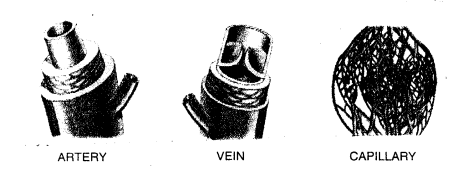
Name the three kinds of blood vessels found in human beings. With the help of suitable diagrams, differentiate between them.
Answer:
Artery :Imagine your arteries as broad, resilient highways, each pulse a surge of traffic heading away from the central hub – your heart. Their sturdy, elastic walls are perfectly designed to manage the forceful push of blood with every heartbeat. Typically, these highways carry vital oxygen to every part of your body, ensuring all your tissues receive the fuel they need. However, there’s a unique route: the pulmonary artery, which acts as a special highway carrying deoxygenated blood to the lungs for a vital oxygen refill.
Veins : Unlike the robust arteries, these vessels have thinner walls. But they possess a clever innovation: tiny, one-way valves nestled inside. These valves are especially crucial in your legs, where they bravely work against gravity, ensuring blood flows only towards the heart and doesn’t succumb to a downward trickle. The blood traveling in most veins carries carbon dioxide and other waste materials, the body’s equivalent of refuse being transported for disposal.
Capillary :Think of them as a vast web of tiny backroads, linking the arteries and veins at a microscopic level. These vessels are unbelievably slender, their walls a mere single cell thick. This thinness is absolutely essential, facilitating the seamless exchange of life-sustaining cargo. Oxygen and nutrients readily pass from the blood into your tissues, while carbon dioxide and waste products make their way from your tissues into the bloodstream.
PQ. During surgical operations or during accidents, the patient may be given blood from outside to save his life. What is the technical name of this process ? Briefly explain the precautions to be taken in this process.
Answer:Blood transfusion It’s not just about giving blood; it’s about ensuring safety at every step.
Thinking about blood group matching, it’s fascinating how those tiny antigens and antibodies can have such a powerful effect. That ABO and Rh system compatibility is truly the first line of defense against a potentially devastating reaction. And the crossmatching step? That’s like a final, very careful handshake between the donor’s and recipient’s blood, making sure there are no hidden disagreements.
It’s a testament to modern medicine that donated blood undergoes such rigorous testing. It adds a critical layer of safety, protecting vulnerable patients from serious illnesses.
Proper identification seems so basic, but in the high-stakes environment of healthcare, those double-checks are indispensable. It’s all about ensuring that the right person receives the right unit of blood – no room for error there.
And you’re spot on about the need for constant monitoring during the transfusion. Those seemingly small signs – a slight fever, a bit of itching – can be early indicators of a problem.
The emphasis on sterile equipment and technique is fundamental to preventing infections. It’s about maintaining a clean and controlled environment throughout the entire process. Using expired blood is simply unthinkable.
It allows for traceability, helps in monitoring patient outcomes, and contributes to ongoing quality improvement in transfusion practices.
It’s clear that blood transfusion is a complex process involving multiple safeguards. Each of these precautions you’ve mentioned plays a critical role in ensuring the safety and well-being of the patient. It’s a true example of how science and careful procedures come together to save lives.
Question 2.
State briefly, the difference between white blood cells and the red blood cells.
Red blood cells (RBCs) and white blood cells (WBCs) are the two primary cellular components of our blood, each specialized for a completely different mission. While RBCs act as the body’s transport system, WBCs function as its defense force.
| Feature | Red Blood Cells (RBCs) | White Blood Cells (WBCs) |
| Scientific Name | Erythrocytes | Leukocytes |
| Primary Function | Transport oxygen to tissues and carbon dioxide to the lungs. | Fight infections and foreign invaders as part of the immune system. |
| Shape | Biconcave disc-shaped (like a donut without a hole). | Irregular or amoeboid shape; can change shape to move through tissues. |
| Nucleus | Absent in mature cells (to make more room for hemoglobin). | Present (often have large or multi-lobed nuclei). |
| Color | Red, due to the presence of the iron-rich protein hemoglobin. | Colorless (they do not contain any pigment). |
| Count | Highly abundant (4.5–5.5 million per mm³ of blood). | Far fewer (5,000–10,000 per mm³ of blood). |
| Lifespan | Approximately 120 days. | Varies from a few hours to a few days (sometimes years for memory cells). |
Question 3.
You can see some blood vessels on the outside of the hands especially in older people. Are those veins or arteries ? How can you confirm your answer ?
Answer:Those bluish lines you see close to the surface of your hands are veins. They look bluish because of how deoxygenated blood interacts with light. Arteries, carrying oxygen-rich blood, are usually deeper and out of sight. If you gently press on one of these surface vessels, it will flatten, and when you let go, blood will flow back towards your forearm (your heart). This one-way flow is a key feature of veins, thanks to tiny valves inside them. Arteries, with their stronger blood flow, wouldn’t collapse like that, and the blood would be moving away from your heart.
Question 4.
Given alongside is a diagram of the human heart showing its internal structures. Label the parts marked 1 to 6, and answer the following questions.
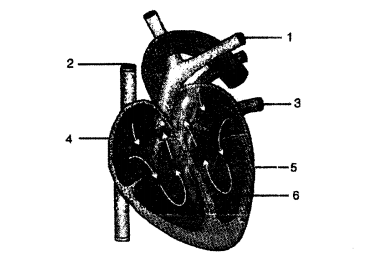
a) Which types of blood are carried by the blood vessel marked 2?
(b) Name the main artery which takes the blood from heart to different parts of the body?
(c) Which chamber of the heart receives deoxygenated blood from the body?
(d) Which chamber of the heart receives oxygenated blood from the lungs ?
Answer:(a) The Superior Vena Cava (2) acts like a drain, returning oxygen-poor blood from the upper body to the heart’s upper right chamber.
(b) The Aorta, a major artery, is the primary route for the heart to pump oxygen-rich blood throughout the body, delivering essential oxygen.
(c) The Right Atrium receives deoxygenated blood that has circulated through the body, serving as the heart’s initial receiving area for this blood.
(d) The Left Atrium is the heart’s upper left chamber where freshly oxygenated blood from the lungs arrives before being distributed to the rest of the body.