
This chapter likely introduces Mahavira and Buddha as significant preachers who offered new religious ideas in ancient India, differing from the prevailing Vedic traditions. It would cover their lives, emphasizing their renunciation of worldly comforts and their quest for enlightenment.
The chapter would detail the core teachings of Jainism by Mahavira, focusing on ahimsa (non-violence), satya (truthfulness), asteya (not stealing), aparigraha (non-possession), and brahmacharya (celibacy). It would also highlight the Jain concepts of karma and the importance of right faith, right knowledge, and right conduct for achieving liberation (moksha).
Similarly, the chapter would explain the key principles of Buddhism as taught by Buddha, including the Four Noble Truths (the existence of suffering, its cause in desire, its cessation, and the path to end it) and the Eightfold Path (right understanding, thought, speech, action, livelihood, effort, mindfulness, and concentration). The concept of nirvana as the ultimate goal would also be discussed.
The chapter might also touch upon the reasons for the rise of these new religions, such as the rigidness of the existing Vedic practices and the social inequalities of the time. It could briefly mention the impact of Mahavira and Buddha teachings on Indian society and their lasting legacy.
I. Fill in the blanks:
- The ———— BC saw the rise of two new religions in India.
Ans : sixth century
- The founders of both the new religions in India were———–.
Ans : Kshatriyas
- Jainism was founded by———–.
Ans : Mahavira
- The Jains believe Mahavira was the—————-.
Ans : 24th and the last Tirthankara
- At the age of 42, Mahavira conquered both misery and happiness and became —————.
Ans : Jina or the conqueror
- Buddhism was founded by————-.
Ans : Gautam Buddha
- His real name was————-.
Ans : Siddhartha
- The tree under which Buddha attained Enlightenment is called————.
Ans : Bodhi Tree
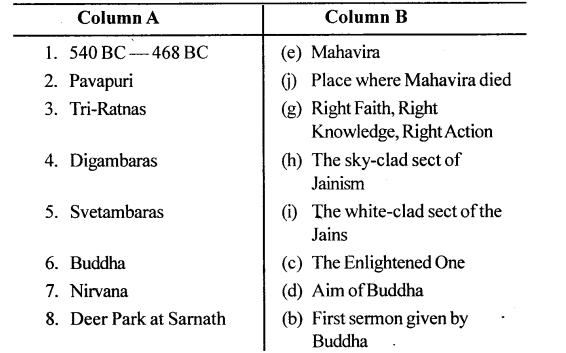
II. Match Column A with Column B
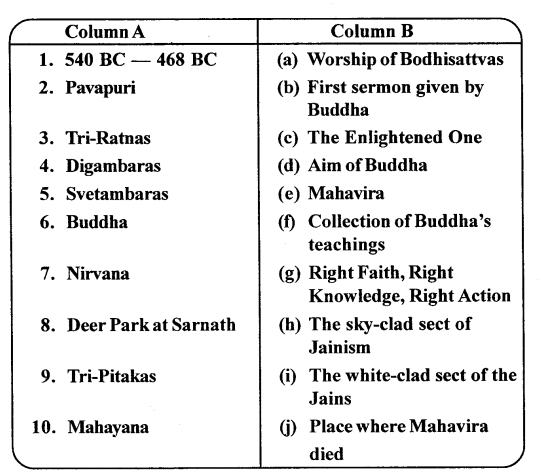
Answer:

III. State whether the following statements are True or False.
- By the 6th century BC the Vedic religion had become too complicated and common people could not understand it.
Ans : True - Mahavira was born at Pavapuri near Rajgir in Bihar.
Ans : False - The attainment of ‘Moksha’ should be the main goal of life according to Mahavira.
Ans : True - Jainism’s strict insistence on non-violence and penance made it popular in India.
Ans : False - Buddha’s teachings are included in the Four Noble Truths and the Eightfold Path.
Ans : True - Jatakas are stories about Buddha’s previous births.
Ans : True. - ‘Mahayana’ form of Buddhism started worshiping Buddha as a god.
Ans : True
Answer the following questions:
Question 1.
Why did new religions rise in India in the 6th century BC?
Answer:The 6th century BC in India witnessed the rise of new religions like Buddhism and Jainism due to several interconnected factors:
- Rigid Vedic Practices: The Vedic religion had become increasingly complex, with elaborate rituals and sacrifices that were often expensive and beyond the understanding of the common people. This led to dissatisfaction and a yearning for simpler spiritual paths.
- Dominance of the Priestly Class: The Brahmins, or priestly class, held significant power and claimed superiority, controlling religious knowledge and practices. This created resentment among other social groups, particularly the Kshatriyas (warriors) and Vaishyas (merchants).
- Social Inequalities: The existing social structure, influenced by the early development of the caste system, led to inequalities and discrimination. The lower castes, especially, sought religions that offered equality and rejected the rigid social hierarchy.
- Economic Changes: The growth of trade and urbanization brought about economic prosperity for the Vaishyas. They desired a higher social status that the traditional Vedic system did not readily provide, leading them to support new religions that were more inclusive.
- New Ideas and Teachings: Figures like Mahavira and Buddha offered new philosophies and paths to liberation that resonated with the people. Their teachings emphasized ethical conduct, non-violence, and personal spiritual experience, providing alternatives to the prevailing religious norms.
- Language Barrier: The Vedic texts were in Sanskrit, which was not easily understood by the common populace. The new religions preached in local languages like Pali and Prakrit, making their teachings more accessible.
Question 2.
What are the five vows a Jain householder had to take?
Answer: For Jain householders, the five vows are: to not harm any living being (ahimsa), to always speak the truth (satya), to not steal (asteya), to limit possessions (aparigraha), and to practice chastity (brahmacharya).
Question 3.
Why did Buddha renounce the world?
Answer:Witnessing the pervasive suffering in the world, including old age, sickness, and death, deeply troubled Prince Siddhartha (who later became Buddha). 1 This profound encounter with the realities of human existence led him to renounce his privileged life in search of a path to end suffering for all beings. 1
Question 4.
Explain the main difference between Jainism and Buddhism.
Answer: In essence, Jainism and Buddhism, while sharing a strong emphasis on non-violence, diverge significantly. Jainism champions a highly austere path with extreme practices to shed karma, believes in eternal individual souls in all life forms, and practices a very strict form of non-violence. It’s generally transtheistic, acknowledging liberated beings but not a creator God, and while valuing spiritual equality, it didn’t directly reject the caste system.
Buddhism, conversely, advocates for a moderate “Middle Path,” denies a permanent soul, practices non-violence with less severity for lay followers, and doesn’t focus on a creator God, emphasizing individual effort. It was also more outspoken in its opposition to the caste system, promoting social equality
Question 5.
Why did Buddhism spread so rapidly?
Answer:Buddhism’s rapid spread stemmed from several key factors. 1 Its simple and accessible teachings resonated with people tired of complex rituals. 2 Unlike the rigid caste system, Buddhism welcomed individuals from all social strata, promoting equality. 3 The use of Pali, a language understood by the common people, rather than the elite Sanskrit, made its message widely accessible. 4 Furthermore, the dedicated efforts of Buddhist monks and nuns, who traveled extensively to spread the teachings, coupled with the support of powerful rulers like Ashoka, significantly contributed to its swift expansion across India and beyond
Question 6.
What were the reasons behind the decline of Buddhism and Jainism?
Answer:Buddhism and Jainism, while initially gaining prominence, faced several factors that contributed to their eventual decline in India:
Buddhism:
- Absorption into Hinduism: Hinduism underwent reforms, incorporating some Buddhist principles and even recognizing Buddha as an avatar of Vishnu, which lessened Buddhism’s distinct appeal.
- Internal divisions: The rise of various sects within Buddhism weakened its unity and diluted its original teachings.
- Loss of royal patronage: After the patronage of rulers like Ashoka, Kanishka, and Harsha, subsequent rulers favored other religions.
- Corruption in the Sangha: Over time, the monastic order (Sangha) sometimes became associated with wealth and corruption, losing its spiritual appeal.
- Muslim invasions: The invasions led to the destruction of major Buddhist centers and the flight of monks.
- Language barrier: The shift from Pali and Prakrit (languages of the common people) to Sanskrit in later Buddhist texts limited its reach.
Jainism:
- Strictness of practices: The rigorous asceticism and strict principles of Jainism were difficult for the general population to follow.
- Lack of widespread royal patronage: Unlike Buddhism in its early phase, Jainism did not receive sustained, widespread royal support across various dynasties.
- Internal divisions: The split into the Shvetambara and Digambara sects weakened the Jain community.
- Competition from other religions: The rise of a reformed Hinduism, with popular movements like the Bhakti movement, and the spread of Buddhism provided strong competition.
- Less missionary zeal: Over time, there might have been a decline in the active propagation of Jainism.
- Philosophical complexity: Some aspects of Jain philosophy were not easily understood by the masses.
Question 7.
Name the religious texts of Buddhism and Jainism.
Answer:Buddhism’s core teachings and monastic guidelines are compiled in the Tripitaka, a collection divided into the Vinaya Pitaka (rules), Sutta Pitaka (discourses), and Abhidhamma Pitaka (philosophy). 1 Similarly, Jainism’s sacred knowledge, the Agamas, contains Mahavira’s teachings, categorized into Angas, Upangas, and other texts, with variations acknowledged between the Svetambara and Digambara traditions
Question 8.
Why is Buddhism called the Middle Path?
Answer:Buddhism is called the Middle Path because it avoids the extremes of severe self-denial practiced by some ascetics and the life of luxury and indulgence. 1 Buddha realized that neither extreme led to enlightenment. 2 Instead, he advocated a balanced way of living, focusing on moderation in all aspects of life, as outlined in the Eightfold Path
V. Picture study This is a picture of a temple.

1)Identify and name it.
Ans. The Dilwara Temples, located in Mount Abu, Rajasthan, are a group of five Jain temples renowned for their stunning white marble architecture and intricate carvings. Built between the 11th and 16th centuries, these temples showcase exceptional craftsmanship, reflecting the values of Jainism through their detailed ceilings, ornate pillars, and delicately sculpted domes. The temples are not only a place of worship but also a testament to India’s rich cultural and architectural heritage, attracting tourists and pilgrims alike.
2)Where is it situated?
Ans. The Dilwara Temples, located in Mount Abu, Rajasthan, are a group of five Jain temples renowned for their stunning white marble architecture and intricate carvings. Built between the 11th and 16th centuries, these temples showcase exceptional craftsmanship, reflecting the values of Jainism through their detailed ceilings, ornate pillars, and delicately sculpted domes. The temples are not only a place of worship but also a testament to India’s rich cultural and architectural heritage, attracting tourists and pilgrims alike.
3)Who built it?
Ans. The Dilwara Temples, as shown in the image, were constructed between the 11th and 16th centuries AD. Vimal Shah, a Jain minister, initiated the construction of the earliest temples, with design or financial support from Vastupala. The Chalukya Dynasty also contributed to their creation.
4)Write a paragraph about it.
Ans. Based on the intricate carvings and the overall architectural style visible in the image, it very likely depicts the interior of one of the Dilwara Temples. These Jain temples in Mount Abu are renowned for their exquisite marble work and are considered important pilgrimage sites. The detailed craftsmanship suggests the rich artistic heritage of the period during which they were built
Additional Questions
A. Fill in the blanks.
- Many ———— customs crept into Hindu society.
Ans : evil
- The ————– were denied the right to study religious texts.
Ans : shudras
- In the 6th century BCE two great religious reformers, ————–and ———–were born.
Ans : Vardhamana Mahavira , Gautama Buddha
- Two famous followers of Jainism were———-.
Ans : Bimbisara and Mahayana
- The religious literature of the Buddhists is contained in the————.
Ans : Tripitakas and Jatakas
- Buddhism was divided into two sects, ———— .
Ans : Hinayana and Mahayana
- Jainism was divided into two sects, ————— .
Ans : Digambaras and Svetambara
B. Match the following.
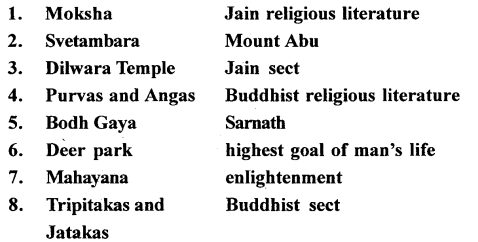
Answer:
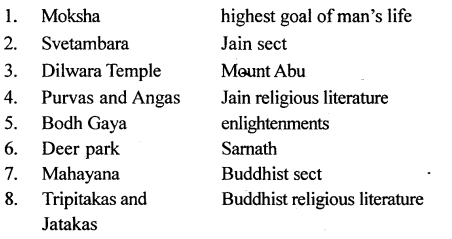
C.Answer the following questions.
Question 1.
How did the new customs destroy the simplicity of the original Vedic religion?
Answer:Over time, the original simple Vedic religion, which focused on nature worship, became more complex due to the introduction of elaborate rituals and sacrifices, a rigid social hierarchy with the entrenched caste system, an increased emphasis on the power of priests, and complex philosophical interpretations. These developments moved the religion away from its initial simplicity.
Question 2.
How did the rigid caste system affect the shudras?
Answer:The Shudras occupied the bottom tier of the rigid caste system, facing significant limitations. Their primary role was to serve the upper three castes, and they were often denied access to education, religious involvement, and opportunities for advancement in power or wealth. This social structure subjected them to considerable discrimination and hardship simply based on their birth.
Question 3.
Mention the main teachings of Mahavira.
Answer:Mahavira’s core teachings revolved around five essential vows that Jains strive to uphold. 1 These include not just physical non-violence but also avoiding harmful thoughts and speech, always speaking the truth, never taking what is not freely given, letting go of material attachments, and practicing rigorous self-control, including celibacy. 2 He emphasized that adhering to these principles with purity and righteousness is key to liberating the soul from the cycle of birth and death. 3 These vows continue to form the ethical foundation of Jainism
Question 4.
Name the two Jain sects. What was the difference between the two?
Answer:The two main sects of Jainism are the Digambaras and the Shvetambaras.
The primary difference between them lies in their practice regarding clothing. Digambara monks traditionally renounce all possessions, including clothing, and thus live nude. Shvetambara monks, on the other hand, wear simple white robes.
There are also minor differences in their beliefs and practices, such as their views on the status of women and the authenticity of certain Jain scriptures, but the practice of nudity versus wearing white robes remains the most visible distinction
Question 5.
In which parts of India is Jainism still popular?
Answer:Jainism continues to have a notable presence in several parts of India. 1 You’ll find significant Jain populations particularly in states like Maharashtra, Rajasthan, Gujarat, and Karnataka. These regions have a long history with Jainism and are home to many important Jain temples and pilgrimage sites, reflecting the enduring influence of the religion. 2
Question 6.
What were the ‘four great sights’ that proved to be a turning point in Gautama Buddha’s life?
Answer:These four sights acted as a turning point for Siddhartha Gautama. Confronting old age, sickness, and death made him deeply aware of the pain woven into life. However, seeing the peaceful ascetic sparked the idea that there might be a way to escape this suffering. These powerful encounters motivated him to leave his comfortable life and embark on a spiritual journey that eventually led him to become the Buddha.
Question 7.
Briefly explain the following events in Buddha’s life:
- Renunciation
- Enlightenment
Answer:1)The moment of renunciation was truly a turning point.It must have been a profound shock, shaking the very foundations of his understanding of the world. This wasn’t just a whim; it was a deep, existential crisis that led him to the courageous and radical decision to leave everything behind. Giving up his palace, his family, and his possessions speaks volumes about the intensity of his quest for truth and a way to alleviate suffering. It’s a powerful image of someone prioritizing spiritual understanding above all worldly attachments.
2)Following his renunciation, the path to enlightenment was far from easy. Siddhartha’s years of intense spiritual seeking, including his experiments with extreme asceticism, highlight the dedication and perseverance he brought to his mission. It’s fascinating that his enlightenment didn’t come through these harsh practices but through a process of deep meditation and introspection. This moment of profound awakening, when he grasped the fundamental truths about existence and the cessation of suffering, is what defined him as the Buddha. It wasn’t just an intellectual understanding; it was a transformative experience that fundamentally changed his being and his perception of reality. Achieving enlightenment marked the culmination of his arduous journey and the beginning of his role as a teacher and guide for others seeking liberation.
Answer the following questions.
Question 1.
How did the new customs destroy the simplicity of the original Vedic religion?
Answer:Over time, the original simple Vedic religion, which focused on nature worship, became more complex due to the introduction of elaborate rituals and sacrifices, a rigid social hierarchy with the entrenched caste system, an increased emphasis on the power of priests, and complex philosophical interpretations. These developments moved the religion away from its initial simplicity.
Question 2.
How did the rigid caste system affect the shudras?
Answer:The Shudras occupied the bottom tier of the rigid caste system, facing significant limitations. Their primary role was to serve the upper three castes, and they were often denied access to education, religious involvement, and opportunities for advancement in power or wealth. This social structure subjected them to considerable discrimination and hardship simply based on their birth.
Question 3.
Mention the main teachings of Mahavira.
Answer:Mahavira’s core teachings revolved around five essential vows that Jains strive to uphold. 1 These include not just physical non-violence but also avoiding harmful thoughts and speech, always speaking the truth, never taking what is not freely given, letting go of material attachments, and practicing rigorous self-control, including celibacy. 2 He emphasized that adhering to these principles with purity and righteousness is key to liberating the soul from the cycle of birth and death. 3 These vows continue to form the ethical foundation of Jainism
Question 4.
Name the two Jain sects. What was the difference between the two?
Answer:The two main sects of Jainism are the Digambaras and the Shvetambaras.
The primary difference between them lies in their practice regarding clothing. Digambara monks traditionally renounce all possessions, including clothing, and thus live nude. Shvetambara monks, on the other hand, wear simple white robes.
There are also minor differences in their beliefs and practices, such as their views on the status of women and the authenticity of certain Jain scriptures, but the practice of nudity versus wearing white robes remains the most visible distinction
Question 5.
In which parts of India is Jainism still popular?
Answer:Jainism continues to have a notable presence in several parts of India. 1 You’ll find significant Jain populations particularly in states like Maharashtra, Rajasthan, Gujarat, and Karnataka. These regions have a long history with Jainism and are home to many important Jain temples and pilgrimage sites, reflecting the enduring influence of the religion. 2
Question 6.
What were the ‘four great sights’ that proved to be a turning point in Gautama Buddha’s life?
Answer:These four sights acted as a turning point for Siddhartha Gautama. Confronting old age, sickness, and death made him deeply aware of the pain woven into life. However, seeing the peaceful ascetic sparked the idea that there might be a way to escape this suffering. These powerful encounters motivated him to leave his comfortable life and embark on a spiritual journey that eventually led him to become the Buddha.
Question 7.
Briefly explain the following events in Buddha’s life:
- Renunciation
- Enlightenment
Answer:1)The moment of renunciation was truly a turning point.It must have been a profound shock, shaking the very foundations of his understanding of the world. This wasn’t just a whim; it was a deep, existential crisis that led him to the courageous and radical decision to leave everything behind. Giving up his palace, his family, and his possessions speaks volumes about the intensity of his quest for truth and a way to alleviate suffering. It’s a powerful image of someone prioritizing spiritual understanding above all worldly attachments.
2)Following his renunciation, the path to enlightenment was far from easy. Siddhartha’s years of intense spiritual seeking, including his experiments with extreme asceticism, highlight the dedication and perseverance he brought to his mission. It’s fascinating that his enlightenment didn’t come through these harsh practices but through a process of deep meditation and introspection. This moment of profound awakening, when he grasped the fundamental truths about existence and the cessation of suffering, is what defined him as the Buddha. It wasn’t just an intellectual understanding; it was a transformative experience that fundamentally changed his being and his perception of reality. Achieving enlightenment marked the culmination of his arduous journey and the beginning of his role as a teacher and guide for others seeking liberation.
D. State whether the following are true or false.
- The brahmanas were very popular among the common people.
Ans : False - Mahavira was the last tirthankara of the Jains.
Ans : True - Mahavira believed in the existence of a supreme God.
Ans : False - Buddhism was taught in Prakrit.
Ans : False - Buddhism is the main religion of people in south-east Asia, Tibet. China and Japan.
Ans : True