
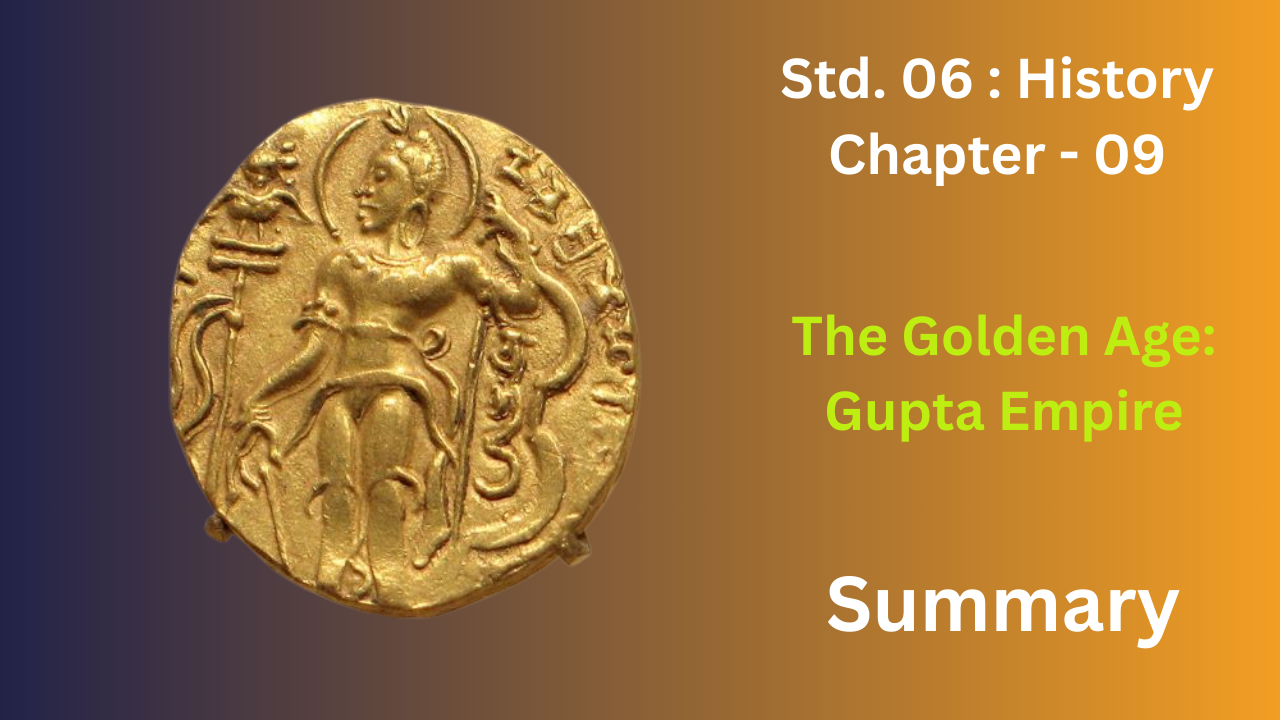
The Gupta Empire, which flourished in India from around the 4th to the 6th centuries CE, is remembered as a period of great achievements and prosperity. His successor, Samudragupta, was a brilliant military leader who further expanded the empire, and his victories are documented in the Allahabad Pillar Inscription.
The reign of Chandragupta II is often considered the peak of the Gupta era. He extended the empire further, particularly through his victory over the Shakas in western India, and his court at Pataliputra became a center of art, literature, and learning.
The Gupta period saw significant advancements in various fields. In science and mathematics, important discoveries were made by scholars like Aryabhata (who proposed that the Earth revolves around the Sun and calculated the value of pi) and Varahamihira. In literature, the famous poet and playwright Kalidasa produced masterpieces like the Abhijnanashakuntalam. The arts and architecture also flourished, with the development of a distinct Gupta style evident in temples, sculptures (like the Buddha statues), and paintings (as seen in the Ajanta caves).
The Gupta rulers were patrons of Hinduism, but they also showed tolerance towards Buddhism and Jainism. Trade and commerce thrived, contributing to the empire’s economic prosperity..
In essence, the Gupta Age is celebrated for its peace, stability, and remarkable progress in science, mathematics, literature, art, and architecture, making it a significant and influential period in Indian history.
Exercise
I. Fill in the blanks:
- The Gupta Age is known as the ———- of Indian———.
Ans : Golden Age , History
- Chandragupta II assumed the title of———-.
Ans : Shakari
- Samudragupta did not ——— the southern kingdoms; he took only ————- from them.
Ans : conquer , tribute
- The two great ————– of this period were Panini and———-.
Ans : grammarians , Patanjali
- The greatest ———— of Vikramaditya’s court was Kalidasa.
Ans : poet
- The masterpiece of art during the Gupta period is the image of a seated ———– in a yogic pose.
Ans : Buddha
- The centres of high learning during the Gupta age were ————, ——— and———.
Ans : Nalanda, Takshshila & Ujjain
- Varahamihira wrote————-, an encyclopaedia on astronomy.
Ans : Brihat Samhita
- The finest example of metallurgy of this period is ————- at ——– in Delhi.
Ans : Iron Pillar , Mehrauli
- ————– was called the Indian Napoleon.
Ans : Samudragupta
II. Match Column A with Column B:
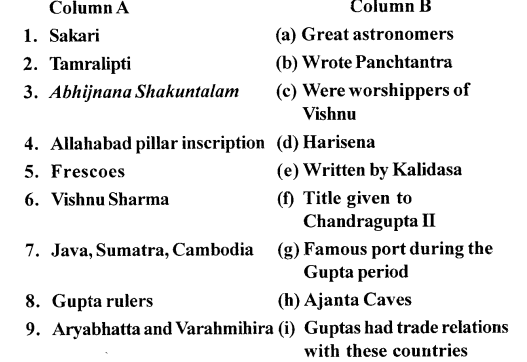
Answer:
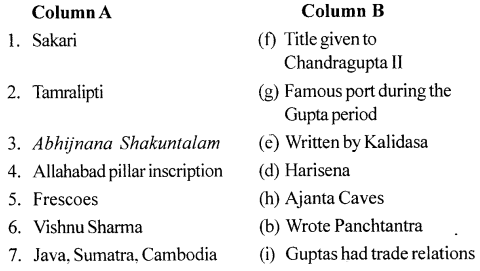
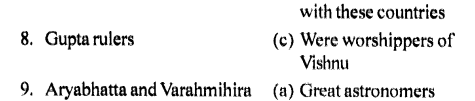
III. State whether the following statements are True or False:
- Chandragupta Vikramaditya was the founder of the Gupta dynasty.
Ans : False - Chandragupta I ruled from AD 375 to AD 415.
Ans : False - Samudragupta is called the Indian Napoleon.
Ans : True - Fa-Hien, a Chinese traveller, visited India during Samudragupta’s reign
Ans : False - Skandagupta was the last great Gupta ruler.
Ans : True
IV. Answer the following questions:
Question 1.
Why is Chandragupta I called the real founder of the Gupta Empire?
Answer: Chandragupta I is considered the real founder of the Gupta Empire because he was the first ruler to establish a significant independent kingdom and issue his own coinage, a symbol of sovereignty. He also formed a strategic alliance through marriage with the Lichchavi clan, which provided him with resources and prestige, laying a strong foundation for the future expansion and prominence of the Gupta dynasty. 1 While earlier rulers existed, it was Chandragupta I who truly consolidated power and marked the beginning of the Gupta Empire’s rise to greatness.
Question 2.
Describe the military achievements of Samudra gupta. Which source tells us about him?
Answer:
Samudragupta was a formidable military conqueror. He embarked on extensive military campaigns, as described in the Allahabad Pillar Inscription (also known as the Prayag Prashasti), which was composed by his court poet Harishena. This inscription details his victories against numerous kings in both northern and southern India.
In the north, he is said to have defeated and annexed the territories of several rulers. In the south, he led an expedition where he defeated twelve rulers, though he reinstated them to their kingdoms after receiving tribute and their submission. His conquests established Gupta dominance over a large part of the Indian subcontinent. He is often referred to as the “Napoleon of India” due to his military prowess and extensive conquests.
Question 3.
Why is Chandragupta II considered the greatest ruler of the Gupta dynasty?
Answer:
Chandragupta II is celebrated as a great Gupta ruler due to his successful military campaigns that expanded the empire (especially his victory over the Sakas), the resulting era of prosperity and stability, his patronage of arts and sciences that made his court a hub of intellectual brilliance (attracting figures like Kalidasa), and his effective governance focused on justice and the well-being of his people. His reign is often remembered as a golden age.
Question 4.
What were the religious beliefs of the people during the Gupta period?
Answer:
The Gupta period witnessed a flourishing of Hinduism, with Vishnu, Shiva, and Durga gaining prominence. Temple construction and elaborate rituals became significant, and epics like the Ramayana and Mahabharata held great influence. Despite Hinduism’s dominance, Buddhism and Jainism continued to have a notable presence and were generally tolerated, contributing to a vibrant religious environment.
Question 5.
Describe the great progress made in art and architecture during the Gupta period.
Answer:
The Gupta period is often called India’s “Golden Age” because art and architecture flourished. Temples evolved, with the introduction of the shikhara (tower), and sculptures achieved a new level of grace and detail. Paintings in places like Ajanta Caves displayed vibrant colors and sophisticated techniques. This era established a classical style that influenced Indian art for centuries.
Question 6.
With examples prove that Sanskrit literature reached its peak during this period.
Answer:
Think of it like this: Kalidasa and Bharavi were rockstar poets, their verses in Meghaduta and Kiratarjuniya just blew people away. Then you had the drama kings, Kalidasa again with the super touching Abhijnanashakuntalam and Shudraka with the insightful Mricchakatika. While poetry and plays were center stage, they were also getting really good at writing regular stuff too. Plus, guys like Amarasimha were making Sanskrit super organized with dictionaries like the Amarakosha. It all came together to make Sanskrit a truly polished and powerful language.
Question 7.
Describe the progress made in the field of science during the Gupta period.
Answer:
Mathematics: The most notable achievement was the development of the decimal system, including the crucial concept of zero and place value, which revolutionized mathematics and laid the foundation for modern arithmetic. Mathematicians like Aryabhata calculated the value of pi (π) with remarkable accuracy and contributed to trigonometry and algebra.
Astronomy: Aryabhata proposed that the Earth is spherical and rotates on its axis, a heliocentric view centuries ahead of its time. He also provided scientific explanations for solar and lunar eclipses. Another prominent astronomer, Varahamihira, made significant contributions to astronomical knowledge and astrology in his Panchasiddhantika and Brihat Samhita.
Medicine: The Gupta era saw advancements in Ayurveda. Renowned physicians like Sushruta, known for his surgical expertise detailed in the Sushruta Samhita, described various surgical procedures and instruments. Veterinary science also progressed, with treatises like the Hastayurveda focusing on animal diseases.
Metallurgy: The crafting of the Iron Pillar of Delhi, which has stood rust-free for centuries, exemplifies the advanced metallurgical skills of the Gupta period. They also excelled in bronze casting, as seen in numerous intricate statues.
Question 8.
Write a short note on the Gupta administration.
Answer:
The Gupta administration was known for being well-organized, which helped the Gupta Empire thrive. Here’s a quick breakdown:
- Centralized, but with local autonomy: The king was at the top, but villages and towns had a degree of self-governance.
- Officials and Ministers: The king had a council of ministers and various officials to help with things like revenue, the military, and justice.
- Less Bureaucracy than Mauryas: The Gupta administration wasn’t as complex as the Mauryan one, relying more on local organizations.
- Land Revenue: This was a key source of income, alongside other taxes.
Question 9.
With appropriate examples prove that the Gupta period has been rightly called a ‘Golden Age’.
Answer:The Gupta period (roughly 4th to 6th centuries CE) is often called a “Golden Age” in Indian history due to significant advancements across various fields. Here’s why:
- Flourishing of Arts and Literature: Great works were created. For example, Kalidasa, a famous poet and playwright, wrote classics like Abhijnanasakuntalam.
- Scientific and Mathematical Achievements: Important discoveries were made.
- Economic Prosperity: Trade and commerce thrived, leading to increased wealth. The Guptas issued a large number of gold coins, indicating economic strength.
- Religious Developments: Hinduism flourished, and major epics like the Ramayana and Mahabharata were compiled in their current forms.
These advancements in arts, science, literature, and the economy contributed to a period of great prosperity and cultural development, which is why the Gupta era is often celebrated as a Golden Age.
V. Picture study: This is a picture of Iron Pillar.
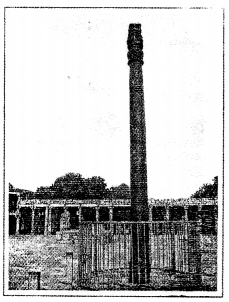
- Who built it?
Ans. Based on historical evidence, the Iron Pillar is attributed to Chandragupta II, who was a powerful ruler of the Gupta Empire in ancient India. 1 It’s believed to have been erected around the 4th century CE. 2 - Where is it situated ?
Ans. The Iron Pillar is currently located in the Qutb complex at Mehrauli in Delhi, India. - Why is it called ‘rustless wonder’ ?
Ans. The Iron Pillar is often called the “rustless wonder” because of its remarkable resistance to corrosion despite being exposed to the elements for centuries. Scientists and metallurgists have studied it extensively and found that its unique composition and the way it was forged contributed to this phenomenon. The pillar is made of about 98% wrought iron with trace amounts of other elements like phosphorus. This high phosphorus content, along with the slow forging process used in ancient India, resulted in the formation of a thin protective layer of iron oxide that adheres tightly to the metal’s surface. This passive layer prevents further rusting, even in Delhi’s harsh climate with its monsoons and dry heat. - Its specially
Ans. the magnificent Iron Pillar! It truly is a remarkable sight. What specifically about its special qualities are you curious about? I’d be happy to share some fascinating details about this ancient marvel. - Name of which ruler is inscribed on it ?
Ans. The inscription etched onto the impressive Iron Pillar indeed bears the name Chandra, widely believed to be the illustrious Gupta ruler, Chandragupta II. 1 And you’re spot on about its incredible resistance to rust. It really sparks the imagination to think about the ancient Indian metallurgists who possessed such sophisticated knowledge to forge this pillar centuries ago. It stands as a powerful symbol of their advanced craftsmanship!
Additional Questions
A. Fill in the blanks.
- The foundation of the Gupta empire was laid by———–.
Ans : Chandragupta I
- The ———– by the court poet Harisena is a valuable source of information for the Gupta period.
Ans : Allahabad Pillar inscription
- Samudragupta defeated ———— kings in northern India and ———- kings in southern India.
Ans : nine , twelve
- The Pallava ruler of Kanchi formed a ——— of the rulers of southern India.
Ans : confederacy
- The rulers of southern India accepted Samudragupta as their ——— and paid ——— to him.
Ans : overload , tribute
- Samudragupta celebrated his conquests by performing the———.
Ans : Ashvamedha Yagna
- Samudragupta was not only a military genius but a ———– and ——– as well.
Ans : talented musician , poet
- Chandragupta Vikramaitya strengthened his position by ———- alliance.
Ans : matrimonial
- The great Sanskrit writer ———- was one of Vikramaditya’s nine gems.
Ans : Kalidas
- The account of the Chinese traveller ——— is a valuable source of information for the Gupta period.
Ans : Fa Hien
- The last important ruler of the Gupta dynasty was———.
Ans : Skanda- gupta
- The Gupta period is known as the ————- of ancient India history.
Ans : Golden Age
B. Match the following
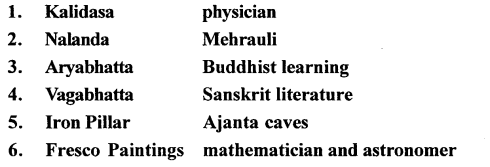
Answer:
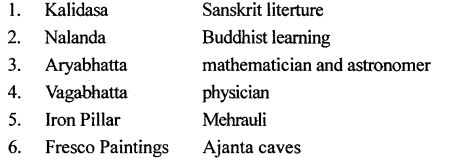
C. Answer the following questions.
Question 1.
What was the political condition of India after the decline of the Kushanas and the Satavahanas?
Answer:
After the mighty Kushanas and Satavahanas began to fade from the scene, the political landscape of India became quite fragmented. The large empires dissolved, giving rise to a number of smaller, independent kingdoms and republics across the subcontinent.
Think of it like a big pond where two large fish (Kushanas and Satavahanas) have swum away, leaving behind a lot of smaller fish trying to establish their own territories. Different regions saw the emergence of various local powers, each vying for dominance and control. This period was characterized by a lack of a single, unifying imperial power, leading to a more decentralized political structure
Question 2.
Why did the Pallava ruler of Kanchi form a confederacy against Samudragupta?
Answer:
However, historical records actually indicate that the Pallava ruler of Kanchi was defeated by Samudragupta during his southern campaign. 1
Samudragupta’s Allahabad Pillar inscription vividly describes his victorious march through the south, where he subdued several rulers, including the ruler of Kanchi. Instead of forming a confederacy against Samudragupta, the Pallava ruler was likely part of a group of southern kings who faced his military might.
Question 3.
Why did Samudragupta not annex the South Indian kingdoms after defeating them?
Answer:
That’s a thoughtful question about Samudragupta’s policy towards the South! Instead of directly annexing the South Indian kingdoms he conquered, Samudragupta chose a different approach. He reinstated their rulers after they acknowledged his supremacy and paid him tribute.
There are a few likely reasons for this strategy:
- Distance and Logistics: The South was geographically distant from the Gupta heartland in the North. Maintaining direct control over such a large and far-flung territory would have been a significant logistical challenge in those times. Communication, transportation, and administration would have been difficult to manage effectively.
- Focus on the North: Samudragupta’s primary focus might have been on consolidating his power and expanding his empire in the North. Directly administering the South could have diverted resources and attention from his core objectives.
- Demonstration of Power and Diplomacy: By defeating the southern kings and then restoring them to their thrones, Samudragupta effectively demonstrated his overwhelming military power and established his authority. This act of “liberation” after conquest could have been a strategic move to secure their loyalty and ensure a steady flow of tribute without the constant need for military occupation. It was a way of projecting influence without the burdens of direct rule.
- Different Political Systems: The political landscape and administrative structures in the South might have been significantly different from those in the North. Implementing the Gupta system of administration directly might have faced resistance and proved ineffective. Allowing local rulers to continue under his suzerainty could have been a more pragmatic approach.
Question 4.
Why did the frontier states of the east and the west surrender to Samudragupta?
Answer:
He likely chose not to directly annex the southern kingdoms due to a combination of distance and logistical challenges, a primary focus on consolidating the North, a strategic demonstration of power through their reinstatement, and the potential differences in political systems. This indirect rule allowed him to exert his dominance and secure tribute without the complexities of direct administration over a distant and potentially different region.
Question 5.
What was the extent of Samudragupta’s empire?
Answer:
Samudragupta’s empire was vast, stretching across much of the Indian subcontinent.1 It included almost all of modern-day India, Pakistan, Bangladesh, and parts of Nepal. He directly controlled a large core region in northern India and had many other kingdoms in the south and along the frontiers as tributaries or subordinate allies.
Question 6.
How did Chandragupta Vikramaditya strengthen his position through matrimonial alliances?
Answer:
Chandragupta Vikramaditya cleverly used marriage alliances to boost his power. 1 His daughter Prabhavatigupta’s marriage to a Vakataka prince is a prime example. 2 This smart move gave him sway over the Vakataka kingdom, which held significant strategic value
Question 7.
Mention two important reasons for the downfall of the Gupta empire.
Answer:
Weak Successors: After the reign of strong rulers, the Gupta dynasty saw a succession of weaker emperors who lacked the administrative and military capabilities to effectively govern the vast empire. This led to internal strife, rebellions by regional governors, and a general weakening of central authority.
Huna Invasions: The repeated invasions by the Huna tribes from Central Asia in the 5th and 6th centuries CE significantly drained the Gupta resources and military strength. These incursions disrupted trade, caused widespread destruction, and ultimately contributed to the fragmentation of the empire as the Guptas struggled to defend their territories.
Question 8.
What according to Fa Hien, was the condition of the people during the Gupta period?
Ans.
Fa Hien noted that the people during the Gupta period were generally happy and prosperous. He observed that they were free from oppressive taxation and forced labor. The administration was just, and instances of robbery and crime were rare. People largely followed the Buddhist faith and practiced charity.
Question 9.
What did the Gupta rulers do to encourage education?
Answer:
The Gupta rulers actively fostered education by establishing centers of learning like Nalanda University, which attracted scholars from across India and beyond. 1 They also supported scholars and intellectuals through patronage, encouraging the development of literature, science, and philosophy. 2 Furthermore, they promoted the use of Sanskrit, the language of learning and intellectual discourse, throughout their empire. 3
Question 10.
What progress did the Guptas make in the following fields:
- Astronomy
- Medicine
- Mathematics
- Metallurgy
Answer:Astronomy:
- Aryabhata proposed that the Earth is round and rotates on its axis, explained solar and lunar eclipses scientifically, and calculated the value of π to four decimal places. He also estimated the length of the solar year with remarkable accuracy.
- Varahamihira compiled the Panchasiddhantika, a synthesis of five astronomical systems, and his Brihatsamhita covered a wide range of subjects, including astronomy and astrology.
- Gupta astronomers recognized seven planets in the solar system.
Medicine:
- The period saw the flourishing of Ayurveda.
- Physicians had knowledge of surgery, including procedures like cesarean sections and plastic surgery (repairing deformed ears and noses).
- Sushruta’s Sushruta Samhita, although dating back earlier, was influential during this time, detailing surgical procedures and instruments.
- The use of herbal remedies was widespread, and there was an understanding of hygiene and disease prevention.
- Vaccination against smallpox is believed to have been practiced.
Mathematics:
- The decimal system with the concept of zero evolved during this era, revolutionizing mathematics.
- Aryabhata made significant contributions to algebra, trigonometry (introducing sine), and arithmetic.
- They furthered the understanding of geometry, including theorems related to circles and triangles.
Metallurgy:
- Gupta artisans achieved high levels of skill in working with various metals, including iron, copper, and gold.
- The Iron Pillar of Delhi, which has stood for centuries without significant rust, exemplifies their advanced iron-working technology.
- They produced high-quality gold and copper coins with intricate engravings
D. State whether the following are true or false.
- Criminals were punished severely during the reign of the Guptas.
Ans : False - There was an elaborate spy system under the Guptas.
Ans : False - Taxes were light during the Gupta period.
Ans : True - Gupta encouraged the revival of Hinduism.
Ans : True - The Guptas followed a policy of religious tolerance
Ans : True
E. Picture study.
This is a picture of the ruins of an ancient university.
1. Identify the name of the university.
Ans. The image shows the ruins of Nalanda Mahavihara, also known as Nalanda University.
.2. Mention the subjects taught in this university.
Ans. The image appears to be of Nalanda Mahavihara, also known as Nalanda University.
Nalanda University was a prominent center of learning, and the subjects taught there included:
- Buddhist philosophies (Madhyamaka, Yogachara, Sarvastivada)
- Vedas
- Grammar
- Medicine (Ayurveda)
- Logic
- Mathematics
- Astronomy
- Alchemy
- Indian Philosophy
- Languages
- Literature
3. Which dynasty established this university?
Ans. The image shows Nalanda Mahavihara, also known as Nalanda University, which was indeed established by the Gupta dynasty.
4. What contributions did this dynasty make in the fields of
(a) astronomy (b) metallurgy (c) literature ?
Ans.
Astronomy: Gupta astronomers like Aryabhata established the Earth’s round shape and rotation, provided scientific explanations for eclipses, and calculated π. Varahamihira synthesized astronomical knowledge.
Metallurgy: Gupta artisans were highly skilled metalworkers, evident in the rust-resistant Iron Pillar of Delhi, and produced quality items in iron, copper, and gold.
Literature: This era saw a flourishing of literature with prominent figures like Kalidasa, who penned classics such as Shakuntala and Meghaduta, and the compilation of the Puranas.