
Introduction to Numbers
The Number System is the foundation of Mathematics. In this chapter, we explore how numbers are categorized, written, and compared across different global standards.
1. Types of Numbers
Understanding the basic sets of numbers is essential:
- Natural Numbers (N): Also known as counting numbers, these start from 1 and go up to infinity (e.g., 1, 2, 3, \dots).
- Whole Numbers (W): These include all natural numbers plus zero (e.g., 0, 1, 2, 3, \dots).
- Integers (Z): A collection of positive numbers, negative numbers, and zero.
2. Systems of Numeration
There are two primary ways to express large numbers using commas (periods):
- The Indian System: Used primarily in India. The periods are Units, Thousands, Lakhs, and Crores.
- Example: $12,34,56,789$ (Twelve crore, thirty-four lakh, fifty-six thousand, seven hundred eighty-nine).
- The International System: Used globally. The periods are Units, Thousands, Millions, and Billions.
- Example: $123,456,789$ (One hundred twenty-three million, four hundred fifty-six thousand, seven hundred eighty-nine).
3. Place Value and Face Value
- Face Value: The actual value of a digit, regardless of its position.
- Place Value: The value represented by a digit based on its position in a number.
4. Predecessor and Successor
- Predecessor: The number that comes immediately before a given number.
- Successor: The number that comes immediately after a given number.
5. Estimation and Rounding Off
Estimation helps in finding an approximate value that is close to the actual number for quick calculations.
- To the Nearest 10: Look at the digit in the units place.
- To the Nearest 100: Look at the digit in the tens place.
- To the Nearest 1000: Look at the digit in the hundreds place.
6. Roman Numerals
A system of notation used by the ancient Romans using seven basic symbols:
- I (1), V (5), X (10), L (50), C (100), D (500), M (1000).
- Key Rule: A symbol can be repeated up to a maximum of three times. Symbols like V, L, and D are never repeated or subtracted.
EXERCISE 1(A)
Question 1.
Which is greater ?
(i) 537 or 98
(ii) 2428 or 529
(iii) 2, 59, 467 or 10, 35, 729
Solution:
(i) 537 or 98
Since 537 is three digit number and 98 is two digit number.
Hence 537 > 98 and 537 is greater
(ii) 2428 or 529
Since 2498 is four digit number and 529 is three digit number.
2498 > 529 ; 2498 is greater
(iii) 2, 59, 467 or 10, 35, 729
Since 10, 35, 729 is seven digit number and 2, 59, 467 is six digit number
10, 35, 729 > 2, 59, 467 ; 10, 35, 729 is greater
Question 2.
Which is smaller ?
(i) 428 or 437
(ii) 2497 or 2597
(iii) 3297 or 3596
Solution:
(i) 428 or 437
We observe that both the numbers are of three-digits.
And at the leftmost, both the number have same digit i.e. 4. But at the second place
from the left, the first, number has 2 and the second number has 3.
Since 2 < 3
437 is greater
(ii) 2497 or 2597
We observe that both the numbers are of four digits.
And at the leftmost, both the numbers have same digit i.e. 2. But at the second place
from the left, the first number has 4 and the second number has 5.
Since 4 < 5
2597 is greater
(iii) 3297 or 3596
We observe that both the numbers are of four digits.
And at the leftmost, both the numbers have same digit i.e. 2. But at the second place
from the left, the first number has 4 and the second number has 5.
Since 4 < 5
3596 is greater
Question 3.
Which is greater ?
(i) 45293 or 45427
(ii) 380362 or 381007
(iii) 63520 or 63250
Solution :
i) 45,293 or 45,427
- Compare the digits from left to right: Both numbers have ‘4’ in the ten-thousands place and ‘5’ in the thousands place.
- Now, look at the hundreds place: 2 vs 4.
- Since 4 > 2, the second number is greater.
- Result: 45,427 is greater than 45,293. (45,427 > 45,293)
(ii) 3,80,362 or 3,81,007
- Compare the digits:
- Both have ‘3’ in the lakhs place and ‘8’ in the ten-thousands place.
- Now, look at the thousands place: 0 vs 1.
- Since 1 > 0, the second number is greater.
- Result: 3,81,007 is greater than 3,80,362. (3,81,007 > 3,80,362)
(iii) 63,520 or 63,250
- Compare the digits:
- Both have ‘6’ in the ten-thousands place and ‘3’ in the thousands place.
- Now, look at the hundreds place: 5 vs 2.
- Since 5 > 2, the first number is greater.
- Result: 63,520 is greater than 63,250. (63,520 > 63,250)
Question 4.
By making a suitable chart, compare:
(i) 540276 and 369998
(ii) 6983245 and 6893254
Solution :
(i) 5,40,276 and 3,69,998
| Number | Lakhs (L) | Ten-Th. (T-Th) | Thousands (Th) | Hundreds (H) | Tens (T) | Ones (O) |
| 5,40,276 | 5 | 4 | 0 | 2 | 7 | 6 |
| 3,69,998 | 3 | 6 | 9 | 9 | 9 | 8 |
Comparison: Look at the Lakhs place.
Since 5 > 3, the number starting with 5 is greater.
Final Answer: 5,40,276 > 3,69,998
(ii) 69,83,245 and 68,93,254
| Number | Ten-Lakh (T-L) | Lakhs (L) | Ten-Th. (T-Th) | Thousands (Th) | Hundreds (H) | Tens (T) | Ones (O) |
| 69,83,245 | 6 | 9 | 8 | 3 | 2 | 4 | 5 |
| 68,93,254 | 6 | 8 | 9 | 3 | 2 | 5 | 4 |
Comparison: 1. The digits in the Ten-Lakhs place are the same (6).
2. Move to the Lakhs place: 9 vs 8.
3. Since 9 > 8, the first number is greater.
Final Answer: 69,83,245 > 68,93,254
Question 5.
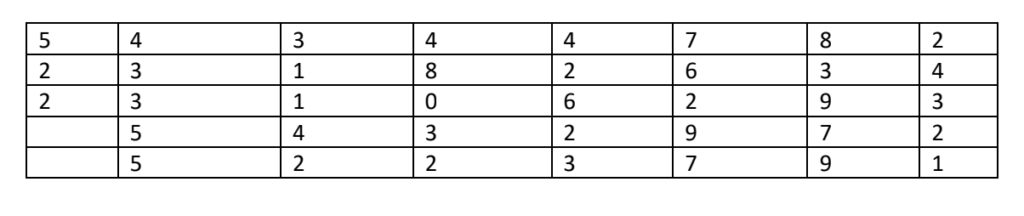
Compare the numbers written in the following table by writing them in ascending order:

Solution :
5,223,791 < 5,432,972 < 23,106,293 < 23,182,634 < 54,344,782$
Question 6.
Use table form to compare the numbers in descending order : 5,43,287; 54,82,900;
27,32,940; 43,877 ; 78,396 and 4,999
Solutions :
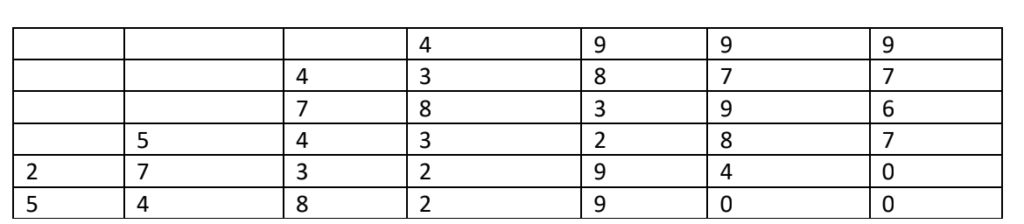
4, 999 < 43, 877 < 78, 396 < 5, 43, 287 < 27, 32, 940 < 54, 82, 900
Question 7.
Find the smallest and the greatest numbers in each case given below:
(i) 983, 5754, 84 and 5942
(ii) 32849, 53628, 5499 and 54909.
Solutions:
(i) 983, 5754, 84 and 5942
- Analysis:
- 84 has 2 digits.
- 983 has 3 digits.
- 5754 and 5942 both have 4 digits.
- Comparison of 4-digit numbers: Both start with 5. In the hundreds place, 9 > 7. Therefore, 5942 is larger than 5754.
- Final Answer:
- Smallest Number: 84
- Greatest Number: 5942
(ii) 32849, 53628, 5499 and 54909
- Analysis:
- 5499 has 4 digits.
- 32849, 53628, and 54909 all have 5 digits.
- Comparison of 5-digit numbers:
- Looking at the ten-thousands place: The digits are 3, 5, and 5.
- Between the two numbers starting with 5 (53,628 and 54,909), we look at the thousands place: 4 > 3. Therefore, 54,909 is the greatest.
- Final Answer:
- Smallest Number: 5499
- Greatest Number: 54909
Question 8.
Form the greatest and the smallest 4 digit numbers using the given digits without
repetition
(i) 3, 7, 2 and 5
(ii) 6, 1, 4 and 9
(iii) 7, 0, 4 and 2
(iv) 1, 8, 5 and 3
(v) 9, 6, 0 and 7
Solution :
| Digits Given | Greatest 4-Digit Number | Smallest 4-Digit Number |
| (i) 3, 7, 2, 5 | 7532 | 2357 |
| (ii) 6, 1, 4, 9 | 9641 | 1469 |
| (iii) 7, 0, 4, 2 | 7420 | 2047 (Not 0247) |
| (iv) 1, 8, 5, 3 | 8531 | 1358 |
| (v) 9, 6, 0, 7 | 9760 | 6079 (Not 0679) |
Question 9.
Form the greatest and the smallest 3-digit numbers using any three different digits with
the condition that digit 6 is always at the unit (one’s) place.
Solution :
1. Forming the Greatest 3-Digit Number
- Constraint: The units place must be 6.
- Goal: To make the number as large as possible, we must use the highest available digits (9 and 8) for the hundreds and tens places.
- Selection: * Hundreds place: 9
- Tens place: 8
- Units place: 6 (Fixed)
- Result: The greatest number is 986.
2. Forming the Smallest 3-Digit Number
- Constraint: The units place must be 6.
- Goal: To make the number as small as possible, we must use the lowest available digits.
- Selection:
- Hundreds place: We cannot use 0 (otherwise it becomes a 2-digit number), and we cannot use 6 (because digits must be different). So, the smallest available digit is 1.
- Tens place: The smallest available digit now is 0.
- Units place: 6 (Fixed)
- Result: The smallest number is 106.
Question 10 .
Form the greatest and the smallest 4-digit number using any four different digits with the
condition that digit 5 is always at ten’s place.
Solution :
1. Forming the Greatest 4-Digit Number
- Condition: The Tens place is fixed as 5.
- Logic: To maximize the value, we place the largest available digits in the highest place values (Thousands and Hundreds).
- Selection:
- Thousands place: 9 (Largest digit)
- Hundreds place: 8 (Next largest digit)
- Tens place: 5 (Fixed)
- Units place: 7 (Next largest digit after 9 and 8)
- Result: The greatest number is 9,857.
2. Forming the Smallest 4-Digit Number
- Condition: The Tens place is fixed as 5.
- Logic: To minimize the value, we place the smallest available digits in the highest place values.
- Selection:
- Thousands place: We cannot use 0, so the smallest available digit is 1.
- Hundreds place: Now we can use 0.
- Tens place: 5 (Fixed)
- Units place: The smallest remaining digit is 2.
- Result: The smallest number is 1,052.
Question 11.
Fill in the blanks :
(i) The largest number of 5-digit is …………… and the smallest number of 6-digit is
…………….
(ii) The difference between the smallest number of four digits and the largest number of
three digits = …………. – ………….. = …………..
(iii) The sum (addition) of the smallest number of three digit and the largest number of
two digit = ………… + …………= ………….
(iv) On adding one to the largest five digit number, we get ……………. which is the
smallest ……………… digit number.
(v) On subtracting one from the smallest four digit number, we get ……………… which
is the ……………. three digit number.
Solution :
(i) The largest number of 5-digit is 99,999 and the smallest number of 6-digit is 1,00,000.
(ii) The difference between the smallest number of four digits and the largest number of three digits = 1,000 – 999 = 1.
(iii) The sum (addition) of the smallest number of three digit and the largest number of two digit = 100 + 99 = 199.
(iv) On adding one to the largest five digit number, we get 1,00,000 which is the smallest six digit number.
(v) On subtracting one from the smallest four digit number, we get 999 which is the largest three digit number.
Question 12.
Form the largest number with the digits 2, 3, 5, 9, 6 and 0 without repetition of digits.
Solution :
The largest number is 9,65,320
Question 13.
Write the smallest and the greatest numbers of 4 digits without repetition of any digit.
Solution :
Greatest 4-Digit Number : 9,876
Smallest 4-Digit Number : 1,023
Question 14.
Find the greatest and the smallest five digit numbers with 8 in hundred’s place and with
all the digits different.
Solution :
The smallest number is 10,823.
The greatest number is 97,865.
Question 15.
Find the sum of the largest and the smallest four-digit numbers:
Solution :
Greatest (different digits): 9,876
Smallest (different digits): 1,023
Sum: 9,876 + 1,023 = 10,899
Question 16.
Find the difference between the smallest and the greatest six-digits numbers.
Solution :
“Difference” means we need to subtract the smaller number from the larger one:
9,99,999 – 1,00,000 = 8,99,999
The difference between the smallest and the greatest six-digit numbers is 8,99,999.
Question 17.
(i) How many four digit numbers are there between 999 and 3000 ?
(ii) How many four digit numbers are there between 99 and 3000 ?
Solution :
(i) How many four-digit numbers are there between 999 and 3000?
- Step 1: 3000 – 999 = 2001
- Step 2: 2001 – 1 = 2000
- Final Answer: There are 2,000 four-digit numbers between 999 and 3000.
- Logic Check: The first number is 1000 and the last is 2999.
(ii) How many four-digit numbers are there between 99 and 3000?
- Step 1: Identify the range of four-digit numbers within these bounds.
- The first four-digit number after 99 is 1000.
- Since we are looking for numbers between 99 and 3000, the last number is 2999.
- Step 2: Use the formula for the range [1000 to 2999]:
- Since we are counting from the first 4-digit number (1000) to the last one in this range (2999), we calculate: $(2999 – 1000) + 1 = 2000$.
- Final Answer: There are 2,000 four-digit numbers in this range.
Question 18.
How many four digit numbers are there between 500 and 3000 ?
Solution :
- Calculation: (2,999 – 1,000) + 1
- 1,999 + 1 = 2,000
There are 2,000 four-digit numbers between 500 and 3000.
Question 19.
Write all the possible three digit numbers using the digits 3, 6 and 8 only; if the repetition
of digits is not allowed.
Solution :
- Fix 3 in the Hundreds place:
- 3, 6, 8 – 368
- 3, 8, 6 –386
- Fix 6 in the Hundreds place:
- 6, 3, 8 – 638
- 6, 8, 3 – 683
- Fix 8 in the Hundreds place:
- 8, 3, 6 – 836
- 8, 6, 3 – 863
The possible three-digit numbers are:
368, 386, 638, 683, 836, and 863.
Question 20.
Make the greatest and the smallest 4-digit numbers using the digits 5, 4, 7 and 9
(without repeating the digits) and with the condition that:
(i) 7 is at unit’s place.
(ii) 9 is at ten’s place
(iii) 4 is at hundred’s place
Solution :
(i) Condition: 7 is at the unit’s (one’s) place.
- Greatest Number: Place 7 at the end. Arrange the remaining (9, 5, 4) in descending order.
- Result: 9,547
- Smallest Number: Place 7 at the end. Arrange the remaining (4, 5, 9) in ascending order.
- Result: 4,597
(ii) Condition: 9 is at the ten’s place.
- Greatest Number: Place 9 at the tens position. Arrange the remaining (7, 5, 4) in descending order.
- Result: 7,594
- Smallest Number: Place 9 at the tens position. Arrange the remaining (4, 5, 7) in ascending order.
- Result: 4,597
(iii) Condition: 4 is at the hundred’s place.
- Greatest Number: Place 4 at the hundreds position. Arrange the remaining (9, 7, 5) in descending order.
- Result: 9,475
- Smallest Number: Place 4 at the hundreds position. Arrange the remaining (5, 7, 9) in ascending order.
- Result: 5,479
EXERCISE 1(B)
Question 1.
Population of a city was 3, 54, 976 in the year 2014. In the year 2015, it was found to be
increased by 68, 438. What was the population of the city at the end of the year 2015?
Solution :
Problem: The population of a city was 3,54,976 in the year 2014. In 2015, it increased by 68,438. What was the population of the city at the end of 2015?
Step 1: Identify the Given Information
- Population in 2014 = 3,54,976
- Increase in 2015 = 68,438
Total population at the end of the year 2015 = 3, 54, 976 + 68, 438 = 423414
The population of the city at the end of the year 2015 was 4,23,414.
Question 2.
A = 7,43,000 and B = 8,00,100. Which is greater A or B ? And, by how much?
Solution :
Problem: A = 7,43,000 and B = 8,00,100. Which is greater, A or B ? And by how much?
Step 1: Comparison
To find which number is greater, we compare the digits starting from the highest place value (Lakhs).
- Number A: 7,43,000 (Highest digit is 7 in the Lakhs place)
- Number B: 8,00,100 (Highest digit is 8 in the Lakhs place)
Since 8 > 7, B is greater than A.
Step 2: Finding the Difference (“By how much?”)
To find “by how much,” we subtract the smaller number (A) from the greater number (B).
Calculation:
8,00,100 – 7,43,000 = 57,100
Question 3.
A small and thin notebook has 56 pages. How many total number of pages will 5326
such note-books have?
Solution :
Problem: A small and thin notebook has 56 pages. How many total number of pages will 5,326 such notebooks have?
Step 1: Identify the Given Information
- Number of pages in 1 notebook = 56
- Total number of notebooks = 5,326
5326
x 56
——
31956 <– (5,326 x 6)
266300 <– (5,326 x 50)
——
298256
Question 4.
The number of sheets of paper available for making notebooks is 75,000. Each sheet makes 8 pages of a notebook. Each notebook contains 200 pages. How many
notebooks can be made from the available paper ?
Solution :
Since one sheet produces 8 pages, we multiply the total number of sheets by 8.
- Total Sheets = 75,000
- Pages per Sheet = 8
- Total Pages = 75,000 \times 8
- Total Pages = 6,00,000
- Total Pages = 6,00,000
- Pages per Notebook = 200
- Number of Notebooks = 6,00,000 \ 200
Calculation Tip:
To divide easily, cancel out the zeros:
{6,00,000}{200} ={6,000}{2} = 3,000
Question 5.
Add 1, 76, 209; 4, 50, 923 and 44, 83, 947
Solution :
           1, 7, 6, 2, 0, 9
           4, 5, 0, 9, 2, 3
      + 44, 8, 3, 9, 4, 7
      --------------------
        51, 11, 079
Question 6.
A cricket player has so far scored 7, 849 runs in test matches. He wishes to complete 10, 000 runs ; how many more runs does he need ?
Solution :
Problem: A cricket player has so far scored 7,849 runs in test matches. He wishes to complete 10,000 runs. How many more runs does he need?
Target runs = 10,000
Runs already scored = 7,849
Subtract the current score from the target score:
10,000 – 7,849 = 2,151
The player needs 2,151 more runs to reach his target of 10,000.
Question 7.
In an election two candidates A and B are the only contestants. If candidate A scored 9, 32, 567 votes and candidates B scored 9, 00, 235 votes, by how much margin did A win
or loose the election ?
Solution :
Problem: In an election, Candidate A scored 9,32,567 votes and Candidate B scored 9,00,235 votes. By how much margin did A win or lose the election?
Votes for A: 9,32,567
Votes for B: 9,00,235
The “margin” is the difference between the winner’s votes and the loser’s votes.
Margin = Votes of A – Votes of B
Calculation:
9,32,567 – 9,00,235 = 32,332
Candidate A won the election by a margin of 32,332 votes.
Question 8.
Find the difference between the largest and the smallest number that can be written using the digits 5, 1, 6,3 and 2 without repeating any digit.
Solution :
Problem: Find the difference between the largest and the smallest number that can be written using the digits 5, 1, 6, 3, and 2 without repeating any digit.
To form the largest number, arrange the digits in Descending Order (largest to smallest).
- Digits: 6, 5, 3, 2, 1
- Largest Number: 65,321
To form the smallest number, arrange the digits in Ascending Order (smallest to largest).
- Digits: 1, 2, 3, 5, 6
- Smallest Number: 12,356
“Difference” means we subtract the smallest number from the largest number.
Calculation:
65,321 – 12,356 = 52,965
The difference between the largest and the smallest number is 52,965.
Question 9.
A machine manufactures 5,782 screws every day. How many screws will it manufacture in the month of April ?
Solution :
Problem: A machine manufactures 5,782 screws every day. How many screws will it manufacture in the month of April?
Step 1: Identify the Given Information
- Screws manufactured per day = 5,782
- Time period = The month of April
Number of days in April = 30
To find the total production for the month, we multiply the daily production by the number of days.
Total Screws = 5,782 * 30
5782
    x   30
    ------
         0  (5782 x 0)
  + 173460  (5782 x 30)
    ------
    173460
The machine will manufacture 1,73,460 screws in the month of April.
Question 10.
A man had ₹ 1, 57, 184 with him. He placed an order for purchasing 80 articles at 125 each. How much money will remain with him after the purchase?
Solution :
Problem: A man had ₹ 1,57,184. He ordered 80 articles at ₹ 125 each. How much money will remain with him after the purchase?
To find the total expenditure, multiply the number of articles by the price of one article.
- Number of articles = 80
- Price per article = ₹ 125
- Total Cost = 125 * 80
Cost of 80 articles : 80 x 125 = ₹ 10,000
Subtract the total cost from the initial amount the man had.
- Initial amount = ₹ 1,57,184
- Total cost = ₹ 10,000
- Remaining Money = 1,57,184 – 10,000
Calculation:
1,57,184 – 10,000 = 1,47,184
Question 11.
A student multiplied 8,035 by 87 instead of multiplying by 78. By how much was his answer greater than or less than the correct answer?
Solution :
Problem: A student multiplied 8,035 by 87 instead of multiplying by 78. By how much was his answer greater than or less than the correct answer?
Determine if the answer is greater or less
- He multiplied by 87.
- He should have multiplied by 78.
- Since 87 > 78, his answer will be greater than the correct answer.
Difference in multipliers = 87 – 78 = 9
This means the answer is “9 times” the original number too large.
Difference in answers = 8,035 * 9
His answer was greater than the correct answer by 72,315.
Question 12.
Mohani has 30 m cloth and she wants to make some shirts for her son. If each shirt requires 2 m 30 cm cloth, how many shirts, in all, can be made and how much length of
cloth will be left?
Solution :
Problem: Mohani has 30 m of cloth. Each shirt requires 2 m 30 cm. How many shirts can be made, and how much cloth will be left?
Since we are dealing with both meters and centimeters, it is easier to convert everything to the smaller unit (cm).
Rule: 1m = 100cm
Total cloth: 30m = 30*100 = 3,000cm
Cloth per shirt:2m 30cm = (2*100) + 30 = 230cm
Number of shirts = 3,000/230
Calculation (Long Division)
We can simplify the division by dividing both numbers by 10 (canceling the zeros):
300\23
- 23*10 = 230
- 23*13 = 299
- Remainder: 300 – 299 = 1
Question 13.
The weight of a box is 4 kg 800 gm. What is the total weight of 150 boxes?>
Solution :
Problem: The weight of one box is 4 kg 800 gm. What is the total weight of 150 such boxes?
To multiply effectively, we convert the weight of a single box into grams.
- Rule: 1kg = 1,000 gm
- Weight of 1 box: 4kg 800gm = (4 *1,000) + 800 = 4,800gm
To find the total weight for 150 boxes, we multiply the weight of one box by the number of boxes.
Total Weight= 4,800*150
= 7,20,000 gm
To make the answer more readable, we convert the grams back into kilograms.
- 7,20,000 / 1,000 = 720g
The total weight of 150 boxes is 720 kg.
Question 14.
The distance between two places A and B is 3 km 760 m. A boy travels A to B and then B to A every day. How much distance does he travel in 8 days?
Solution :
Problem: The distance between place A and B is 3 km 760 m. A boy travels from A to B and back from B to A every day. How much distance does he travel in 8 days?
To make multiplication easier, we convert the distance into the smaller unit.
- Rule: 1km = 1,000m
- Distance (A to B): 3km 760m = (3 * 1,000) + 760 = 3,760 m
The boy goes from A to B and B back to A. This means he covers the distance twice a day.
- Distance per day: 3,760m * 2 = 7,520m
Calculate Total Distance for 8 Days
Now, multiply the daily distance by 8.
- Total Distance: 7,520m* 8
Total in meters: 60,160 m
Divide by 1,000 to express the answer in km and m.
60,160 / 1,000 = 60 km 160 m
The boy travels a total distance of 60 km 160 m in 8 days.
Question 15.
An oil-tin contains 6 litre 60 ml oil. How many identical bottles can the oil fill, if capacity
of each bottle is 30 ml?
Solution :
Problem: An oil-tin contains 6 litres 60 ml of oil. How many identical bottles can the oil fill, if the capacity of each bottle is 30 ml?
To divide the oil into bottles, we must ensure the tin and the bottles are measured in the same unit.
- Rule: 1 litre = 1,000 =ml
- Total Oil: 6 =litres 60 ml = (6 * 1,000) + 60 = 6,060 ml
To find the number of bottles, we divide the total amount of oil by the capacity of one bottle.
Number of bottles = 6,060\30
= 202
The oil can fill 202 identical bottles.
Question 16.
The scale receipt of a company in a certain year was ₹ 83, 73, 540. In the following
year, it was decreased by ₹ 7, 84, 670.
(i) What was the sale receipt of the company during second year?
(ii) What was the total sale receipt of the company during these two years?
Solution :
Problem: The sale receipt of a company in a certain year (Year 1) was ₹ 83,73,540.
In the following year (Year 2), it decreased by ₹ 7,84,670.
(i) What was the sale receipt during the second year?
(ii) What was the total sale receipt during these two years?
To find the second year’s receipt, we subtract the decrease from the first year’s receipt.
Calculation: ₹ 83,73,540 – ₹ 7,84,670
Result (i): The sale receipt for the second year was ₹ 75,88,870.
(ii) Total sale receipt during these two years
To find the total, we add the receipts of Year 1 and Year 2.
- Year 1 Receipt: ₹ 83,73,540
- Year 2 Receipt: ₹ 75,88,870
- Calculation: ₹ 83,73,540 + ₹ 75,88,870
The total sale receipt for both years was ₹ 1,59,62,410 (One crore, fifty-nine lakh, sixty-two thousand, four hundred and ten).
Question 17.
A number exceeds 8, 59, 470 by 3, 00, 999. What is the number?
Solution :
Problem: A number exceeds 8,59,470 by 3,00,999. What is the number?
First number = 8, 59, 470
Difference between second and first number = 3, 00, 999
Second number = 8, 59, 470 + 3, 00, 999 = 11, 60, 469