
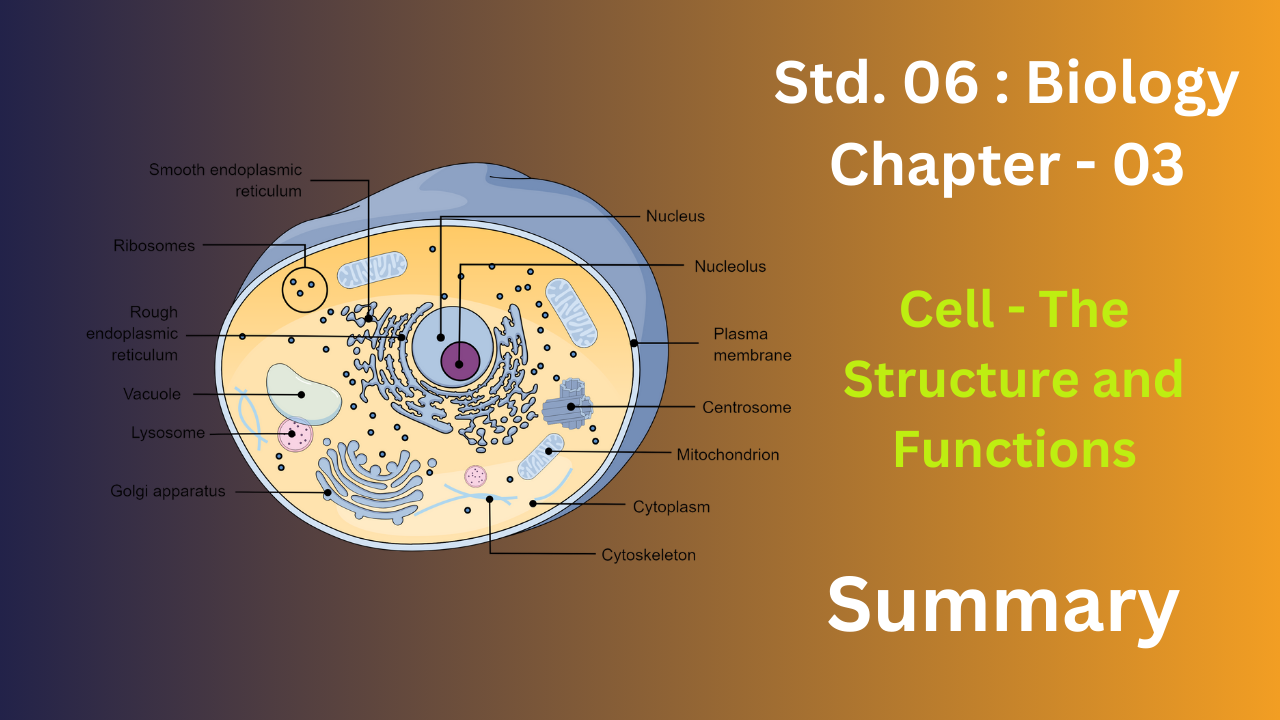
This chapter serves as the fundamental introduction to how living things are put together and how those different parts work. It starts by revealing that all life is built from cells, those incredibly tiny units that are the basic working components of every organism, from the smallest bacterium to the largest whale or tallest tree.
The chapter then takes a closer look at what makes up a typical cell, highlighting the cell membrane as the gatekeeper, the cytoplasm as the bustling internal environment, and the nucleus as the cell’s command center, holding the vital genetic information. It might also give a sneak peek at other tiny structures within the cell, called organelles, like vacuoles for storage and mitochondria for energy, perhaps even hinting at the differences between plant and animal cells.
Moving up a level of organization, the chapter introduces the idea of tissues, explaining how groups of similar cells team up to perform specific jobs. Think of muscle tissue allowing us to move, nerve tissue enabling communication throughout the body, and epithelial tissue forming protective coverings. For plants, it would likely discuss epidermal tissue for protection and the crucial vascular tissues, xylem and phloem, for transporting water and food.
The chapter then shows how different tissues work together to form organs, which are more complex structures designed for particular functions. In animals, familiar examples like the heart (pumping blood), lungs (breathing), stomach (digestion), and brain (control) would be discussed. In plants, the focus would be on organs like roots (anchoring and absorbing), stems (support and transport), and leaves (photosynthesis).
Finally, the chapter would tie it all together by explaining how multiple organs collaborate to form organ systems, which carry out major life processes. Animal examples like the digestive system (breaking down food), respiratory system (gas exchange), and circulatory system (transport) would be key..
Essentially, this “Structure and Functions” chapter lays the groundwork for understanding the complexity of life by systematically building from the microscopic cell to the macroscopic organ system, always emphasizing how the specific structure of each component is perfectly suited to its particular function. It’s about understanding the beautiful and intricate organization that underpins all living things.
Review Questions
Multiple Choice Questions:
1. Put a tick mark (✓) against the correct alternative in the following statements:
(i) Identify the part which contain pigment:
(a) cell membrane
(b) plastid
(c) centrosome
(d) cell wall
(ii) The organelle that controls all activities in
(a) nucleus
(b) vacuole
(c) plastids
(d) cytoplasm
(iii) A cell that is spherical in shape is:
(a) white blood cell
(b) nerve cell
(c) red blood cell
(d) amoeba
(iv)The vacuole contains:
(a) water
(b) cell sap
(c) salts
(d) food
Short Answer Questions:
Question 1.
Name the scientist who invented the first microscope.
Answer :Antonie van Leeuwenhoek.
Question 2.
Who coined the term “cell” ?
Answer :Robert Hooke, the flickering candlelight illuminating his face as he peered through the lens of his early microscope. The world he saw in that thin slice of cork must have been astonishing – not a solid, undifferentiated mass, but a universe of minuscule compartments.
It’s easy to see how those tiny, box-like spaces would have evoked the image of monastic cells, those simple, self-contained rooms. And the fact that he chose that very word, “cell,” to describe these fundamental structures, immortalized in his groundbreaking “Micrographia” of 1665, is just incredible.
To think that such a basic observation of what was essentially dead plant material sparked the naming of the very building blocks of all life is truly awe-inspiring. It really underscores how even the most seemingly simple discoveries, made with the most rudimentary tools, can lay the foundation for entire fields of scientific understanding. Hooke’s initial glimpse into that microscopic world was the first step on a journey that has led to our current, incredibly detailed knowledge of cell biology. It makes you appreciate the power of observation and the profound impact even the smallest insights can have.
Question 3.
Briefly describe the three essential basic parts of a cell.
Answer :First, envision the cell membrane as more than just a simple outer layer. It’s the cell’s dynamic interface with the outside world, a sophisticated and incredibly thin boundary that acts like a vigilant security system. This isn’t a rigid wall; it’s a selectively permeable barrier, meaning it has the remarkable ability to control precisely which molecules can pass into the cell, bringing in essential nutrients and expelling waste products. It’s actively involved in maintaining the delicate internal balance of the cell, a process vital for its survival.
Next, picture the cytoplasm as the bustling internal world of the cell, a jelly-like fluid that fills the space between the cell membrane and the nucleus. This isn’t just empty space; it’s a dynamic environment where a multitude of life-sustaining chemical reactions occur. Think of it as a miniature workshop where the cell’s machinery is constantly active. Suspended within this fluid are various specialized structures called organelles, each carrying out specific tasks that contribute to the overall function of the cell.
This vital organelle is the carefully guarded repository of the cell’s genetic blueprint – the DNA. This DNA holds the complete set of instructions that dictate every aspect of the cell’s life, from its growth and metabolism to its reproduction. The nucleus acts like the cell’s brain, orchestrating its activities and ensuring that all processes are carried out according to the genetic code.
Question 4.
The cell membrane is called selectively permeable. Why?
Answer : The cell membrane earns the “selectively permeable” label because it acts like a gatekeeper, carefully choosing which substances can pass in and out of the cell. It allows essential things like nutrients to enter and waste products to leave, while blocking other, potentially harmful, molecules.
Question 5.
State the difference between
(i) Nucleus and Nucleolus: The Cell’s Command Center and Ribosome Factory
Ans :
| Feature | Nucleus | Nucleolus |
| Position | It is a major organelle located within the cytoplasm of the cell. | It is a sub-organelle located inside the nucleus. |
| Membrane | Enclosed by a double-layered nuclear envelope. | It has no membrane; it is a dense region within the nucleoplasm. |
| Genetic Material | Rich in DNA (in the form of chromatin/chromosomes). | Rich in RNA (specifically ribosomal RNA). |
| Main Function | Acts as the control center; manages growth, metabolism, and reproduction. | Acts as the ribosome factory; synthesizes and assembles ribosome subunits. |
| Visibility | Large and easily visible under a light microscope. | Appears as one or more dark, dense spots inside the nucleus. |
(ii) Cytoplasm and Protoplasm: The Cell’s Interior Landscape
Ans :
| Feature | Cytoplasm | Protoplasm |
| Definition | The jelly-like substance located specifically between the cell membrane and the nuclear envelope. | The entire “living substance” of the cell, encompassing all contents inside the cell membrane. |
| Components | Contains cytosol, organelles (like mitochondria and ribosomes), and inclusions. | Includes the cytoplasm PLUS the nucleus (and the nucleoplasm within it). |
| Scope | A subset of the protoplasm; it excludes the genetic command center. | The total sum of the cell’s living material; it is the “physical basis of life.” |
| Primary Function | Acts as a site for metabolic reactions (like glycolysis) and provides mechanical support to organelles. | Orchestrates all vital life processes, including reproduction and genetic control (due to the inclusion of the nucleus). |
(iii) Cell Wall and Cell Membrane: The Cell’s Outer Boundaries
Ans :
| Feature | Cell Wall | Cell Membrane (Plasma Membrane) |
| Occurrence | Found in plants, fungi, and bacteria; absent in animal cells. | Present in all living cells (animals, plants, bacteria, etc.). |
| Nature | It is non-living, thick, and rigid. | It is living, thin, and flexible. |
| Permeability | Freely permeable; allows most substances to pass through easily. | Selectively permeable; carefully controls which substances enter or exit. |
| Composition | Primarily made of cellulose (in plants), chitin (in fungi), or peptidoglycan (in bacteria). | Primarily made of phospholipids and proteins. |
| Function | Provides structural support, protection, and fixed shape. | Regulates cellular transport and maintains the internal environment. |
Question 6.
List the major differences between a plant cell and an animal cell.
Ans :
| Feature | Plant Cell | Animal Cell |
| Shape | Fixed, regular, and usually rectangular or square. | Irregular or roundish; can change shape easily. |
| Cell Wall | A rigid outer cell wall made of cellulose is present. | The cell wall is absent; only the cell membrane is present. |
| Vacuoles | One large, central vacuole that occupies 90% of the cell volume. | Several small, temporary vacuoles (if present at all). |
| Chloroplasts | Present to perform photosynthesis and make food. | Absent; animals must ingest food for energy. |
| Centrioles | Usually absent in higher plants. | Present; they help in the process of cell division. |
| Lysosomes | Very rare; the vacuole handles waste. | Commonly present; they act as the cell’s “garbage disposal.” |
| Energy Storage | Stored in the form of Starch. | Stored in the form of Glycogen. |
Question 7.
Briefly discuss the importance of chromosomes to an organism.
Answer :Chromosomes are super important because they carry all the instructions (DNA) that tell an organism how to grow, function, and even look. 1 They’re like the complete blueprint of life, passed down from parents to offspring, ensuring all the essential traits are inherited. 2 Without them, there would be no organized genetic information, and life as we know it couldn’t exist!
8. Fill up the blanks with the terms given below in the box.
Pigments, wall, pre-existing, cell, vacuoles
- The cell is the structural unit of all living things.
- All cells arise from pre-existing cells.
- Animal cells have no cell wall.
- Plastids contain pigments.
- Vacuoles are filled with water and dissolved substance
Question 9.
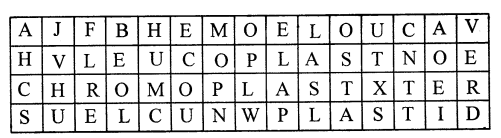
Try to find the names of four cell organelles hidden in this maze, (hint: The hidden words can appear horizontally or vertically; forwards or backward or even mixed up). Write them in the lines provided. For example :
“NUCLEUS” in the last row, seven backward letters.
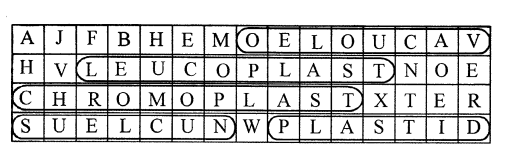
- Vacuole
- Leucoplast
- Chromoplast
- Nucleus, Plastid