
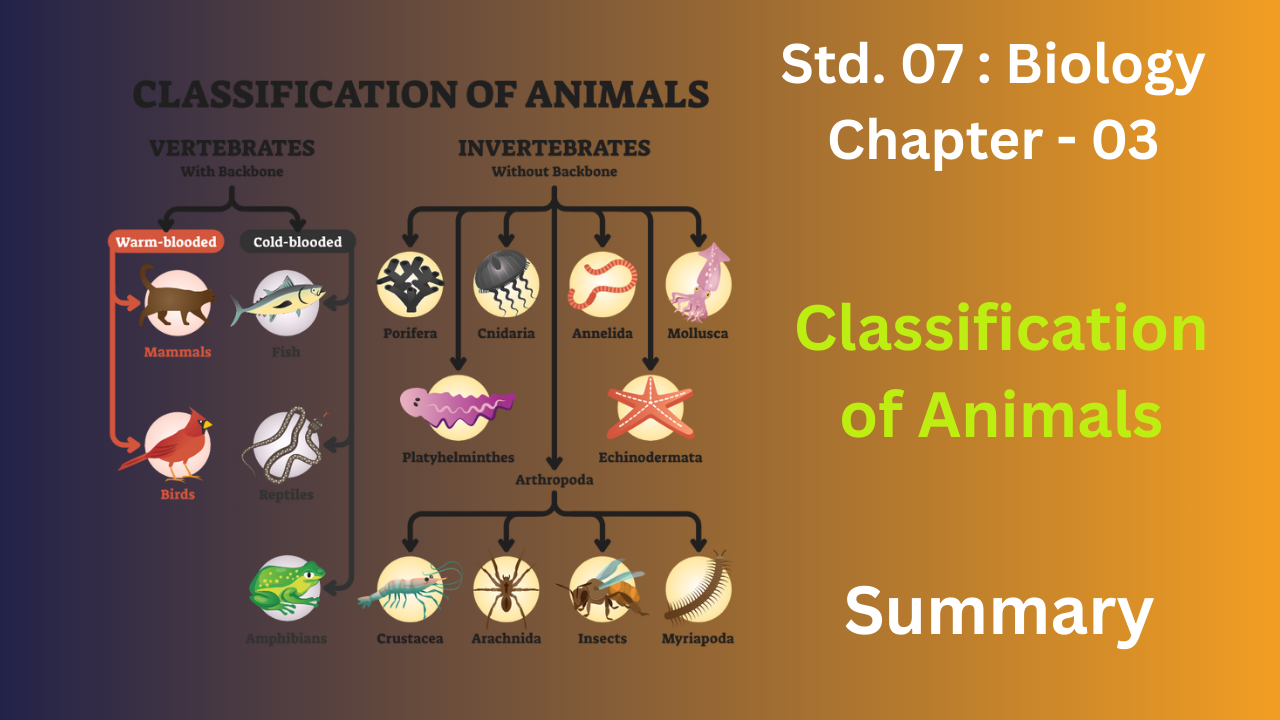
It introduces the Linnaean hierarchy, from the broad Kingdom Animalia down to the specific species level. The core of the chapter then focuses on the defining features of the major animal phyla. Simple unicellular organisms like Amoeba and Paramecium are classified under Protozoa. Sponges (Porifera) are presented as simple multicellular filter feeders. Coelenterates, such as jellyfish and corals, are characterized by their radial symmetry and stinging cells. Flatworms (Platyhelminthes) and roundworms (Nematoda) are introduced, often highlighting their parasitic lifestyles. Segmented worms (Annelida) like earthworms showcase a more complex, segmented body plan. Arthropoda, the largest phylum, is exemplified by insects, crustaceans, and arachnids, all sharing an exoskeleton and jointed appendages. Molluscs, a diverse group including snails and octopuses, are characterized by their soft bodies and often a shell. Marine animals with radial symmetry like starfish belong to Echinodermata. Finally, Chordata, the phylum to which humans belong, is introduced based on key features like a notochord. Throughout the chapter, emphasis is placed on understanding the unique characteristics, body symmetry (radial or bilateral), the presence or absence of a body cavity, segmentation, and the general ecological roles of animals within each phylum, using common examples to illustrate these concepts.
Review Questions
MULTIPLE CHOICE QUESTIONS
1. Tick (✓) the appropriate answer:
(i) Identify the aquatic animal with scaly skin which breathe with gills –
(a) Rohu
(b) Tortoise
(c) Sparrow
(d) Rat
(ii) The unicellular organism causing malaria –
(a) Amoeba
(b) Paramecium
(c) Euglena
(d) Plasmodium
(iii) Identify the animal which is not an Arthropoda —
(a) Prawn
(b) Butterfly
(c) Earthwonn
(d) Spider
(iv) Scientist who introduced binomial nomenclature is —
(a) Charles Darwin
(b) Carolus Linnaeus
(c) Robert Hooke
(d) Gregor Mendel
Short Answer Questions
1. Give two examples of each of the following:
(i) Amphibians:
Ans. Amphibians: 1. Frog 2. Toad
(ii) Segmented worms:
Ans. Segmented worms: 1. Earthworm 2. Leech
(iii) Reptiles:
Ans. Reptiles: 1. Snake 2. Lizard
(iv) Coelenterates:
Ans. Coelenterates : 1. Hydra 2. Jellyfish
(v) Arthropods:
Ans. Arthropods: 1. Crab 2. Centipede
(vi) Flatworms:
Ans. Flatworms: 1. Tapeworm 2. Liverfluke
2. Give names of two animals which are found as parasites inside the human intestine.
Ans.
Ascaris (Roundworm): These are large, cylindrical worms that can live in the small intestine. Infection occurs by ingesting their eggs, often found in contaminated soil or food.
Taenia (Tapeworm): These are flat, segmented worms that attach to the intestinal wall. Humans can get tapeworm infections by eating raw or undercooked meat (beef, pork, or fish) containing the larval cysts of the tapeworm.
3. Name one example each of an animal which shows the following characteristics:
(i) Fixed animals with a pore-bearing body:
Ans. Fixed animals with a pore-bearing body: sponge
(ii) Star-shaped body:
Ans. Star-shaped body: Star-fish
(iii) Can live in water as well as on land:
Ans. Can live in water as well as on land: Frog
(iv) Has a flattened ribbon-like body:
Ans. Has a flattened ribbon-like body: Tapeworm
4. Write one difference each between the following pairs:
(i) Porifera and Coelenterata.
(ii) Arthropoda and mollusca.
(iii) Invertebrates and Vertebrates
(iv) Platyheminthes and Nematoda
Ans:
(i) Porifera and Coelenterata:
| Feature | Porifera (Sponges) | Coelenterata (Cnidarians: Jellyfish, Hydra, Corals) |
| Level of Organization | Cellular Level. Their bodies are an aggregation of cells with little to no true tissue organization. | Tissue Level. They possess true tissues (e.g., nerve net, epithelia) and distinct layers (ectoderm and endoderm). |
| Body Symmetry | Mostly Asymmetrical. They have no regular body axis or plane of symmetry. | Radially Symmetrical. Their body parts are arranged around a central axis (like spokes on a wheel). |
(ii) Arthropoda and Mollusca:
| Feature | Phylum Arthropoda | Phylum Mollusca |
| Symmetry | Bilateral | Bilateral (often lost or modified in snails) |
| Body Segmentation | Segmented (Body divided into distinct regions like head, thorax, and abdomen) | Non-segmented (Body typically consists of a head, visceral mass, and foot) |
| Body Covering/Skeleton | Possess a rigid, external Exoskeleton made of chitin. | Usually possess a calcareous Shell (external or internal), or no shell at all (e.g., octopus). |
| Appendages | Have jointed appendages (legs, antennae, wings). | Appendages are absent; movement is achieved by a muscular Foot. |
| Coelom (Body Cavity) | Coelom is highly reduced; main body cavity is a Haemocoel (filled with blood). | Coelom is reduced, confined mostly around the heart. |
| Circulatory System | Open circulatory system (blood flows through the haemocoel). | Mostly Open (except in Cephalopods like octopuses, which have a closed system). |
| Respiratory Organs | Gills, tracheae, or book lungs. | Gills (ctenidia) or lungs (in terrestrial snails). |
| Examples | Insects, Crustaceans, Spiders, Millipedes. | Snails, Slugs, Clams, Oysters, Octopuses, Squids. |
(iii) Invertebrates and Vertebrates:
Invertebrates
| Feature | Description |
| Backbone/Spine | Absent. They lack a vertebral column or notochord (a flexible rod supporting the body). |
| Skeleton Type | Often possess an exoskeleton (hard outer shell, like insects), a hydrostatic skeleton (fluid-filled body cavity, like worms), or no hard skeleton at all. |
| Body Size | Generally smaller in size due to the limited structural support provided by an exoskeleton or fluid skeleton. |
| Nervous System | Simple, often composed of a nerve ring and paired ventral nerve cords. |
| Examples | Insects, spiders, worms, mollusks (snails, clams), jellyfish, starfish. |
Vertebrates
| Feature | Description |
| Backbone/Spine | Present. They possess a vertebral column made of bone or cartilage that protects the spinal cord. |
| Skeleton Type | Always possess a rigid, bony or cartilaginous endoskeleton (internal skeleton) for structural support. |
| Body Size | Generally larger, as the endoskeleton allows for much greater support and muscle attachment. |
| Nervous System | Highly complex, featuring a large, centralized brain protected by a skull (cranium) and a dorsal spinal cord. |
| Examples | Fish, amphibians, reptiles, birds, and mammals. |
(iv) Platyhelminthes and Nematoda:
| Feature | Platyhelminthes (Flatworms) | Nematoda (Roundworms) |
| Body Shape | Dorso-ventrally flattened (thin, ribbon-like). | Cylindrical (round in cross-section), tapered at both ends. |
| Body Cavity (Coelom) | Acoelomate (Lack a true body cavity; the space is filled with solid tissue/parenchyma). | Pseudocoelomate (Have a body cavity, the pseudocoel, that is not fully lined by mesoderm). |
| Digestive System | Incomplete digestive tract. Has only one opening (mouth/pharynx) for both ingestion and egestion. | Complete digestive tract. Has two openings: a separate mouth and anus, allowing for continuous, one-way digestion. |
| Protective Covering | Soft outer body layer (epidermis) or a specialized covering called a tegument in parasitic forms. | Covered by a thick, protective, non-cellular cuticle that must be periodically shed (molting or ecdysis). |
| Musculature | Have both circular and longitudinal muscles. | Primarily have only longitudinal muscles, resulting in a characteristic thrashing, non-undulating movement. |
| Example | Tapeworms, Flukes, Planaria. | Ascaris, Hookworms, Pinworms. |
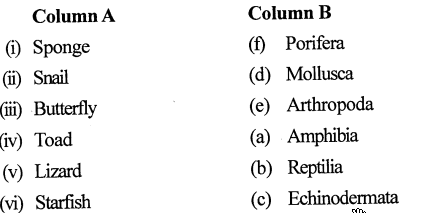
5. Match the animals given under column A with their respective classification group given under column B –
Column A Column B
Answer:
6. Write the characteristics of class Aves with reference to their body covering and jaws.
Ans:
Birds (Class Aves) are uniquely characterized by a body predominantly covered in feathers, which are crucial for flight, providing lift and control, as well as for insulation, enabling their endothermic lifestyle. While feathers are the primary covering, they also possess scales on their legs and feet, a remnant of their reptilian ancestry. Notably, birds lack sweat glands, relying instead on feathers for temperature regulation and sometimes panting to dissipate heat. Most birds also have a uropygial gland at the base of their tail, secreting oil that they spread on their feathers for waterproofing and maintenance.
The jaws of birds have undergone a significant evolutionary modification into a beak or bill, a toothless structure made of keratin covering the upper and lower mandibles. The absence of teeth is a key adaptation for reducing body weight, essential for flight. Remarkably, the shape and size of the beak vary dramatically across different bird species, reflecting their diverse diets and feeding habits. From the stout beaks of seed-eaters to the long, slender beaks of nectar feeders and the powerful, hooked beaks of birds of prey, the beak is a versatile tool perfectly suited to each bird’s ecological niche.
7. Categorise the following animals under their appropriate columns of classification.
Ans:
Worms – Arthropods, Butterfly, Ascaris, Scorpion, Honey bee, Liverfluke, Leech, grasshopper, Eathworm
Molluscs – Snail
Fishes – Rohu
Amphibians – Toad, Frog
Reptiles – Snake, Lizard, Turtle
Birds – Parrot, Pigeon
Mammals – Rat, Bat, Dog, Cattle, Cow, Rabbit, Monkey, Elephant