
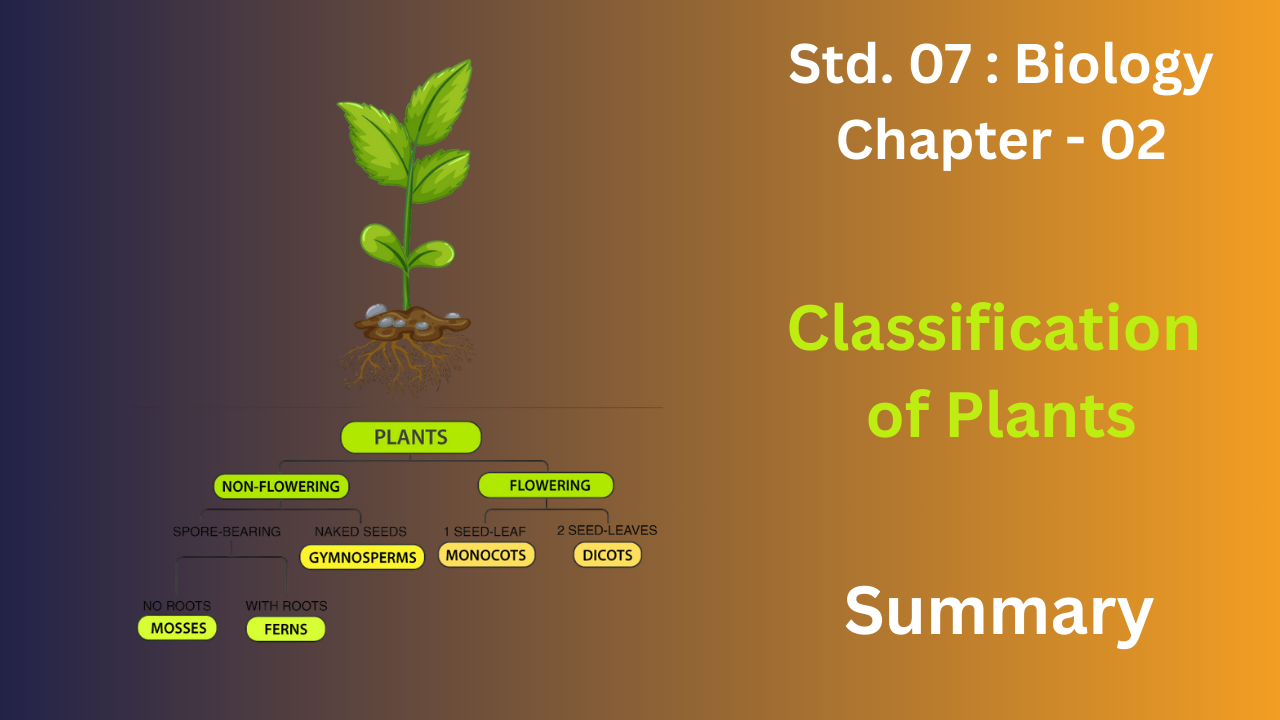
Plant Classification likely introduces the necessity of organizing the diverse plant kingdom for easier study and understanding evolutionary relationships. It covers the basic taxonomic hierarchy: Kingdom (Plantae), Divisions/Phyla, Classes, Orders, Families, Genera, and Species, emphasizing increasing specificity at each level. The main focus is on major plant groups:
- Algae: Simple, mostly aquatic, lacking true roots, stems, and leaves, photosynthetic (e.g., Spirogyra).
- Bryophytes: More complex but still simple, lacking true roots (possess rhizoids), stems, and leaves, found in moist areas, reproduce via spores (e.g., Mosses).
- Pteridophytes: Vascular plants with true roots, stems, and leaves, reproduce via spores (e.g., Ferns).
- Gymnosperms: Vascular plants with true roots, stems, and leaves, produce unenclosed (“naked”) seeds (e.g., Pine).
- Angiosperms: Vascular plants with true roots, stems, and leaves, produce seeds enclosed in fruits, the most diverse group, further divided into Monocots (one cotyledon, fibrous roots, parallel leaf venation, flower parts in multiples of three, e.g., Wheat) and Dicots (two cotyledons, taproots, net-like leaf venation, flower parts usually in multiples of four or five, e.g., Mango).
Key concepts include the classification hierarchy, distinguishing features of each group (vascular tissue presence, reproduction method, seed characteristics), and basic differences between monocots and dicots, illustrated with common examples.
Review Questions
1.Tick (✓) the appropriate answer :
(i) The two main categories of plants recognised on the basis of whether they produce fruits or not:
a) Biennials and annuals
b) Angiosperms and gymnosperms
c) Herbs and shrubs
d) Bryophyta and pteridophyta
(ii) Unicellular organisms with a proper nucleus are known as :
(a) Protista
(b) Monera
(c) Fungi
(d) Algae
(iii) Amoeba belongs to :
(a) Monera
b) Protista
(c) Fungi
(d) Algae
Short Answer Questions
1. Name the categories of the following:
- Plants which do not have roots, stems, and leaves: Thallophyta.
- Plants with no roots, but have stems and leaves: Bryophyta or Mosses.
- Plants with roots, stems, and leaves, and which bear spore- producing bodies: Pteridophyta or Ferns.
- The amphibians of the plant kingdom mosses (Bryophytes)
2. Give two characterists and one example of each of the following:
(i) Algae:
Ans.
Characteristics:
- Autotrophic via Photosynthesis: Algae possess chlorophyll and accessory pigments, allowing them to synthesize their own food using sunlight, similar to plants.
- Simple Thalloid Structure: In contrast to higher plants, algae do not exhibit differentiation into true roots, stems, or leaves; their body is typically a simple, undifferentiated structure called a thallus.
Example:
- Chlamydomonas: A unicellular green alga commonly found in soil and freshwater environments.
(ii) Fungi:
Ans.
Characteristics:
- Nutritional Mode via Absorption: Unlike plants, fungi are unable to perform photosynthesis. They acquire nourishment by secreting enzymes externally and then absorbing the digested organic compounds from their environment, functioning as decomposers, parasites, or in mutually beneficial relationships.
- Cell Walls Composed of Chitin: A key structural feature of fungi is their cell walls, which are predominantly made of chitin, a robust nitrogen-containing polysaccharide also found in the exoskeletons of arthropods. This chemical composition differs from the cellulose-based cell walls of plants.
Example:
- Yeast (Saccharomyces cerevisiae): A unicellular fungus widely used in baking and brewing, reproducing asexually through budding.
(iii) Monocot:
Ans.
Characteristics:
- Embryonic Seed Leaf Singularity: Monocotyledonous plants are characterized by seeds containing a single embryonic leaf, termed a cotyledon. This singular seed leaf distinguishes them from dicotyledonous plants, which possess two such embryonic leaves.
- Leaf Vein Arrangement: The vascular bundles within monocot leaves are typically arranged in a parallel pattern, running longitudinally from the base to the apex of the leaf blade.
Example:
- Rice (Oryza sativa): A globally significant cereal crop whose seeds contain a single cotyledon and whose leaves display a characteristic parallel venation pattern.
(iv) Dicot
Ans.
Characteristics:
- Dual Embryonic Leaves: Dicotyledonous plants are defined by their seeds containing two embryonic leaves, known as cotyledons. These structures often become the first photosynthetic organs of the seedling upon emergence.
- Net-like Leaf Vein Pattern: The vascular tissues within dicot leaves are typically arranged in an interconnected, branching network, creating a reticulate or net-like venation pattern.
Example:
- Mustard (Brassica species): A common plant whose seeds readily separate into two cotyledons during germination, and whose leaves exhibit a clearly branched or reticulate venation.
(v) Bryophyta
Ans.
Characteristics:
- Absence of Specialized Transport Systems: Bryophytes are distinguished by the lack of true vascular tissues – xylem and phloem – which are responsible for efficient long-distance transport of water and nutrients in more complex plants. This structural limitation constrains their size and habitat range.
- Gametophyte as the Prominent Life Stage: The life cycle of bryophytes is characterized by a dominant gametophyte generation, which is the multicellular haploid phase that produces gametes. The sporophyte generation, which is diploid and spore-producing, is typically smaller and nutritionally dependent on the gametophyte.
Example:
- Liverwort (e.g., Marchantia): A type of bryophyte often found in damp, shady locations, characterized by a flattened, lobed thallus (the gametophyte) from which the sporophyte generation develops.
(vi) Pteridophyta
Ans.
Characteristics:
- Presence of Specialized Conducting Systems: Pteridophytes mark an evolutionary advancement with the development of true vascular tissues – xylem and phloem – enabling efficient long-distance transport of water and nutrients, facilitating larger size and terrestrial adaptation compared to bryophytes.
- Spore-Mediated Reproduction: Reproduction in pteridophytes occurs through the production and dispersal of spores, formed within specialized structures called sporangia, often located on the lower surface or margins of their leaves.
Example:
- Horsetail (Equisetum): A unique pteridophyte characterized by its distinctive jointed stems and small, scale-like leaves arranged in whorls. It reproduces via spores produced in cones at the tips of some stems.
(vii) Thallophytes
Ans.
Characteristics:
- Simple Plant Body (Thallus): Thallophytes have a simple, undifferentiated plant body called a thallus. This means their body is not divided into true roots, stems, and leaves.
- Lack Vascular Tissue: They lack true vascular tissues (xylem and phloem) for the transport of water and nutrients. This is a key feature distinguishing them from more complex plants.
Example:
- Spirogyra: It exhibits a simple, thread-like thallus and lacks specialized transport systems.
3. Differentiate between
(i) Algae and fungi
Ans:
| Feature | Algae | Fungi |
| Kingdom | Protista or Plantae (varies by classification system) | Fungi |
| Cell Wall Composition | Primarily Cellulose | Primarily Chitin |
| Chlorophyll & Pigments | Present. Contains chlorophyll and other photosynthetic pigments (e.g., fucoxanthin, phycobilins). | Absent. Does not contain chlorophyll. |
| Mode of Nutrition | Autotrophic (Photosynthesis). They produce their own food. | Heterotrophic (Absorption). They obtain food by secreting digestive enzymes and absorbing the digested material (saprophytic, parasitic, or symbiotic). |
| Food Storage | Stored as Starch | Stored as Glycogen and Oil |
| Structure | Usually unicellular or multicellular filaments/thalli. Body is called a thallus. | Body is composed of thread-like filaments called hyphae, which collectively form a mycelium. |
| Ecological Role | Primary producers; responsible for significant oxygen production. | Decomposers (saprophytes); essential for nutrient cycling. |
| Habitat | Mainly aquatic (freshwater and marine) or moist terrestrial environments. | Terrestrial (damp, dark places) or parasitic/symbiotic on other organisms. |
(ii) Monocot and dicot plants.
Ans:
| Feature | Monocotyledonous Plants (Monocots) | Dicotyledonous Plants (Dicots) |
| Cotyledons (Seed Leaves) | One cotyledon in the seed. | Two cotyledons in the seed. |
| Root System | Fibrous root system (many slender roots arising from the stem). | Tap root system (one main, thick root with smaller lateral roots). |
| Stem Vascular Bundles | Vascular bundles are scattered throughout the stem (no organized ring). | Vascular bundles are arranged in a distinct ring around the stem. |
| Secondary Growth | Typically absent (no true wood formation). | Present (allows for increase in girth/thickness, forming wood). |
| Leaf Venation | Veins are typically parallel to each other, running the length of the leaf (e.g., grass). | Veins form a net-like or reticulate pattern. |
| Flower Parts | Flower parts (petals, sepals, etc.) are usually in multiples of three (trimerous). | Flower parts are usually in multiples of four or five (tetramerous or pentamerous). |
| Examples | Grasses, lilies, corn, rice, bamboo, palms, orchids. | Beans, peas, roses, sunflowers, mangoes, maples, oaks. |
(iii) Autotrophs and heterotrophs
Ans:
| Feature | Autotrophs (Producers) | Heterotrophs (Consumers) |
| Origin of Food/Energy | Produce their own food from inorganic sources. | Obtain food/energy by consuming other organisms (or their remains). |
| Energy Source | Primarily Sunlight (photosynthesis) or Chemical Reactions (chemosynthesis). | Chemical energy stored in the organic molecules of the food they eat. |
| Role in Ecosystem | Producers (form the base of the food chain). | Consumers (primary, secondary, and tertiary), Decomposers. |
| Carbon Source | Inorganic carbon (e.g., carbon dioxide, CO2). | Organic carbon (from complex molecules like carbohydrates and proteins). |
| Examples | Plants, Algae, Cyanobacteria, some Bacteria. | Animals, Fungi, Protozoa, most Bacteria. |
(iv) bacteria and amoeba
Ans:
| Feature | Bacteria | Amoeba |
| Cell Type | Prokaryotic | Eukaryotic |
| Genetic Material | Free-floating circular DNA in the cytoplasm (nucleoid region); no true membrane-bound nucleus. | Linear DNA contained within a true nucleus (membrane-bound). |
| Organelles | Few organelles; lack membrane-bound structures like mitochondria, endoplasmic reticulum, etc. | Possess numerous membrane-bound organelles like a nucleus, mitochondria, food vacuoles, and contractile vacuoles. |
| Size | Typically much smaller (0.5 to 5 μm). | Much larger (often 100 μm or more, visible under low magnification). |
| Motility | Use flagella (rigid, rotating tail-like structures) or are non-motile. | Use temporary extensions of the cytoplasm called pseudopods (“false feet”) for movement and feeding. |
| Cell Wall | Usually present (made of peptidoglycan). | Absent. |
| Domain of Life | Bacteria | Eukaryota (Kingdom Protista) |
(v) mosses and ferns
Ans:
| Feature | Mosses (Phylum Bryophyta) | Ferns (Phylum Pteridophyta) |
| Vascular Tissue | Non-vascular (Lack xylem and phloem). | Vascular (Possess xylem and phloem for transport). |
| Plant Structure | Simple, small, and low-growing. Lack true leaves, stems, and roots. | More complex, varying in size. Possess true roots, stems (rhizomes), and large leaves (fronds). |
| Dominant Generation | Gametophyte (The leafy green plant we commonly see; haploid). | Sporophyte (The large plant body with fronds; diploid). |
| Reproduction | Reproduce via spores produced in a capsule (sporophyte). Requires water for sperm to swim to the egg. | Reproduce via spores produced in structures called sori (on the underside of fronds). Also requires water for fertilization. |
| Water Dependence | Highly dependent; require moisture for physical support and reproduction. | Less dependent than mosses due to vascular tissue, but still require moisture for reproduction. |
| Rhizoids/Roots | Have simple, hair-like rhizoids for anchorage (not true roots). | Have true roots that absorb water and nutrients. |
(vi) Angiosperms and gymnosperms
Ans:
| Feature | Angiosperms (Flowering Plants) | Gymnosperms (Non-flowering Plants) |
| Seed Enclosure | Seeds are enclosed within a protective structure (fruit), developed from the ovary wall. | Seeds are naked; they are not enclosed within an ovary or fruit, typically lying exposed on scales (like cones). |
| Reproductive Organ | Flower is the reproductive organ. | Cones are the reproductive organs. (Male cones produce pollen; female cones produce seeds). |
| Presence of Fruit | Produce fruits that aid in seed dispersal. | Do not produce true fruits. |
| Type of Wood | Primarily Hardwoods (e.g., Oak, Maple). | Primarily Softwoods (e.g., Pine, Cedar). |
| Leaf Type | Generally have broad, flat leaves (deciduous or evergreen). | Generally have needle-like or scale-like leaves (mostly evergreen). |
| Vascular Tissues | Xylem tissue contains vessels (more efficient water transport). | Xylem tissue lacks vessels (less efficient water transport). |
| Examples | Grasses, roses, flowering trees (Mango, Apple). | Conifers, cycads, ginkgos. |
Long Answer Questions
(Write the answers in your note book)
Question 1.
What name is given to bacteria found in the root nodules of pea plants ? State their importance.
Ans:
Their importance is significant:
- Nitrogen Fixation: Rhizobium bacteria have the crucial ability to convert atmospheric nitrogen (N₂) into ammonia (NH₃), a form of nitrogen that plants can absorb and utilize for their growth and development. Pea plants, like other legumes, cannot directly use atmospheric nitrogen.
- Symbiotic Relationship: This relationship between Rhizobium and pea plants is a classic example of symbiosis, specifically mutualism. The bacteria live within the root nodules, receiving shelter and nutrients from the plant. In return, they provide the plant with a readily available source of nitrogen, which is essential for protein synthesis, chlorophyll production, and overall plant health.
- Soil Enrichment: When the pea plant dies and decomposes, the nitrogen fixed by Rhizobium in its root nodules is released back into the soil in the form of nitrates and other nitrogen compounds. This naturally enriches the soil, reducing the need for synthetic nitrogen fertilizers, which can have environmental drawbacks.
- Sustainable Agriculture: The symbiotic nitrogen fixation by Rhizobium is a natural and sustainable way to provide nitrogen to plants, contributing to more environmentally friendly agricultural practices.
Question 2.
Briefly explain four types of bacteria on basis of their shape.
Ans:
Here are four basic types:
- Cocci (Spherical): These bacteria are round or oval-shaped. They can exist as single cells or in clusters (e.g., Staphylococcus) or chains (e.g., Streptococcus).
- Bacilli (Rod-shaped): These bacteria are elongated, resembling small rods or cylinders (e.g., Bacillus subtilis, Escherichia coli). They can occur singly or in chains.
- Spirilla (Spiral-shaped): These bacteria have a spiral or helical form, often rigid and with external flagella (e.g., Spirillum). A more tightly coiled and flexible form is called a spirochete (e.g., Treponema pallidum).
- Vibrio (Comma-shaped): These bacteria are curved rods, resembling a comma (e.g., Vibrio cholerae).
Question 3.
Give reasons for the following:
(i) Bryophytes are called amphibians of plant kingdom.
(ii) Amoeba does not have any regular shape.
Ans:
(i) Bryophytes: Why “Amphibians of the Plant Kingdom”
- They are terrestrial organisms inhabiting land but necessitate the presence of water for their sexual reproduction process, specifically for the mobile male gametes to reach the female gametes.
- Their survival and propagation are generally favored by humid and shaded environments, reflecting a reliance on moisture.
(ii) Amoeba: Reason for Lack of Regular Shape
- The absence of a rigid cell wall, with only a flexible plasma membrane as its outer boundary, allows for dynamic changes in form.
- Its characteristic mode of locomotion and feeding involves the formation and retraction of temporary cytoplasmic extensions called pseudopodia, which continuously alter its overall morphology.
Question 4.
What is a contractile vacoule ? State its function in amoeba.
Ans:
A contractile vacuole is a specialized, membrane-enclosed cellular compartment found in numerous freshwater protists, prominently including Amoeba. Its principal role is osmoregulation, the maintenance of a stable internal water balance. In the hypotonic freshwater environment where Amoeba resides, water continuously enters the cytoplasm via osmosis. The contractile vacuole counteracts this influx by accumulating surplus intracellular water and then rhythmically contracting to expel it across the cell membrane into the external surroundings, thereby preventing cellular swelling and lysis. Additionally, it may play a secondary role in the elimination of certain soluble metabolic waste products, such as ammonia, along with the expelled water.
Question 5.
List out Jive uses each of bacteria and fungi in our lives.
Ans:
Bacteria and fungi, though often unseen, play indispensable roles in our daily lives. Bacteria are vital in the food industry, contributing to the creation of staples like yogurt and cheese through fermentation. Within our bodies, a diverse community of gut bacteria aids in digestion and even produces essential vitamins. In agriculture, certain bacteria are crucial for nitrogen fixation, converting atmospheric nitrogen into a form usable by plants, thus supporting crop growth. Furthermore, bacteria are essential in environmental management, breaking down waste in treatment plants and cleaning up pollutants through bioremediation. Finally, genetic engineering utilizes bacteria as tiny factories to produce life-saving pharmaceuticals such as insulin and various antibiotics.
Many species of mushrooms are a direct source of nutritious food. Yeast, a single-celled fungus, is indispensable in baking, causing bread to rise, and in brewing, fermenting sugars into alcoholic beverages. Fungi are also key players in food fermentation, contributing unique flavors and textures to products like certain cheeses and soy sauce. Medicinally, fungi are a treasure trove, with the discovery of penicillin being a landmark achievement, and other fungi yielding crucial immunosuppressants and cholesterol-lowering drugs. Ecologically, fungi are the primary decomposers, breaking down organic matter and ensuring the recycling of vital nutrients back into the ecosystem, a process essential for all life.