
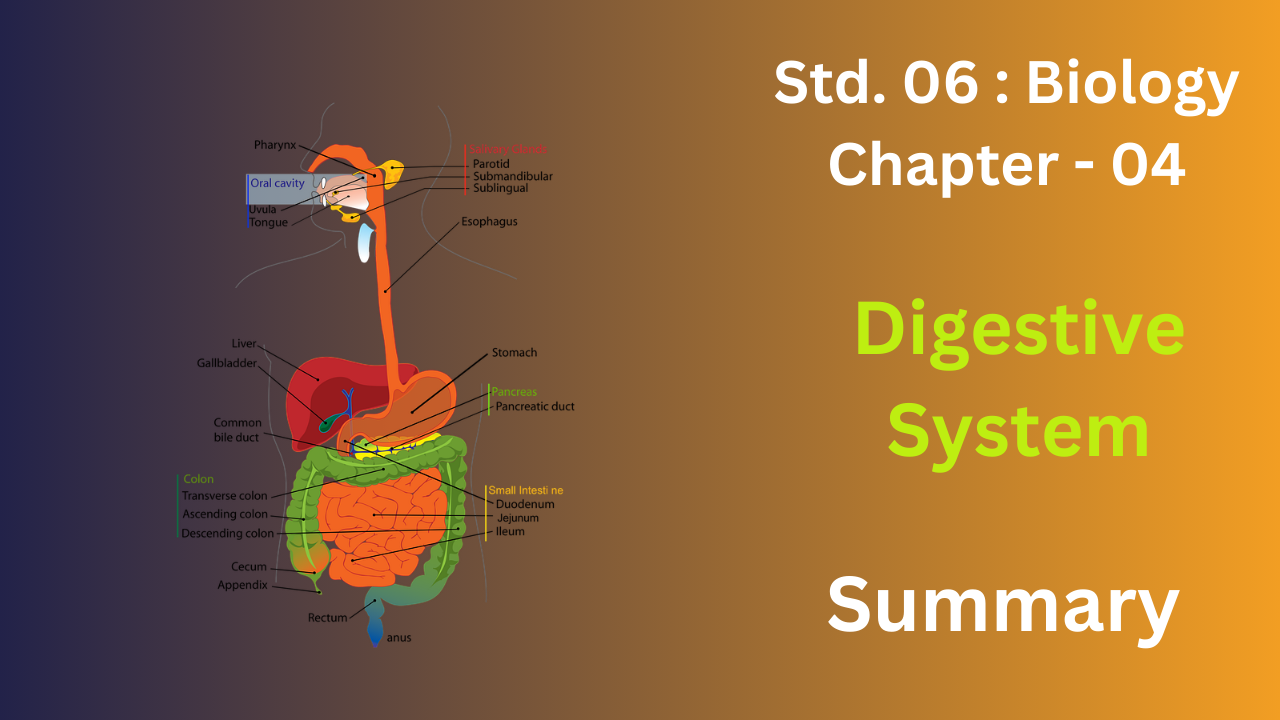
This chapter explains how our bodies get energy from food. It covers the essential nutrients we eat (carbs, fats, proteins, vitamins, minerals, water, and fiber) and the five main steps of digestion: eating, breaking down food (both by chewing and with body juices), absorbing nutrients into the blood, using those nutrients for energy and growth, and finally, getting rid of waste.
You’ll learn about the key organs involved: the mouth (where it all starts with teeth and saliva), the food pipe (carrying food down), the stomach (churning and mixing), the small intestine (where most digestion and absorption happens), the large intestine (absorbing water), and the anus (for waste removal).
The chapter also likely talks about important helpers called digestive glands: salivary glands (for saliva), the liver (producing bile for fats), and the pancreas (making juices for carbs, fats, and proteins in the small intestine).
Essentially, it’s all about understanding how the food you eat travels through your body and how your body extracts the good stuff to keep you going!
Review Questions
Multiple Choice Questions :
1. Put a tick (✓) against the most appropriate alternative in the following statements.
(i) The teeth which help in tearing the food are the:
(a) Incisors
(b) Canines
(c) Premolars
(d) Molars
(ii) Last molar tooth in human beings is called:
(a) Adult tooth
(b) Wisdom tooth
(c) Child tooth
(d) Elders tooth
(iii) The hardest substance in your body?
(a) Dentine
(b) Bone
(c) Cement
(d) Enamel
(iv) Saliva converts starch into:
(a) Glucose
(b) Sucrose
(c) Maltose
(d) Lactose
(v) Proteins of the milk are converted into curd by the enzyme:
(a) Trypsin
(b) Rennin
(c) Pepsin
(d) Steapsin
(vi) Bile juice is produced by :
(a) Stomach
(b) Liver
(e) Pancreas
(d) Gallbladder
1. Write True or False in the following statements.
- Molars help in cutting and tearing food.
Answer :False
Correct — Molars help in finer crushing and grinding. - Carbohydrates are digested into glucose.
Answer :True - Proteins are digested into fatty acids.
Answer :False
Correct — Proteins are digested into amino acids.
2. Fill in the blanks.
- The teeth called are a total of four in number on the sides of——–.
Ans : incisors
- The teeth called ————are a total of four in number on the sides of incisors.
Ans : canines
- ————-is a common opening of the food pipe and windpipe.
Ans : Pharynx
- Molars are meant for —————-the food.
Ans : crushing
- Incisors are used for ————-and ———– the food.
Ans : biting , cutting
- The ————are used for tearing the food.
Ans : canines
- The ———–and ———–are used for crushing and grinding the food.
Ans : premolars , molars
- In an adult human, there are a total of ———— teeth.
Ans : 32
- The human teeth appear in two sets, the first set is called ————-which consists of only ———– teeth.
Ans : primary , twenty
3. Name the following :
- End product of starch after digestion — glucose.
- The organ where protein digestion-begins — stomach.
- The organ into which the pancreatic juice and the bile juice are poured — small intestine.
- The enzyme which digests fat — lipases.
- The simplest form of carbohydrates — glucose. ‘
- The part of the alimentary canal where water from undigested food is absorbed — large intestine.
- The end-product of proteins after digestion — amino acids.
4. Identify and name the four type of teeth shown below and give their functions.
Answer :
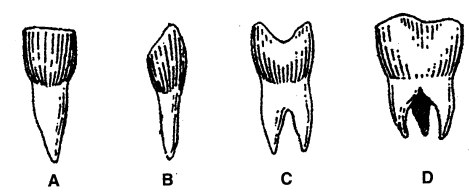
A (Incisor): Your front, sharp “biting” teeth.
B (Canine): The pointy teeth next to them, good for “tearing.”
C (Premolar): The teeth after the canines, wider and ridged for “grinding.”
D (Molar): Your big back teeth with wide, ridged surfaces for really “chewing” food.
5. State whether the following statements are True or False.
(i) Wisdom teeth appear at the age of 5-6 years when the child starts going to school.
(ii) The temporary set of teeth includes incisors, canines and premolars only.
(iii) The ducts from the salivary glands open into the duodenum.
(iv) Saliva changes starch into maltose.
Ans :
(i) False
Wisdom teeth (the third molars) are the last teeth to erupt, typically appearing between the ages of 17 and 25 years. The teeth that usually appear around age 6 are the first permanent molars.
(ii) False
The temporary (milk) set of teeth includes incisors, canines, and molars. It is important to note that premolars are absent in the temporary set; they only appear in the permanent set of teeth.
(iii) False
The ducts from the salivary glands open into the buccal cavity (mouth). The duodenum is the first part of the small intestine, which receives secretions from the liver and pancreas, not the salivary glands.
(iv) True
Saliva contains an enzyme called salivary amylase (also known as ptyalin), which breaks down complex starch molecules into a simpler sugar called maltose.
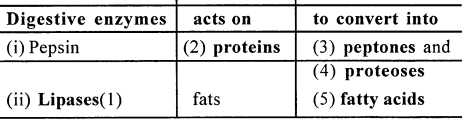
6.Fill in the blanks in the table (1-5) by selecting the suitable names of substances from the list given below:
(steapsin, peptones, fatty acids, proteoses, protein).

Ans :
Question 7.
(i) Name the juice secreted by the liver.
Ans The liver makes a juice called bile.
(ii) Name the organ where this juice is temporarily stored.
Ans. Imagine a little storage bag attached to your digestive system – that’s your gallbladder. It holds onto a fluid called bile, which is super helpful for breaking down your food. It just chills there, ready to squeeze out that bile when you eat!
(iii) What is the main function of this juice ?
Ans. Bile juice’s main gig is to help your body digest fats. Think of it like a detergent for grease – it breaks down big globs of fat into tiny droplets so that enzymes can easily do their work and your body can absorb them. It also helps get rid of some waste products from the liver.
Question 8.
Name the three enzymes found in pancreatic juice.
(i)….. (ii)….. (iii) ……
Answer :The liver uses bile to get rid of certain waste.
And for the pancreatic juice enzymes, here are three key players:
(i) Amylase: Helps break down those starchy foods. (ii) Lipase: Works on digesting fats. (iii) Protease (like trypsin or chymotrypsin): Takes care of breaking down proteins.
Question 9.
Name the three regions of the large intestine.
Answer :So, the large intestine kicks off with a little pouch called the cecum. Then it goes upwards – that’s the ascending colon. It takes a bend and goes across your belly as the transverse colon, and after that, it heads downwards as the descending colon before ending in the rectum. Easy peasy!
Question 10.
Given alongside is the diagram of the human alimentary canal.
(i) Name the parts 1-11 indicated by guidelines.
1. … 2. … 3. … 4. … 5. … 6. …
7. … 8. … 9. … 10. … 11 ….
(ii) State the function of the juice secreted by part 1.
(iii) State the function of the three enzymes found in the juice secreted by part 3.
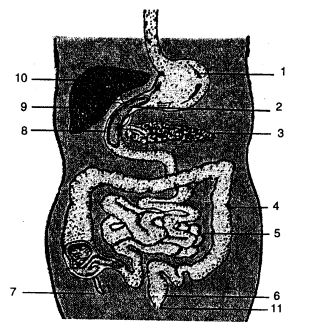
Answer :(i) Parts:
- Oesophagus
- Stomach
- Pancreas
- Large Intestine
- Small Intestine
- Rectum
- Anus
- Duodenum
- Gallbladder
- Liver
- Appendix
(ii) Oesophagus Function:
It mainly moves food to the stomach using muscle contractions and secretes mucus for smooth passage.
(iii) Pancreatic Enzyme Functions:
- Amylase: Digests starches into sugars.
- Lipase: Digests fats into fatty acids and glycerol.
- Protease: Digests proteins into smaller pieces
Question 6.
Rewrite the following parts of the human alimentary canal in their correct sequence
Stomach, Oesophagus, Large intestine, Small intestine, Pharynx.
Answer :Pharynx → Oesophagus → Stomach → Small intestine → Large intestine
Question 7.
What is the fate of excess glucose in our body ?
Answer :so when you eat, the food goes down your throat – that’s the pharynx. Then it slides down this tube, the esophagus (or food pipe), right into your stomach. After your stomach mixes it all up, the food moves into the small intestine. And last stop on the main route is the large intestine. That’s the whole trip your food takes!
Question 8.
Define the term ‘digestion’.
Answer :digestion is your body’s way of taking the food you eat and breaking it down into really tiny pieces. It’s like turning your meal into the fuel and building blocks your body needs to have energy, grow, and fix itself. So, it’s all about making the big stuff small enough to soak up and use!
Question 9.
State the four ways in which saliva is useful to us.
Answer :First off, saliva helps you actually taste your food. It dissolves the flavors so your taste buds can do their thing. Without it, everything would be super bland!
It also makes swallowing a breeze. Saliva turns your food into a nice slippery ball so it goes down your throat smoothly, no more struggling with dry food.
Believe it or not, saliva even starts digesting some foods right in your mouth! It has a special stuff called amylase that begins to break down starches, like the ones in bread and potatoes, into sugars. So, digestion starts sooner than you think!
And last but not least, saliva is like your mouth’s natural cleaner. It washes away food bits and germs, which helps keep your teeth healthy and your breath fresh. Pretty cool, huh?
Question 10.
Food is classified into three groups on the basis of the function they perform in our body. Name the three categories, and briefly give their functions. Also give their two sources each.
Answer :Energy Givers (Your Body’s Fuel): These foods are what give you the get-up-and-go for everything you do – running around, learning, even just chilling out. Think of them as your body’s gasoline! Good examples are rice and bananas.
Body Builders (The Construction Crew): These foods are all about helping you grow big and strong, building your muscles, and fixing any little damages inside. Think of them as the bricks and mortar for your body. You can find them in things like eggs and beans.
Protective Foods (Your Health Heroes): These foods are like your personal bodyguards, helping to keep you healthy and fight off any nasty bugs that try to make you sick. Think of them as your defense team! Great examples are apples and carrots.