
Electricity: This section introduces electric charge (positive and negative), explains static electricity as the buildup of these charges through friction, and describes the attraction and repulsion between them. It might also touch upon a simple electroscope for detecting charge.
Electric Current and Circuits: Here, the chapter likely defines electric current as the flow of charge and introduces the concept of an electric circuit as a closed path. Key components like batteries (energy source), wires (path), switches (control), and bulbs (load) are explained. The difference between conductors (allow flow) and insulators (resist flow) is also covered.
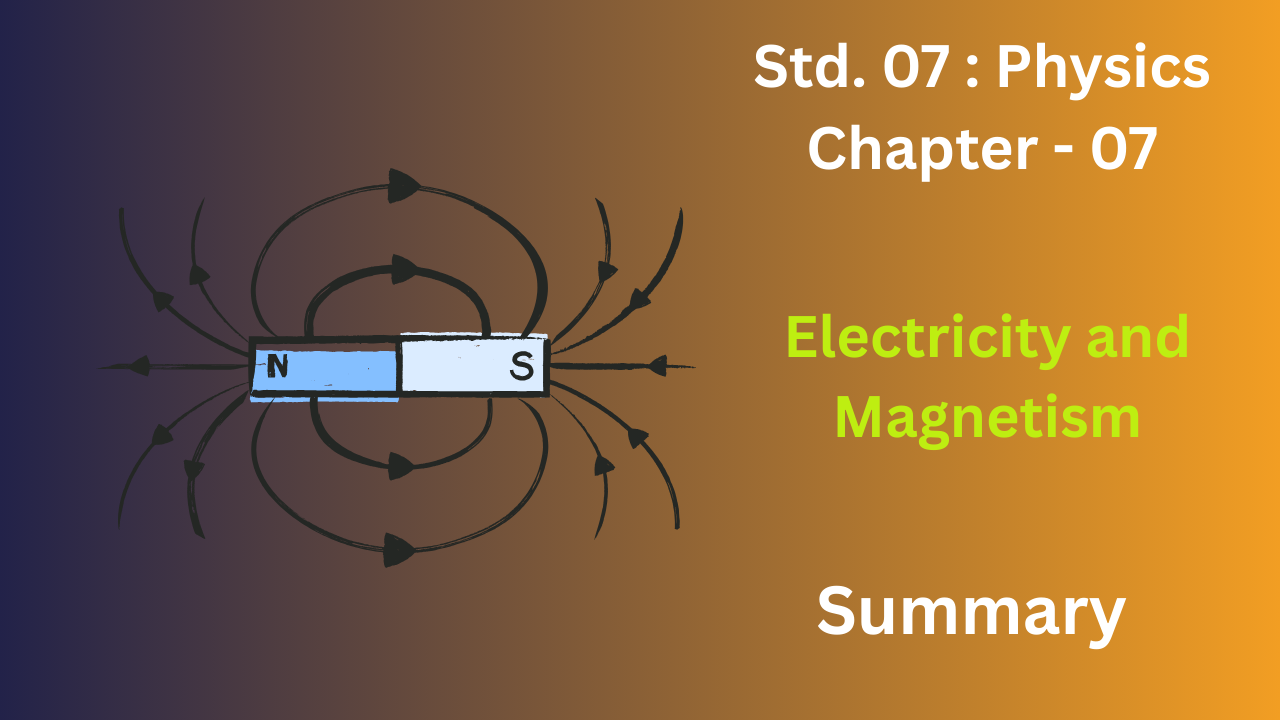
Magnetism: This part explores natural and artificial magnets, their North and South poles, and the attractive and repulsive forces between these poles. The idea of a magnetic field, the region of magnetic influence, and magnetic field lines are introduced. The Earth’s own magnetic field is also likely mentioned.
Electromagnetism: This crucial section connects electricity and magnetism by demonstrating that an electric current can produce a magnetic effect (e.g., deflecting a compass needle). It then explains how to create electromagnets using coils of wire and current, discusses factors affecting their strength, and might give simple applications like the electric bell.
In essence, this chapter likely builds from basic electrical concepts to fundamental magnetic ideas, culminating in the introduction of electromagnetism, the link between these two forces.
Test Yourself
A. Objective Questions
1. Write true or false for each statement
(a) A current carrying coil when suspended freely can rest in any direction.
Ans: False.
(b) A coil carrying current behaves like a magnet.
Ans: True.
(c) In an electromagnet, the core is made up of copper.
Ans: False.
(d) An electric bell uses an electromagnet.
Ans: True.
(e) An electromagnet with soft iron core is a temporary magnet.
Ans: True.
(f) We use cell as the source of electricity to run an electric immersion rod.
Ans: False.
(g) A torch bulb glows if the terminals of the bulb are connected to the terminals of a cell by the metallic wire.
Ans: True.
(h) Wool is a conductor of electricity.
Ans: False.
Wool is a insulator of electricity.
(i) Silver is an insulator of electricity.
Ans: False.
Silver is good conductor of electricity.
(j) Our body is a conductor of electricity.
Ans: True.
(k) For a circuit to be complete, every part of it must be made up of conductors.
Ans: True.
(l) All metals are conductors of electricity.
Ans: True.
(m) The switch should not be touched with wet hands.
Ans: True.
(n) A switch is an on-off device in an electric circuit.
Ans: True.
2. Fill in the blanks
(a) A magnet has ——– poles.
Ans : two
(b) Like poles ——- each other and unlike poles ——-.
Ans : repel , attract
(c) An electromagnet is used to separate large mass of ——- scrap.
Ans : iron
(d) The strength of magnetic field of an electromagnet is increased by inserting a core of soft ——.
Ans : iron
(e) In a torch we use ——– as the source of electricity.
Ans : dry cell
(f) To light a table lamp and to run a refrigerator, we use —— as the source of electricity.
Ans : mains
(g) A group of two or more cells is called a ——.
Ans : battery
(h) ——– pass electricity through them.
Ans : Conductors
(i) ——- do not pass electricity through them.
Ans : Insulators
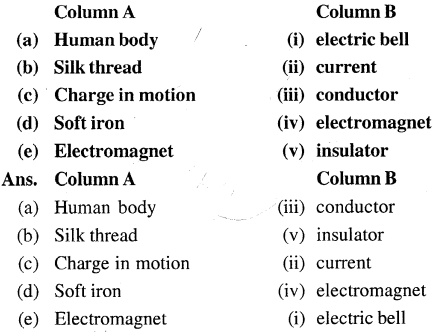
3. Match the following
4. Select the correct alternative
(a) A freely suspended magnet rests in
- east-west direction
- north-south direction
- north-east direction
- north-west direction.
(b) Electromagnets are made up of
- steel
- copper
- brass
- soft iron.
(c) An electromagnet is used in
- electric oven
- ammeter
- electric bell
- radio set.
(d) The purpose of armature in an electric bell is
- to make and break the circuit
- to produce sound
- to produce magnetic field
- to provide spring action.
(e) In a torch, the source of electricity is
- the bulb
- the switch
- the cell
- the mains.
(f) Electricity can flow through
- wood
- rubber
- plastic
- copper wire.
(g) Electricity does not flow through
- human body
- animals body
- rubber
- silver.
(h) We should not touch the switch with wet hands otherwise
- electricity may pass through our body
- electricity may not pass through the appliance
- circuit may break
- the switch may get off.
B. Short/Long Answer Questions
Question 1.
State two properties of a bar magnet.
Ans:
A bar magnet exhibits two primary properties:
- Polarity: Every bar magnet has two distinct magnetic poles, designated as a north pole and a south pole, typically located at opposite ends. When freely suspended, the magnet aligns itself roughly with the Earth’s geographic north-south, with the north pole pointing towards the geographic north and the south pole towards the geographic south.
- Pole Interaction: The magnetic poles of different bar magnets exert forces on each other. Like poles (north-north or south-south) repel, pushing each other away. Conversely, unlike poles (north-south) attract, pulling towards each other.
Question 2.
How will you test whether a given rod is a magnet or not?
Ans:
To test if a rod is a magnet:
- Suspension: If freely suspended, a magnet will point north-south. A non-magnet won’t.
- Interaction with a known magnet: A magnet will show both attraction and repulsion (like poles repel). A non-magnet will only show attraction. Repulsion is the definitive test.
Question 3.
How will you test whether a given rod is made of iron or not?
Ans:
Bring a magnet near the rod. If it’s attracted, it’s likely iron (or steel). Also, if the rod becomes temporarily magnetic and attracts iron filings when a magnet touches it, it’s likely iron. Iron is strongly attracted to magnets and can become temporarily magnetized.
Question 4.
You are given two similar bars. One is a magnet and the other is of soft iron. How will you distinguish and identify them ?
Ans:
To distinguish a magnet from a seemingly identical soft iron bar, perform the following test:
- Bring the central region of one bar near either end of the other bar. If one of the bars is a magnet, both will show attraction because the soft iron will be drawn to the magnet’s poles.
- The bar that can cause the other bar to move away (repel) when their ends are brought near is the magnet. Soft iron will only ever be attracted to a magnet; it will never push it away. This repulsive force is a unique indicator of the interaction between the like poles of two permanent magnets.
Question 5.
You are given a magnet. How will you use it to find north-south direction at a place?
Ans:
Suspend the magnet freely. It will swing and settle pointing approximately north-south. The end pointing towards geographic north is the magnet’s north pole, and the other end is its south pole. This works because the magnet aligns itself with the Earth’s magnetic field. Note that this gives magnetic north-south, which might slightly differ from true geographic north-south due to magnetic declination.
Question 6.
Describe a simple experiment to illustrate that like poles of two magnets repel each other while the unlike poles attract.
Ans:
Suspend one bar magnet freely. Bring the north pole of another magnet near the north pole of the suspended one – they will repel. Do the same with the south poles – they will also repel. This shows that like poles repel, and unlike poles attract.
Question 7.
“Poles exist in pair”. Comment on this statement.
Ans:
“Poles exist in pairs” is a fundamental rule of magnetism. Magnetic field lines always form loops going from a north pole to a south pole, meaning you can’t have one without the other. If you cut a magnet, you just get two smaller magnets, each with its own north and south pole. Isolated magnetic poles (monopoles) haven’t been found. Even at the atomic level, magnetism arises from paired movements of charges. So, every magnet, big or small, always has both a north and a south pole.
Question 8.
What is a magnetic compass ? State its use.
Ans:
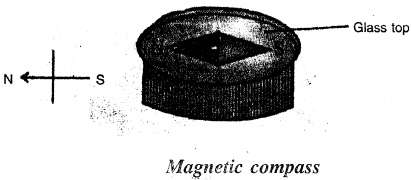
A magnetic compass is a navigational device featuring a freely pivoting magnetic needle or card. This needle aligns itself with the Earth’s magnetic field lines, thereby indicating the approximate north-south direction. Its primary function is navigation across various terrains, including land, sea, and air. Additionally, a compass serves as a fundamental tool for determining cardinal directions (North, South, East, West) at any given location. Beyond navigation, magnetic compasses find utility in fields such as geological surveys and as educational aids for illustrating magnetic principles and geographical orientation.
Question 9.
Explain the meaning of the term magnetic field.
Ans:
A magnetic field is the invisible area around a magnet or moving electric charge where magnetic forces can be felt. It has both strength and direction. We visualize it with magnetic field lines that show the direction of the force on a north pole. These lines form loops from north to south outside the magnet and continue inside. Magnetic fields are created by permanent magnets, electric currents, and changing electric fields.
Question 10.
What is an electromagnet ?
Ans:
An electromagnet is a magnet created by electric current flowing through a coil of wire, often wrapped around an iron core. Its magnetism can be turned on and off, its strength can be varied, and its poles can be reversed by controlling the current.
Question 11.
Name the material of an electromagnet.
Ans:
Soft iron stands out as the most frequently employed material for this purpose, primarily owing to its advantageous characteristics:
Elevated magnetic permeability: It readily and intensely magnetizes when an electric current traverses the surrounding coil.
Minimal retentivity: It largely relinquishes its induced magnetism upon the cessation of the electric current, a vital attribute for the precise control of the electromagnet.
Reduced coercivity: Although alternative ferromagnetic materials such as steel, nickel, and cobalt can also serve as cores, the specific magnetic attributes of soft iron render it exceptionally suitable for applications necessitating rapid and controlled switching of the magnetic field, as seen in devices like electric bells, relays, and electromagnetic lifting mechanisms.
Question 12.
Draw a labelled diagram to make a soft iron bar as an electromagnet. Describe in steps the procedure.
Ans:
Wrap insulated copper wire tightly around a soft iron bar.
Connect the wire ends to a battery (with a switch in between for control).
When the switch is closed (or wires connected directly), current flows, and the bar becomes a magnet, attracting iron objects.
Opening the switch (or disconnecting the wires) stops the current, and the bar loses its magnetism.
Question 13.
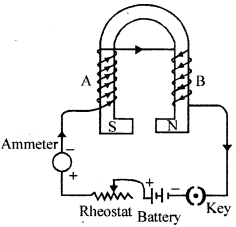
You are given a U shaped soft iron piece, insulated copper wire and a battery. Draw a circuit diagram to make a horse shoe electromagnet.
Ans:
End A becomes S-pole and B becomes N-pole.
Question 14.
Name two factors on which the strength of magnetic field of an electromagnet depends.
Ans:
Electromagnet strength depends mainly on:
- Number of turns in the wire coil.
- Amount of electric current flowing.
Question 15.
State two ways by which the strength of magnetic field of an electromagnet can be increased.
Ans:
One effective method to amplify the magnetic field strength of an electromagnet involves increasing the number of turns in the coil of wire wound around its core. Each individual loop of wire, when carrying an electric current, generates its own magnetic field. By increasing the number of these loops, you are essentially adding more individual magnetic fields that collectively contribute to a stronger overall magnetic field for the electromagnet. This results in a more concentrated and intensified magnetic force emanating from the electromagnet.
The strength of the magnetic field produced by a current-carrying wire is directly proportional to the amount of current. Therefore, by allowing a larger current to pass through the coil, you increase the strength of the magnetic field generated by each individual loop of wire. These stronger individual fields then combine to create a more powerful overall magnetic field for the electromagnet. However, it’s important to note that there are practical limitations to increasing the current, such as the wire’s resistance causing heat and the magnetic core eventually reaching its saturation point, beyond which further increases in current may not lead to a proportional increase in magnetic field strength.
Question 16.
State two common uses of electromagnets.
Ans:
Here are two common uses of electromagnets:
Electric Bells and Buzzers: Electromagnets are a fundamental component in electric bells and buzzers. When the circuit is completed (e.g., when the doorbell button is pressed), the electromagnet attracts a spring-loaded arm with a hammer at the end. This hammer strikes a gong or a metal plate, producing sound. When the circuit is broken, the electromagnet loses its magnetism, and the spring pulls the arm back to its original position, ready for the next cycle.
Lifting Heavy Ferromagnetic Materials (Scrap Yards and Industrial Cranes): Powerful electromagnets are used in scrap yards and industrial settings to lift and move heavy iron and steel objects. These electromagnets, often attached to cranes, can be turned on to attract and lift large quantities of metal and then turned off to release them at the desired location. This controlled lifting and dropping of heavy magnetic materials is much more efficient and safer than manual methods.
Question 17.
Name a domestic device in which an electromagnet is used.
Ans:
A common domestic device that uses an electromagnet is an electric bell.
Question 18.
Draw a neat and labelled diagram of an electric bell and describe its working.
Ans:
When the switch is closed, current flows through the electromagnet, attracting a hammer-attached armature which strikes the gong. This movement also breaks the circuit. The electromagnet loses power, a spring pulls the armature back, remaking the circuit. This cycle repeats rapidly, creating the ringing sound.
Question 19.
The incomplete diagram of an electric bell is given in fig. Complete the diagram and label its different parts.
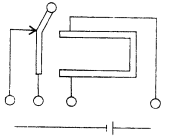
Ans:
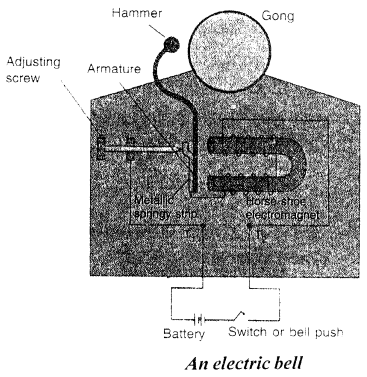
Question 20.
What is declination ? Draw a diagram to show the angle between the declination and true direction of geographic north.
Ans:
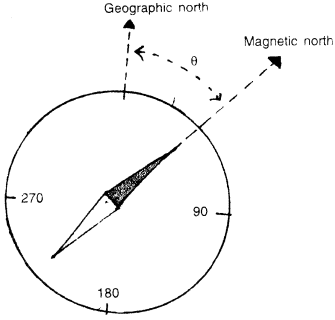
- It’s the angular difference on the horizontal plane between the direction to the geographic North Pole (True North) and the direction a compass needle points (Magnetic North).
- This angle changes depending on your location on Earth and shifts over time as the Earth’s magnetic field fluctuates.
- By convention, it’s East declination (positive) if Magnetic North is east of True North, and West declination (negative) if Magnetic North is west of True North
Question 21.
Define the term current.
Ans:
Quantified in amperes (A), it represents the quantity of charge traversing a point per second. By convention, its direction aligns with the movement of positive charges, although electrons (negatively charged particles) are the typical charge carriers in metals. Two primary forms exist: DC (unidirectional flow) and AC (periodically reversing flow). Essentially, it embodies the movement of electrical energy.
Question 22.
Name four appliances which work using electricity.
Ans:
Here are four common household devices powered by electricity:
- Electric Fan: Facilitates air circulation and cooling.
- Television: Serves as a medium for entertainment and information dissemination.
- Refrigerator: Maintains low temperatures for food and beverage preservation.
- Electric Lamp (Light Bulb): Provides artificial illumination.
Question 23.
Name two sources of electricity.
Ans:
Two sources of electricity are:
- Power plants (using fuels, nuclear, water, wind, sun, geothermal).
- Batteries (chemical energy conversion).
Question 24.
What is a battery?
Ans:
A battery is a device that converts chemical energy directly into electrical energy through one or more electrochemical cells.1 Each cell contains a positive electrode (cathode), a negative electrode (anode), and an electrolyte2 that facilitates the movement of ions between them.3 Chemical reactions at the electrodes cause a buildup of electrons at the anode and a deficit at the cathode.
Question 25.
What is an electric circuit?
Ans:
An electric circuit constitutes a complete and unbroken pathway that facilitates the continuous movement of electric charge. Essential for its functionality is a source of electrical energy, which establishes the electrical potential difference necessary to drive the charge flow. This flow occurs through conductors, typically wires, forming the closed loop. Often, the circuit includes a load, a component designed to utilize the electrical energy to perform a specific task. An optional switch can be incorporated to interrupt or complete the circuit, thereby controlling the flow of charge. The uninterrupted nature of the loop is paramount for current to persist; any break renders the circuit open, ceasing the charge movement.
Question 26.
Describe an experiment to show that electricity flows only if the circuit is complete and it does not flow if the circuit is incomplete.
Ans:
Take two torch bulbs A and B. Connect them to a cell through a switch as shown in fig. The bulbs are said to be in series. Close the switch (i.e., the circuit it completed), you will see that both the bulbs glow.
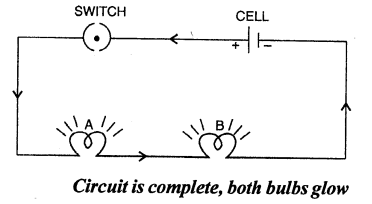
Now take out the connection of the bulb B as shown in fig. Now close the switch, you will observe that the bulb A does not glow because the circuit is now incomplete.
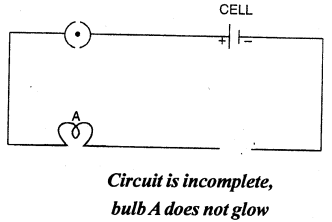
Now replace the bulb B by a fused bulb fig. and close the switch. Again you will see that the bulb A does not glow. This is because the circuit being in series, is still incomplete.
Question 27.
You are provided with a torch bulb, a cell and two plastic coated f metal wires. Draw a diagram to show a complete circuit to light the bulb.
Ans:
Take two bulbs A and B. Connect them through switches S1 and S2 in parallel as shown in fig. Close both the switches. You will see that both the bulbs glow.
Question 28.
In which of the following case the bulb will glow :
- Only one terminal of a cell is joined with a metal wire to one terminal of the bulb.
- Both terminals of the bulb are joined with two metal wires to one terminal of the cell.
- One terminal of the cell is joined to one terminal of the bulb and other terminal of the cell to the other terminal of the bulb.
Ans:
The bulb will glow in (3) case i.e.
Question 29.
Distinguish between conductors and insulators of electricity. Give two examples of each.
Ans:
Electrical Conductors: These are substances that readily permit the flow of electric current. Their atomic structure features a significant number of mobile charge carriers, typically electrons, which can move freely when subjected to an electric field. This mobility results in a low opposition, or resistance, to the passage of electricity.
Examples of Electrical Conductors:
- Copper: A highly conductive metal extensively utilized in electrical wiring and components due to its excellent ability to carry current and its relative affordability.
- Aluminum: Another effective conductor, often employed in overhead power transmission lines and certain electrical devices owing to its lighter weight compared to copper, although its conductivity is slightly lower.
Electrical Insulators: Conversely, these are materials that impede the flow of electric current. Their atomic structure lacks a substantial number of free charge carriers; the electrons are tightly bound to their atoms and are not easily mobile to carry charge. Examples of Electrical Insulators:
- Rubber: A common insulating material used as a protective covering for electrical wires and cables to prevent electrical leakage and ensure safety by resisting the flow of current.
- Glass: A non-conductive material frequently employed in electrical components and as an insulating barrier due to its inherent high resistance to the movement of electric charge.
Question 30.
Select conductors and insulators from the following :
Glass, silver, copper, wood, paper, pure water, impure water, aluminium, iron, leather, plastic, steel, human body and ebonite.
Ans:
Conductors:
- Silver: An excellent conductor of electricity.
- Copper: A very good and commonly used conductor.
- Aluminium: A good conductor, lighter than copper.
- Iron: A fair conductor of electricity.
- Steel: An alloy containing iron, which conducts electricity (though not as well as pure metals like copper or silver).
- Impure water: Water containing dissolved salts or minerals becomes a conductor because the ions in the solution can carry charge.
- Human body: Contains water and ions, making it a conductor of electricity (this is why electric shock is dangerous).
Insulators:
- Glass: A good electrical insulator.
- Wood: Generally an insulator, especially when dry. However, damp wood can conduct slightly due to the presence of moisture.
- Paper: Typically an insulator, especially when dry. Similar to wood, damp paper can conduct a small amount.
- Pure water: In its absolutely pure form, water is a poor conductor (almost an insulator) because it has very few ions.
- Leather: Generally an insulator, especially when dry.
- Plastic: A common electrical insulator.
- Ebonite: A hard rubber material known for its excellent insulating properties.
Question 31.
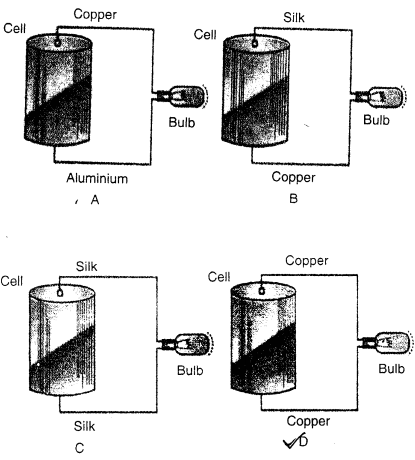
The following diagram shows four circuits A, B, C and D. Each circuit has a cell and a torch bulb. Name the circuits in which the bulb will glow ? Give a reason to your answer
Ans:
The bulb will glow in circuit (D).
This is because copper is the best conductor of electricity as compared to aluminium. Silk is a non-conductor of electricity.
Question 32.
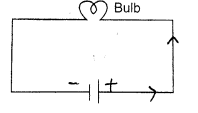
The diagram given below shows a bulb connected with a cell having terminals A and B. Mark the direction of current in the bulb.
Ans:
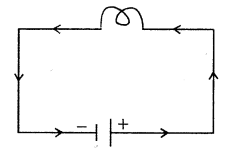
Current always flows from +ve terminal to the -ve terminal of a cell.
Question 33.
State the function of each of the following in an electric circuit and draw its symbolic representation: (1) Switch and (2) Cell.
Ans:
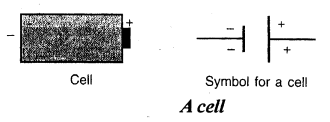
- Switch – A switch or key is used to put the circuit on and off. fig. shows the symbol of a switch or key when it is open (to put the circuit off and when it is closed (to put the circuit on)
2. Cell – A cell or a group of cells is generally used as a source of electricity. A positive (+) and a negative (-). It is represented by the two vertical lines of unequal lengths. The long vertical line represents the positive terminal and the short line represents the negative terminal as shown in fig.
Question 34.
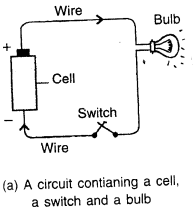
Draw a circuit diagram for a bulb connected to a cell with a switch. Mark arrow in the diagram to indicate the direction of flow of current.
Ans:
Question 35.
In which arrangement are the appliances connected in the electric circuit of our homes, Series or Parallel ? Give one reason for your answer.
Ans:
In the electric circuit of our homes, appliances are connected in parallel.
One crucial reason for this arrangement is that if one appliance fails or is switched off, the other appliances in the circuit continue to work independently. In a parallel circuit, each appliance has its own separate path for the electric current. Therefore, a break in one path (due to a fault or switching off an appliance) does not interrupt the current flow to the other appliances. This allows us to use different appliances simultaneously and ensures that the entire house doesn’t lose power if a single device malfunctions.
Question 36.
State two precautions that you must take when switching on an electric circuit.
Ans:
Verify your hands are thoroughly dry: Water’s conductive properties significantly increase the risk of electric shock. Operating switches or handling any part of an electrical circuit with damp hands can be extremely dangerous. Always ensure your hands are completely free of moisture before interacting with any electrical switches or equipment.
Avoid contact with bare wires or terminals: Never touch any exposed, uninsulated wires or metal connection points in the circuit during activation or at any other time. These components can carry live electrical current, and direct contact can lead to severe electric shock. Only qualified electricians using appropriate safety gear and insulated tools should handle such parts. Always use insulated parts of the circuit, such as switches, for operation.