
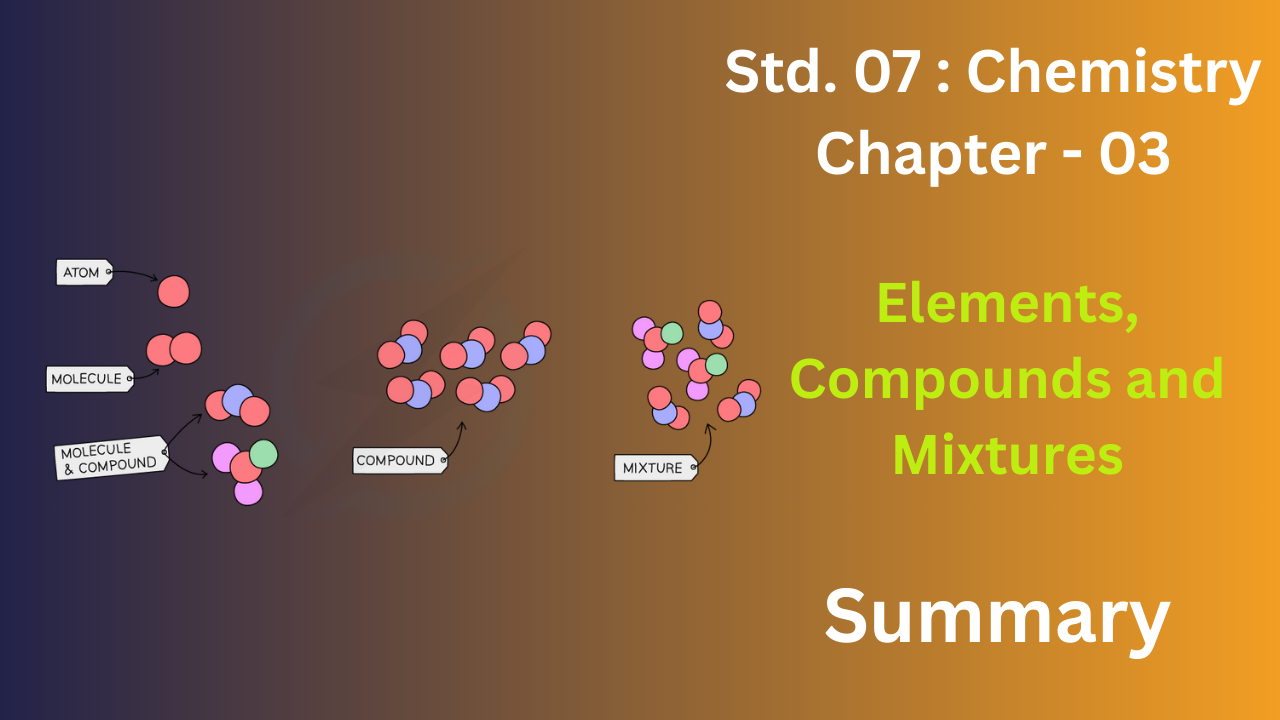
The chapter “Elements, Compounds and Mixtures” introduces basic chemistry by classifying matter. Pure substances have fixed compositions and properties, divided into elements (simplest forms, e.g., oxygen) and compounds (elements chemically combined in fixed ratios, e.g., water). Mixtures involve physically combined substances in any ratio, retaining individual properties. Homogeneous mixtures (solutions, like saltwater) are uniform, while heterogeneous mixtures (like sand and water) are not. The chapter likely covers methods to separate mixtures using physical means like evaporation, filtration, etc. It distinguishes between chemical combination in compounds and physical mixing in mixtures.
EXERCISE – I
Question 1.
Write the symbols of helium, silver, krypton, antimony, barium.
Ans:
Element Symbol
Helium He
Silver Ag
Krypton Kr
Antimony Sb
Barium Ba
Question 2.
Write the names of following elements Na, C, Kr, U, Ra, Fe, Co.
Ans:
Symbol Element
Na Sodium
C Carbon
Kr Krypton
U Uranium
Ra Radium
Fe Iron
Co Cobalt
Question 3.
Define :
- Elements : Elements are the simplest pure substances, made of only one type of atom, and cannot be broken down further by ordinary chemical means. Each has unique properties and a symbol (e.g., O for oxygen).
- Compounds : Compounds are pure substances formed when two or more different elements chemically combine in a fixed ratio. They are represented by chemical formulas (e.g., H₂O).
Question 4.
Name the main metal present in the following :
Ans:
(a) Haemoglobin Iron
(b) Chalk Calcium
(c) Chlorophyll Magnesium
(d) Chocolate wrappers Aluminium
Question 5.
Give four examples of non-metallic elements.
Ans:
- Oxygen (O): A gaseous element vital for respiratory processes in living organisms and a key component in combustion reactions.
- Carbon (C): A solid element existing in various allotropic forms, such as graphite and diamond, and serving as the foundational element of organic chemistry.
- Nitrogen (N): A gaseous element constituting a significant portion of the Earth’s atmosphere and crucial for plant development.
- Sulfur (S): A solid element, typically yellow in appearance, utilized in numerous industrial applications.
Question 6.
What do you understand by :
Ans:
- Metalloids : Metalloids are those substances which have some properties of metals and some of non-metals e.g. boron, silicon.
- Noble gases : Noble gases are those which do not react chemically with other elements or compounds e.g. helium, neon, etc.
Question 7.
Select elements and compounds from the following list: Iron, plaster of paris, chalk, common salt, copper, aluminium, calcium oxide, cane sugar, carbon, silica, sodium sulphate, uranium, potassium carbonate, silver, carbon dioxide.
Ans:
Elements:
- Iron (Fe)
- Copper (Cu)
- Aluminium (Al)
- Carbon (C)
- Uranium (U)
- Silver (Ag)
Compounds:
- Plaster of Paris (CaSO₄⋅½H₂O) (Calcium sulfate hemihydrate)
- Chalk (CaCO₃) (Calcium carbonate)
- Common salt (NaCl) (Sodium chloride)
- Calcium oxide (CaO)
- Cane sugar (C₁₂H₂₂O₁₁) (Sucrose)
- Silica (SiO₂) (Silicon dioxide)
- Sodium sulphate (Na₂SO₄)
- Potassium carbonate (K₂CO₃)
- Carbon dioxide (CO₂)
EXERCISE – II
Question 1.
State four difference between compounds and mixtures.
Ans:
| Compound | Mixture |
| 1. A compound is a pure substance. | 1. A mixture is an impure substance. |
| 2. Compounds are always homogeneous. | 2. Mixtures may be homogeneous or heterogeneous. |
| 3. A compound has a fixed composition, i.e., it is formed when two or more pure substances chemically combine in a definite ratio by mass. | 3. A mixture has no fixed composition, i.e., it is formed by mixing two or more substances in any ratio without any chemical reaction. |
| 4. Formation of a compound involves change in energy. | 4. Formation of a mixture does not involve any change in energy. |
| 5. Compounds have specific set of properties. | 5. Mixtures do not have any specific set of properties. |
| 6. Components of compounds can be separated only by complex chemical processes. | 6. Components of mixtures can be separated by simple physical methods. |
Question 2.
What are the characteristic properties of a pure substance? Why do we need them?
Ans:
These properties help us identify substances, determine their purity, ensure quality in industries, conduct scientific research, and develop separation techniques.
Pure substances are defined by their unchanging and specific properties. Their composition is always the same, and they exhibit consistent characteristics throughout. Key identifying features include sharp melting and boiling points, as well as a fixed density. These reliable properties are essential tools in various fields. Scientists use them to identify unknown materials and classify them. In industries, these properties serve as benchmarks for quality control, ensuring that products meet specific standards of purity. Furthermore, in research, accurate knowledge of these properties is fundamental for conducting experiments and understanding chemical behaviors. Differences in these characteristics are also exploited in techniques designed to separate and purify substances, making them invaluable for both scientific inquiry and practical applications in our daily lives.
Question 3.
Give two examples for each of the following :
(a) Solid + Solid mixture
(b) Solid + Liquid mixture
(c) Liquid + Liquid mixture
Ans:
(a) Solid + Solid mixture:
- A blend of iron filings and sulfur powder: When finely divided iron particles are combined with sulfur powder, they exist as separate solid entities within the mixture.
- Granite rock: This natural stone is a heterogeneous mixture comprising various solid minerals such as quartz, feldspar, and mica, each retaining its solid form within the rock matrix.
(b) Solid + Liquid mixture:
- Sugar dissolved in water (sugar solution): Solid sucrose crystals disperse and become uniformly distributed within the liquid water, forming a solution where the solid phase is no longer visibly distinct.
- Muddy water: This consists of solid soil particles suspended within liquid water, where the solid components remain undissolved and are visibly separate from the liquid.
(c) Liquid + Liquid mixture:
- Vinegar (acetic acid in water): This is a homogeneous mixture where liquid acetic acid is completely miscible with liquid water, resulting in a uniform liquid phase.
- A mixture of kerosene and gasoline: These two liquid hydrocarbons blend together to form a single liquid phase where the individual components are uniformly distributed.
Question 4.
Define :
- Evaporation : Evaporation is when a liquid turns into a gas or vapor, usually at its surface. It happens at any temperature (faster when hotter) as energetic molecules escape, causing a cooling effect.
- Filtration : The process of separating solid particles from liquid by allowing it to pass through a filter paper is called filtration.
- Sublimation : Sublimation is when a solid directly changes into a gas without becoming a liquid first. It needs energy (usually heat).
- Distillation : Distillation is the method of getting a pure liquid from a solution by evaporating and then condensing the vapours.
- Miscible liquids : Homogeneous liquid-liquid mixtures are called miscible liquids.
- Immiscible liquids : Heterogeneous liquid-liquid mixtures are called immiscible liquids.
Question 5.
Name the process by which the components of following mixtures can be separated.
- Iron and sulphur
- Ammonium chloride and sand
- Common salt from sea water
- Chaff and grain
- Water and mustard oil
- Sugar and water
- Cream from milk
Ans:
- Iron & Sulfur: Magnet
- Ammonium Chloride & Sand: Heating (sublimation)
- Salt & Seawater: Evaporation, then crystallization
- Chaff & Grain: Airflow (winnowing)
- Water & Mustard Oil: Separating funnel (or careful pouring)
- Sugar & Water: Evaporation, then crystallization
- Cream & Milk: Spinning (centrifugation)
Question 6.
How will you separate a mixture of common salt, chalk powder and powdered camphor? Explain.
Ans:
Initially, the mixture undergoes sublimation. Upon gentle heating, camphor transitions directly into its gaseous state, bypassing the liquid phase, while common salt and chalk powder remain solid. The camphor vapor can then be collected by condensing it on a cooler surface, effectively separating it from the other two components.
Subsequently, the remaining solid residue, consisting of common salt and chalk powder, is subjected to dissolution. Water is added to this residue, and the mixture is stirred. Common salt, being soluble in water, dissolves to form a salt solution. In contrast, chalk powder is insoluble in water and remains as a solid suspension within the liquid.
The next step involves filtration. The salt and chalk suspension is poured through a filter paper. The insoluble chalk powder particles are too large to pass through the pores of the filter paper and are thus retained as a solid residue. The salt solution, now free of chalk powder, passes through the filter paper and is collected as the filtrate.
Heating the solution causes the water to vaporize, leaving behind the solid common salt. If a purer form of salt is desired, the process can be followed by crystallization, where the salt is allowed to form crystals from a saturated solution.
Thus, through a sequential application of sublimation, dissolution, filtration, and evaporation (potentially followed by crystallization), the three components of the mixture – camphor, chalk powder, and common salt – can be effectively separated based on their distinct physical and chemical properties.
OBJECTIVE TYPE QUESTIONS
Question 1.
Fill in the blanks:
- ————-are made up of same kind of atoms.
Ans : Elements
- ———–and ——–are pure substances.
Ans : Elements & compounds
- In a ————the substances are not combined chemically.
Ans : mixture
- Clay is separated from water by the method called———-.
Ans : loading and decantation
- ————is a process to obtain a very pure form of a solid dissolved in a liquid.
Ans : Crystallisation
- Camphor and ammonium chloride can———-.
Ans : sublimate
Question 2.
Give one word answers for the following :
Ans:
- The solid particles which remain on the filter paper after the filtration – residue.
- The liquid which evaporates and then condenses during the process of distillation – distillate.
- The process of transferring the clean liquid after the solid settles at the bottom of the container – decantation.
- The process by which two miscible liquids are separated – fractional distillation.
MULTIPLE CHOICE QUESTIONS
Select the correct alterative from the choices given for the following statements:
Question 1.
A pure liquid is obtained from a solution by :
Ans:
- evaporation
- distillation
- Alteration
- crystallisation
Question 2.
Components of crude petroleum can be separated by :
Ans:
- distillation
- evaporation
- filtration
- fractional distillation
Question 3.
Example of a homogeneous mixture is :
Ans:
- tap water
- distilled water
- sand and water
- water and oil
Question 4.
In chromatography the filter paper is :
Ans:
- stationary phase
- mobile phase
- mixture
- none of the above
Question 5.
A set of mixture is :
Ans:
- ink, honey, icecream, milk
- tapwater, gold, common salt, alloy
- milk, brass, silver, honey
- butter, petroleum, tapwater, iron