The chapter on HCF (Highest Common Factor) and LCM (Lowest Common Multiple) is a cornerstone of Class 6 Mathematics. It teaches you how to break numbers down into their smallest building blocks and how to find common ground between different numbers.
1. Prime and Composite Numbers
Before diving into HCF and LCM, you must understand the types of numbers:
- Prime Numbers: Numbers that have exactly two factors: 1 and the number itself (e.g., 2, 3, 5, 7, 11).
- Composite Numbers: Numbers that have more than two factors (e.g., 4, 6, 8, 9, 10).
- Co-prime Numbers: Two numbers are co-prime if their only common factor is 1 (e.g., 8 and 9).
2. Prime Factorization
This is the process of expressing a composite number as a product of its prime factors.
- Factor Tree Method: Breaking a number down into “branches” until only prime numbers remain.
- Division Method: Continually dividing the number by the smallest possible prime numbers.
3. Highest Common Factor (HCF)
Also known as the Greatest Common Divisor (GCD). It is the largest number that divides two or more numbers exactly.
Methods to find HCF:
- Listing Factors: List all factors of each number and pick the largest one they share.
- Prime Factorization: Multiply the common prime factors with the lowest powers.
- Continued Division Method: Useful for large numbers. You divide the larger number by the smaller one, then make the remainder the new divisor and the previous divisor the new dividend. Repeat until the remainder is 0.
4. Lowest Common Multiple (LCM)
The LCM of two or more numbers is the smallest number (other than zero) that is a multiple of all the numbers.
Methods to find LCM:
- Listing Multiples: List multiples of each number until you find the first common one.
- Prime Factorization: Multiply all prime factors involved, using the highest power of each factor.
- Common Division Method: Divide all numbers together by prime factors until the last row consists only of 1s.
5. The Golden Relationship
There is a very important formula used in many ICSE exam questions:
HCF * LCM = Product of the two numbers
(HCF * LCM = A * B)
6. Real-World Applications
- Use HCF when: You need to split things into smaller sections, arrange items into equal rows, or find the maximum capacity (e.g., “Find the maximum length of a tape that can measure two distances exactly”).
- Use LCM when: You need to find when events happen at the same time again, or find a minimum quantity (e.g., “When will three bells toll together again?”).
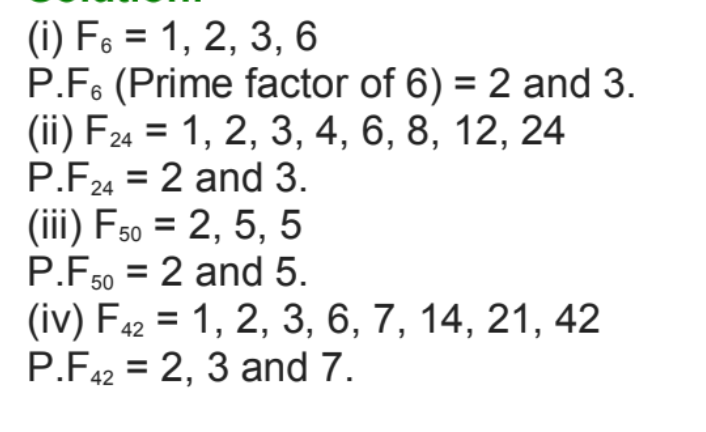
EXERCISE 8(A)
Question 1.
Write all the factors of :
(i) 15
(ii) 55
(iii) 48
(iv) 36
(v) 84
Solution :
(i) 15
- 1 * 15 = 15
- 3 * 5 = 15
- Factors of 15: 1, 3, 5, 15.
(ii) 55
- 1 * 55 = 55
- 5 * 11 = 55
- Factors of 55: 1, 5, 11, 55.
(iii) 48
- 1 * 48 = 48
- 2 * 24 = 48
- 3 * 16 = 48
- 4 * 12 = 48
- 6 * 8 = 48
- Factors of 48: 1, 2, 3, 4, 6, 8, 12, 16, 24, 48.
(iv) 36
- 1 * 36 = 36
- 2 * 18 = 36
- 3 * 12 = 36
- 4 * 9 = 36
- 6 * 6 = 36 (Since 6 is repeated, we only list it once).
- Factors of 36: 1, 2, 3, 4, 6, 9, 12, 18, 36.
(v) 84
- 1 * 84 = 84
- 2 * 42 = 84
- 3 * 28 = 84
- 4 * 21 = 84
- 6 * 14 = 84
- 7 * 12 = 84
- Factors of 84: 1, 2, 3, 4, 6, 7, 12, 14, 21, 28, 42, 84.
Question 2.
Write all prime numbers :
(i) less than 25
(ii) between 15 and 35
(iii) between 8 and 76
Solution :
(i) Less than 25
Checking all numbers from 2 up to 24:
- The List: 2, 3, 5, 7, 11, 13, 17, 19, 23
- Total Count: 9
(ii) Between 15 and 35
Checking numbers starting after 15 and ending before 35:
- The List: 17, 19, 23, 29, 31
- Total Count: 5
(iii) Between 8 and 76
Checking numbers starting after 8 and ending before 76:
- 8 to 20: 11, 13, 17, 19
- 21 to 40: 23, 29, 31, 37
- 41 to 60: 41, 43, 47, 53, 59
- 61 to 76: 61, 67, 71, 73
- The List: 11, 13, 17, 19, 23, 29, 31, 37, 41, 43, 47, 53, 59, 61, 67, 71, 73
- Total Count: 17
Question 3.
Write the prime-numbers from :
(i) 5 to 45
(ii) 2 to 32
(iii) 8 to 48
(iv) 9 to 59
Solution :
(i) 5 to 45
We check every odd number from 5 to 45 (since no even number except 2 is prime).
- The List: 5, 7, 11, 13, 17, 19, 23, 29, 31, 37, 41, 43
- Total Count: 12
(ii) 2 to 32
Starting from 2 (the only even prime) and checking up to 31.
- The List: 2, 3, 5, 7, 11, 13, 17, 19, 23, 29, 31
- Total Count: 11
(iii) 8 to 48
Checking numbers after 8 and ending before 48.
- The List: 11, 13, 17, 19, 23, 29, 31, 37, 41, 43, 47
- Total Count: 11
(iv) 9 to 59
Checking numbers after 9 and ending at 59 (59 itself is prime).
- The List: 11, 13, 17, 19, 23, 29, 31, 37, 41, 43, 47, 53, 59
- Total Count: 13
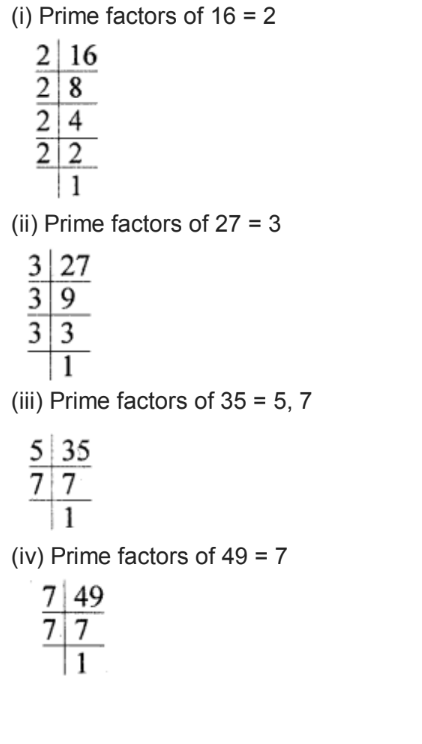
Question 4.
Write the prime factors of:
(i) 16
(ii) 27
(iii) 35
(iv) 49
Solution :
Question 5.
Solution :
EXERCISE 8(B)
Question 1.
Using the common factor method, find the H.C.F. of :
(i) 16 and 35
(ii) 25 and 20
(iii) 27 and 75
(iv) 8, 12 and 18
(v) 24, 36, 45 and 60
Solution :
(i) 16 and 35
- Factors of 16: 1, 2, 4, 8, 16
- Factors of 35: 1, 5, 7, 35
- Common Factors: 1
- H.C.F. = 1
- Note: Since their H.C.F. is 1, these numbers are called Co-prime numbers.
(ii) 25 and 20
- Factors of 25: 1, 5, 25
- Factors of 20: 1, 2, 4, 5, 10, 20
- Common Factors: 1, 5
- H.C.F. = 5
(iii) 27 and 75
- Factors of 27: 1, 3, 9, 27
- Factors of 75: 1, 3, 5, 15, 25, 75
- Common Factors: 1, 3
- H.C.F. = 3
(iv) 8, 12 and 18
- Factors of 8: 1, 2, 4, 8
- Factors of 12: 1, 2, 3, 4, 6, 12
- Factors of 18: 1, 2, 3, 6, 9, 18
- Common Factors: 1, 2
- H.C.F. = 2
(v) 24, 36, 45 and 60
- Factors of 24: 1, 2, 3, 4, 6, 8, 12, 24
- Factors of 36: 1, 2, 3, 4, 6, 9, 12, 18, 36
- Factors of 45: 1, 3, 5, 9, 15, 45
- Factors of 60: 1, 2, 3, 4, 5, 6, 10, 12, 15, 20, 30, 60
- Common Factors: 1, 3
- H.C.F. = 3
Question 2.
Using the prime factor method, find the H.C.F. of:
(i) 5 and 8
(ii) 24 and 49
(iii) 40, 60 and 80
(iv) 48, 84 and 88
(v) 12, 16 and 28
Solution :
(i) 5 and 8
- Prime factors of 5: 5
- Prime factors of 8: 2 * 2 * 2
- Common Factors: There are no common prime factors.
- H.C.F. = 1
- Note: Numbers with an H.C.F. of 1 are called Co-prime numbers.
(ii) 24 and 49
- Prime factors of 24: 2 * 2 * 2 * 3
- Prime factors of 49: 7 * 7
- Common Factors: None.
- H.C.F. = 1
(iii) 40, 60 and 80
- Prime factors of 40: 2 * 2 * 2 * 5
- Prime factors of 60: 2 * 2 * 3 * 5
- Prime factors of 80: 2 * 2 * 2 * 2 * 5
- Common Factors: Two 2s and one 5 (2 * 2 * 5).
- H.C.F. = 20
(iv) 48, 84 and 88
- Prime factors of 48: 2 * 2 * 2 * 2 * 3
- Prime factors of 84: 2 * 2 * 3 * 7
- Prime factors of 88: 2 * 2 * 2 * 11
- Common Factors: Two 2s (2 * 2).
- H.C.F. = 4
(v) 12, 16 and 28
- Prime factors of 12: 2 * 2 * 3
- Prime factors of 16: 2 * 2 * 2 * 2
- Prime factors of 28: 2 * 2 * 7
- Common Factors: Two 2s (2 * 2).
- H.C.F. = 4
Question 3.
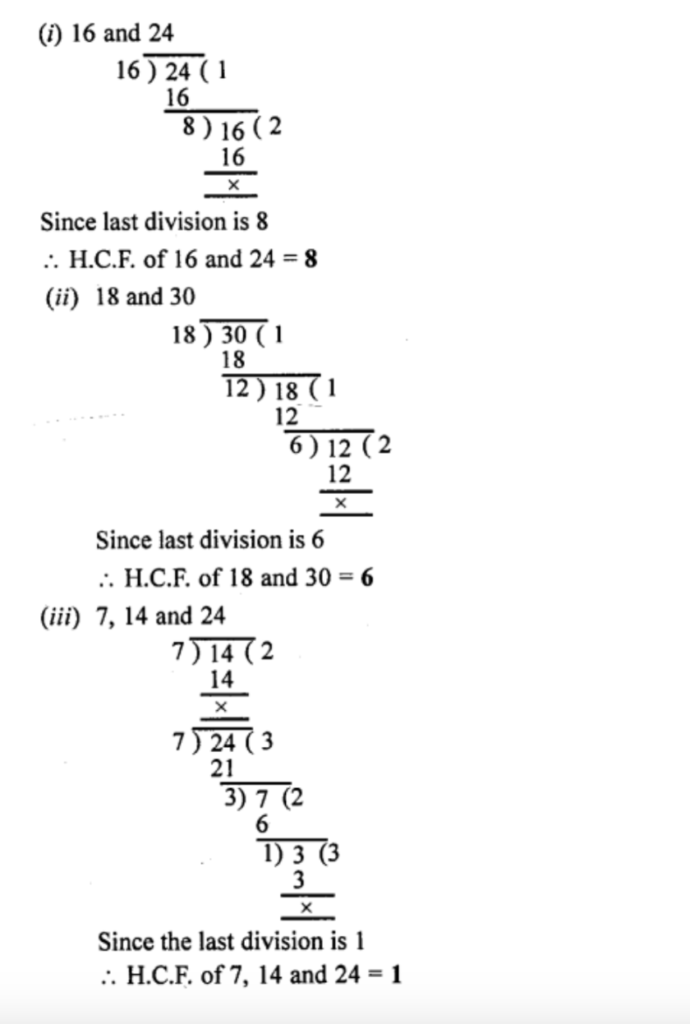
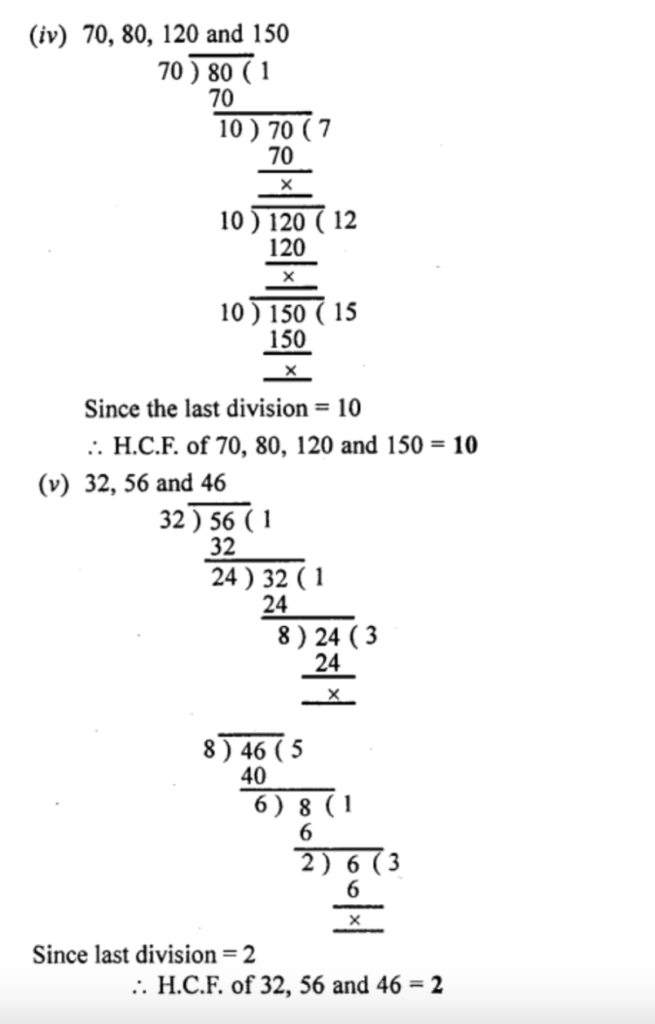
Using the division method, find the H.C.F. of the following :
(i) 16 and 24
(ii) 18 and 30
(iii) 7, 14 and 24
(iv) 70,80,120 and 150
(v) 32, 56 and 46
Solution :
Question 4.
Use a method of your own choice to find the H.C.F. of :
(i) 45, 75 and 135
(ii) 48, 36 and 96
(iii) 66, 33 and 132
(iv) 24, 36, 60 and 132
(v) 30, 60, 90 and 105
Solution :
(i) 45, 75 and 135
- Step 1: All numbers end in 5, so divide by 5: 45, 75, 135 – 9, 15, 27
- Step 2: All are multiples of 3, so divide by 3: 9, 15, 27 – 3, 5, 9
- Step 3: No more common factors for 3, 5, and 9.
- H.C.F. = 5 \times 3 = 15
(ii) 48, 36 and 96
- Step 1: All are even, divide by 2: 48, 36, 96 – 24, 18, 48
- Step 2: All are even, divide by 2: 24, 18, 48 – 12, 9, 24
- Step 3: All are multiples of 3, divide by 3: 12, 9, 24 – 4, 3, 8
- Step 4: No more common factors.
- H.C.F. = 2 * 2 * 3 = 12
(iii) 66, 33 and 132
- Step 1: All are multiples of 3, divide by 3: 66, 33, 132 – 22, 11, 44
- Step 2: All are multiples of 11, divide by 11: 22, 11, 44 – 2, 1, 4
- Step 3: No more common factors.
- H.C.F. = 3 * 11 = 33
(iv) 24, 36, 60 and 132
- Step 1: All are even, divide by 2: 24, 36, 60, 132 – 12, 18, 30, 66
- Step 2: All are even, divide by 2: 12, 18, 30, 66 – 6, 9, 15, 33
- Step 3: All are multiples of 3, divide by 3: 6, 9, 15, 33 – 2, 3, 5, 11
- Step 4: 2, 3, 5, 11 are all prime; no more common factors.
- H.C.F. = 2 * 2 * 3 = 12
(v) 30, 60, 90 and 105
- Step 1: All end in 0 or 5, divide by 5: 30, 60, 90, 105 – 6, 12, 18, 21
- Step 2: All are multiples of 3, divide by 3: 6, 12, 18, 21 – 2, 4, 6, 7
- Step 3: No more common factors (due to 7).
- H.C.F. = 5 * 3 = 15
Question 5.
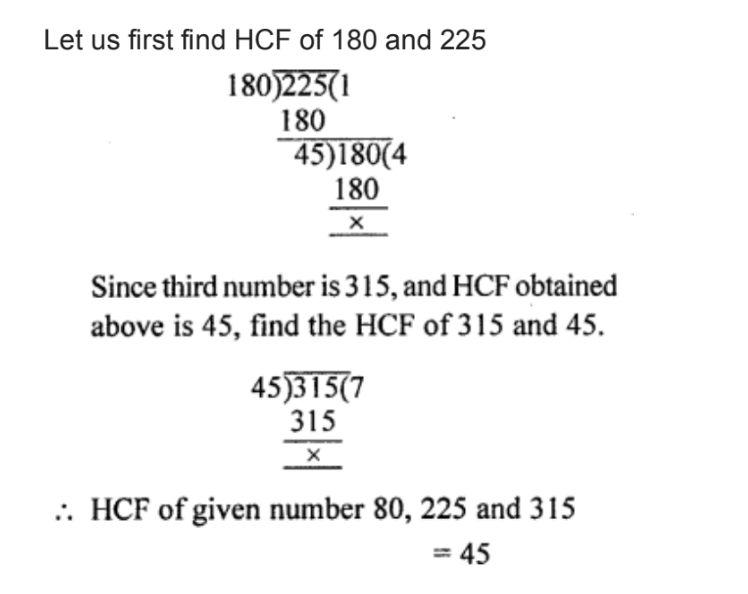
Find the greatest number that divides each of 180, 225 and 315 completely.
Solution :
The greatest number that divides 180, 225 and 315 will be HCF of 180, 225, 315
Question 6.
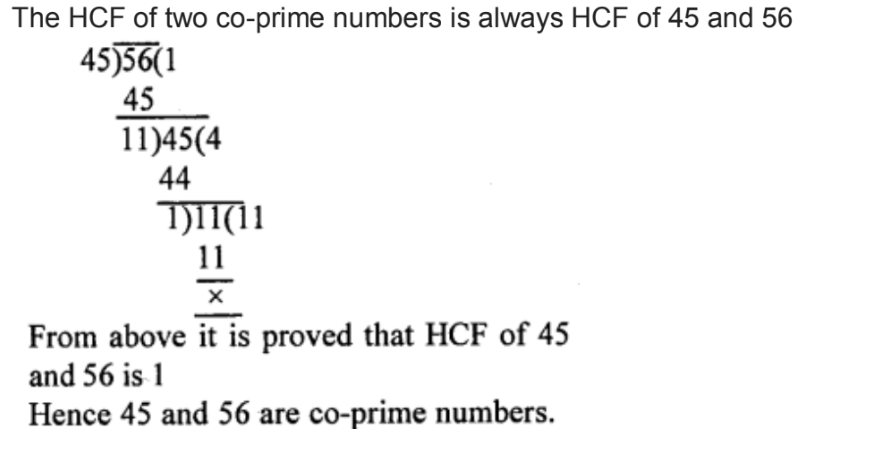
Show that 45 and 56 are co-prime numbers.
Solution :
Question 7.
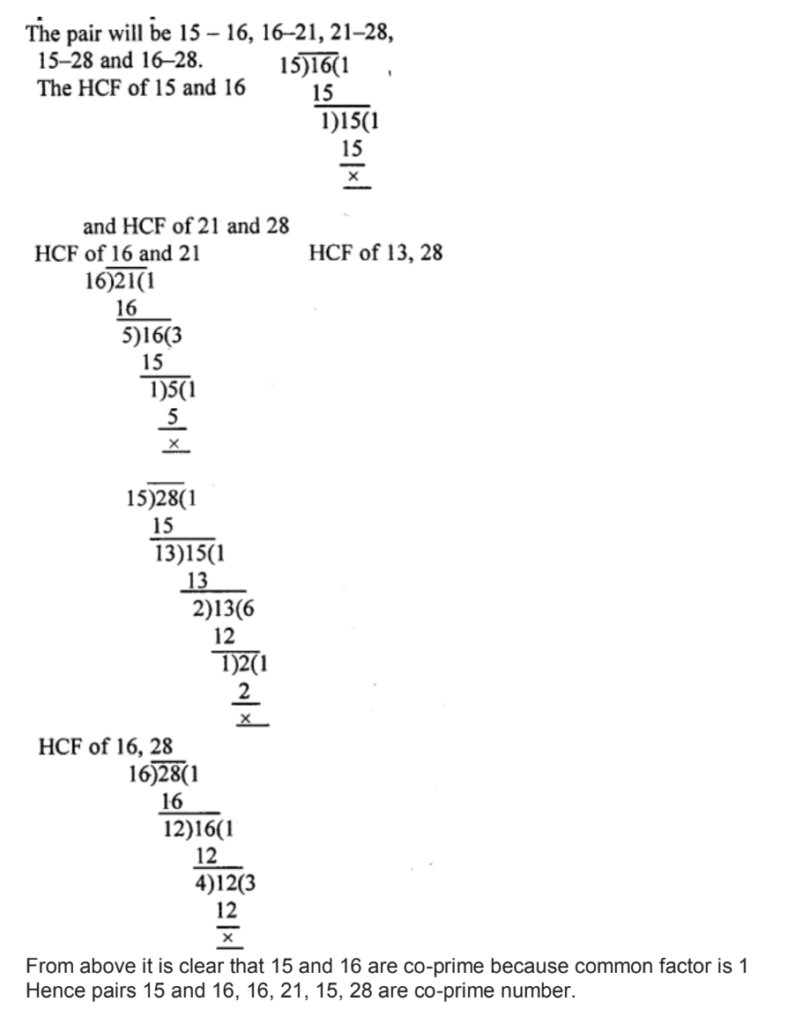
Out of 15, 16, 21 and 28, find out all the pairs of co-prime numbers.
Solution :
Question 8.
Find the greatest no. that will divide 93, 111 and 129, leaving remainder 3 in each case.
Solution :
Step 1: Subtract the Remainder
Since the remainder is 3 in each case, we subtract 3 from all three numbers:
- 93 – 3 = 90
- 111 – 3 = 108
- 129 – 3 = 126
Now, we need to find the H.C.F. of 90, 108, and 126.
Step 2: Find the H.C.F. (Common Division Method)
We divide 90, 108, and 126 by their common prime factors:
- Divide by 2 (all are even):90, 108, 126 – 45, 54, 63
- Divide by 3 (sum of digits is divisible by 3):45, 54, 63 – 15, 18, 21
- Divide by 3 again:15, 18, 21 – 5, 6, 7
Step 3: Calculate the Result
Multiply the divisors used:
H.C.F. = 2 * 3 * 3
H.C.F. = 18
The greatest number that will divide 93, 111, and 129 leaving remainder 3 in each case is 18.
EXERCISE 8(C)
Question 1.
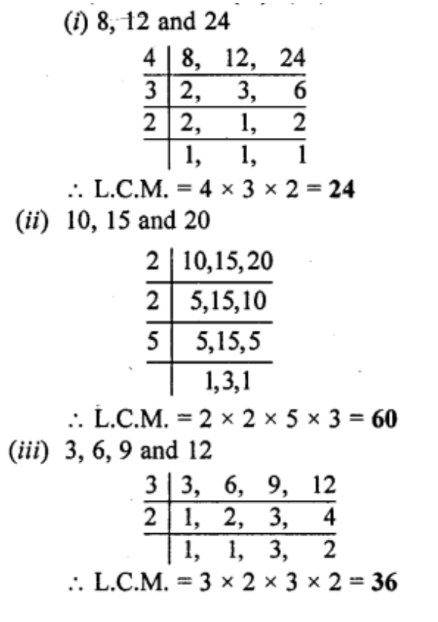
Using the common multiple method, find the L.C.M. of the following :
(i) 8, 12 and 24
(ii) 10, 15 and 20
(iii) 3, 6, 9 and 12
Solution :
Question 2.
Find the L.C.M. of each the following groups of numbers, using
(i) the prime factor method and
(ii) the common division method :
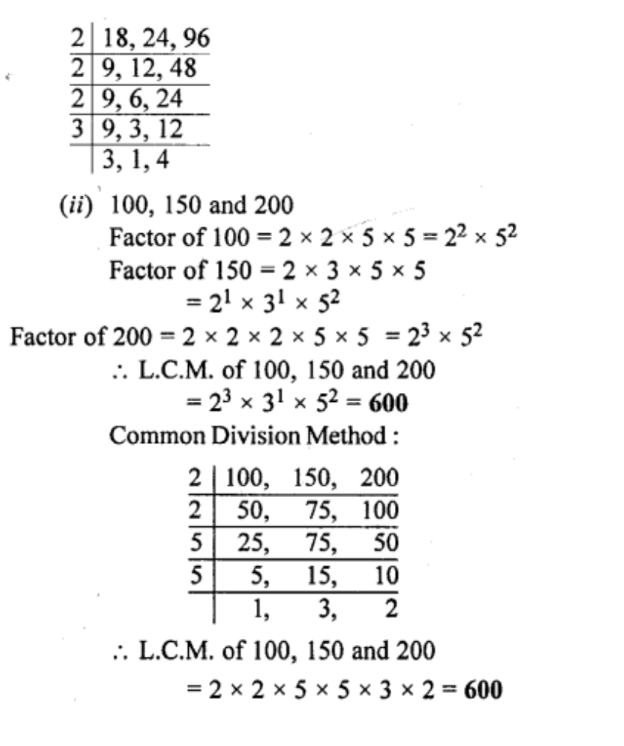
(i) 18, 24 and 96
(ii) 100, 150 and 200
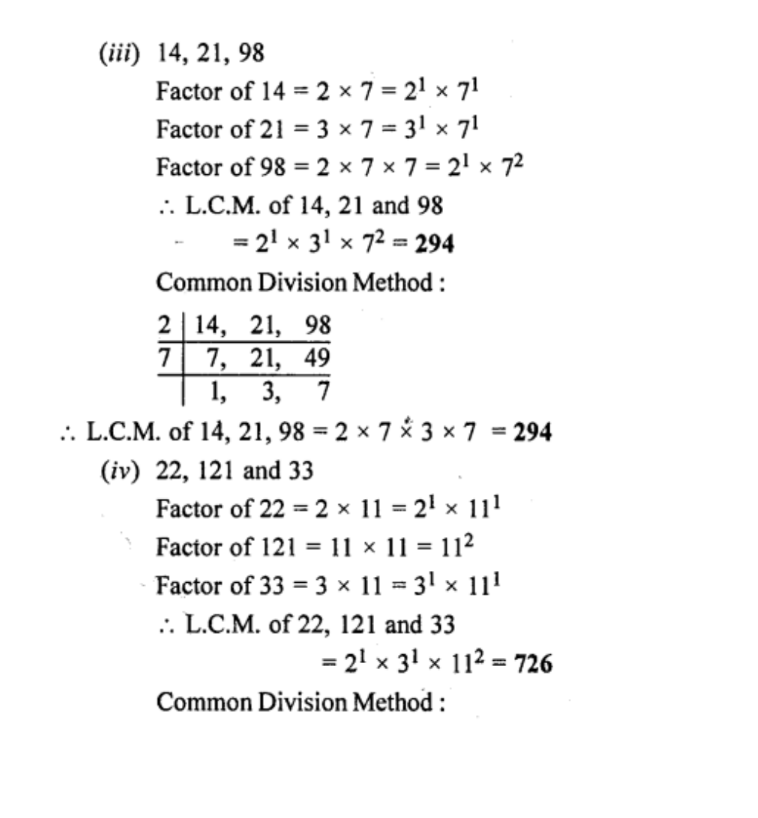
(iii) 14, 21 and 98
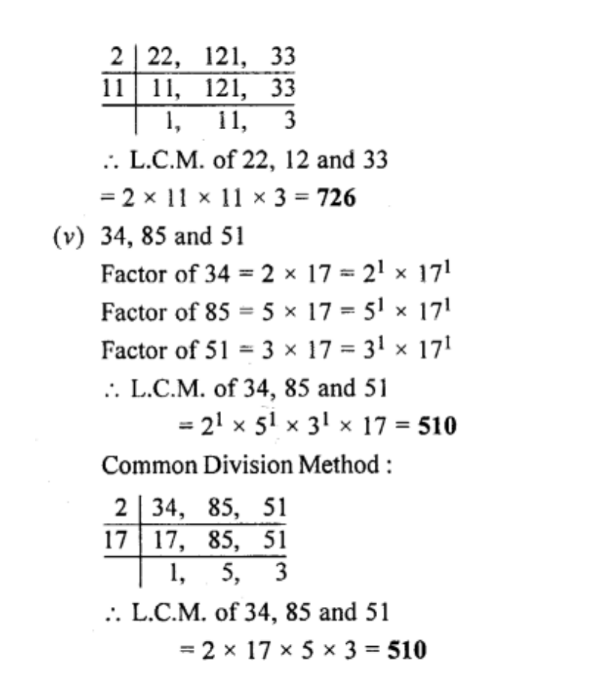
(iv) 22, 121 and 33
(v) 34, 85 and 51
Solution :
(i) L.C.M. of 18, 24 and 96
(i) By prime factors
Prime factors of 18 = 2 x 3 x 3
Prime factors of 24 = 2 x 2 x 2 x 3
Prime factors of 96 = 2 x 2 x 2 x 2 x 2 x 3
L.C.M. = 2 x 2 x 2 x 2 x 2 x 3 x 3 = 288
By common division method
L.C.M. of 18, 24 and 96 = 2 x 2 x 2 x 3 x 3 x 4 = 288
Question 3.
The H.C.F. and the L.C.M. of two numbers are 50 and 300 respectively. If one of the
numbers is 150, find the other one.
Solution :
For any two numbers, the product of the numbers is always equal to the product of their H.C.F. and L.C.M.
First Number * Second Number = H.C.F. * L.C.M.
1. Identify the given values:
- H.C.F. = 50
- L.C.M. = 300
- One number (A) = 150
- Other number (B) = ?
2. Apply the formula:
150 * B = 50 * 300
3. Rearrange to find B:
To find the second number, we divide the product of the H.C.F. and L.C.M. by the known number.
B = {50 * 300}/{150}
4. Simplify the calculation:
- Notice that 300 is exactly double of 150 (300 / 150 = 2).
- So, B = 50 * 2
- B = 100
The other number is 100.
Question 4.
The product of two numbers is 432 and their L.C.M. is 72. Find their H.C.F.
Solution :

Question 5.
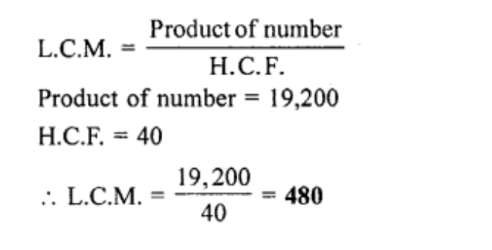
The product of two numbers is 19,200 and their H.C.F. is 40. Find their L.C.M.
Solution :
Question 6.
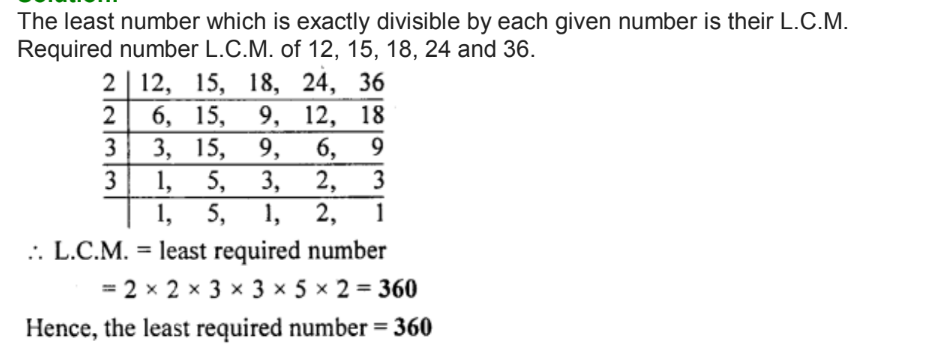
Find the smallest number which, when divided by 12, 15, 18, 24 and 36 leaves no
remainder
Solution :
Question 7.
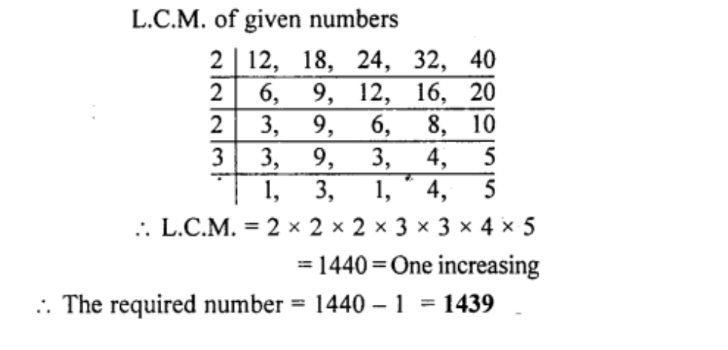
Find the smallest number which, when increased by one is exactly divisible by 12, 18,
24, 32 and 40
Solution :
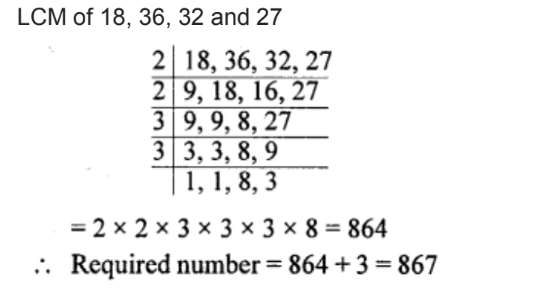
Question 8.
Find the smallest number which, on being decreased by 3, is completely divisible by 18,
36, 32 and 27.