

Health is feeling good physically and mentally, and getting along with others – it’s overall well-being. Keeping clean (hygiene) is key to prevent diseases. This includes personal habits like bathing, handwashing, brushing teeth, and wearing clean clothes, as well as keeping your home tidy and food safe.
Tiny germs can cause diseases, spreading through air, water, or contact. We can prevent this by being clean, getting vaccinated, and having good sanitation. Eating a balanced diet with all the right nutrients, exercising regularly, and getting enough rest are also super important for staying healthy and taking care of yourself!
Review Questions
Multiple Choice questions:
1. Put a tick mark (✓) against the correct alternative in the following statements:
(a) Malaria is caused by:
(i) Bacteria
(ii) Protozoan
(iii) Fungi
(iv) Virus
(b) Deficiency of calcium causes
(i) Poor growth of teeth and gums
(ii) Goitre
(iii) Anaemia
(iv) Polio
(c) Hay fever and asthma are
(i) Deficiency diseases
(ii) Genetic diseases
(iii) Organic diseases
(iv) Allergy diseases
PQ. Cataract is a disease of:
(i) Ears
(ii) Nose
(iii) Eyes
(iv) Throat
(d) Infectious diseases can be prevented by:
(i) Medicines
(ii) Proper food
(iii) Immunisation
(iv) Exercise
(e) Which one of the following is a genetic disease?
(i) Scurvy
(ii) Leukemia
(lii) Goitre
(iv) Haemophilia
(f) Which one of the following is a degenerative disease?
(i) Thalassemia
(ii) Ben-ben
(iii) Cataract
(iv) Diabetes
(g) Pellagra is one disease caused by the deficiency of:
(i) Vit. B3
(ii) Vit. B1
(iii) Vit. C
(iv) Vit. D
(h) Deficiency of Iodine in one’s food can cause:
(i) Ben-ben
(ii) Goitre
(iii) Scurvy
(iv) Pellagra
(i) Which one of the following mineral deficiency diseases can be cured by eating a diet which includes green leafy vegetables, bananas, cereals, egg-yolk?
(i) Goitre
(ii) Anaemia
(iii) Brittle bones
(iv) Pain in muscle contraction
(j) Which one of the following vitamin deficiency diseases can be cured by eating a diet which includes carrot, yellow fruits, vegetables, butter, milk, fish ?
(i) Beri-beri
(ii) Dermatitis
(iii) Night blindness
(iv) Scurvy
(k) Which one of the following is a communicable disease?
(i) Measles
(ii) Cancer
(iii) Heart stroke
(iv) Allergy
Short Answer Questions:
Question 1(a).
What is a non-communicable disease ?
Answer: A non-communicable disease is simply an illness you can’t catch from someone else.
Question 1(b).
What is a deficiency disease
Answer:Imagine your body is like a complex machine that needs different ingredients to run smoothly. A deficiency disease happens when your body doesn’t get enough of one of those crucial ingredients – like a specific vitamin or mineral – for a while. Without enough of that essential nutrient, certain parts of your body can’t function correctly, leading to illness. It’s like the machine is missing a key part and starts to break down.
Question 1(c).
What are communicable diseases ? How can they be avoided ?
Answer:To dodge easily spread germs, regularly wash your hands, cover coughs and sneezes, avoid those who are sick, get your shots, and use clean water for hygiene.
Question 1(d).
Biting nails should be strictly avoided. Give a reason.
Answer:Nail-biting is a triple whammy! You’re inviting germs in, hurting your nail beds which can get infected, and even messing with your teeth. 1 Not a good habit for sure
Question 1(e).
Regular exercise and proper rest is a must. Give a reason.
Answer:Staying active makes your heart stronger, boosts your circulation, and helps you keep a healthy weight, lowering your chances of getting sick. Getting enough rest lets your body fix and rebuild itself, keeps your immune system strong, and sharpens your mind, leading to better overall health. Both exercise and rest are key for a healthy and well-rounded life.
.
Question 1(f).
Children eating more fast food tend to suffer from obesity (overweight). Comment.
Answer:Fast food is often packed with things that contribute to weight gain. It’s usually high in calories, unhealthy fats, lots of salt, and added sugars. At the same time, it tends to be low in the good stuff our bodies need, like fiber, vitamins, and minerals.
Because these foods are so energy-dense (lots of calories in a small amount), it’s easy to eat more calories than your body burns. Over time, these extra calories get stored as fat, leading to weight gain and potentially obesity.
Plus, fast food often isn’t very filling, so kids might feel hungry again sooner and end up eating more overall throughout the day. This pattern of high-calorie, low-nutrient food intake can really increase the risk of becoming overweight.
Question 1(g).
How can we control the spread of diseases by mosquitoes and houseflies ?
AnswerWinning the fight against mosquitoes and houseflies needs a smart, consistent approach. For mosquitoes, think beyond just standing water – those sneaky breeders hide in tarps, plant pots, furniture covers, and blocked gutters. Getting the community involved by reporting public breeding sites is a game-changer. Natural helpers like mosquito fish in ponds or Bti in smaller water can make a big difference. When it comes to bites, choose your repellent wisely based on how long you need protection and the concentration, apply it to both skin and clothes, and seal up any way they can sneak into your house. Citronella is okay for a little outdoor help, but not a long-term solution.
Houseflies are all about cleanliness. A quick rinse of food containers before tossing them, good compost management, and disinfected bins are key. Don’t forget those hidden crumbs on counters and under appliances, and keep fruit covered or in the fridge. Indoor fly traps can offer some relief, but regular cleaning is the real hero. Stick with these habits, and you’ll definitely see fewer of these pesky visitors!
2. Name the following:
(a) A bacterial disease caused due to contaminated water
Ans. A bacterial disease caused due to contaminated water Cholera.
(b) A disease caused due to Plasmodium
Ans. A disease caused due to Plasmodium Malaria.
(c) A disease caused due to the bite of female Culex mosquito
Ans. A disease caused due to the bite of female Culex mosquito Elephantiasis.
(d) A viral disease spread by the bite of a dog
Ans. A viral disease spread by the bite of a dog Rabies/ Hydrophobia
(e) Two diseases caused due to deficiency of protein in the diet of a child.
Ans. Kwashiorkor and marasmus.
(f) Any three water-borne diseases.
Ans. Amoebiasis, Cholera, Hepatitis A.
(g) A viral disease caused due to unhealthy sexual contact
Ans. A viral disease caused due to unhealthy sexual contact AIDS.
(h) A disease caused due to choking of coronary artery
Ans. A disease caused due to choking of coronary artery Atherosclerosis.
3. Write short (1-2 sentences) notes on the following:
Disease, immunisation, pathogen, allergy, AIDS.
Answer:Disease: Something disrupts your body’s normal function or appearance, often with clear signs. It can be caused by infections, genes, or lifestyle.
- Immunisation: Getting protected from infectious diseases, usually through vaccines, by training your body’s defenses.
- Pathogen: A tiny germ like bacteria or a virus that can make you sick. Different pathogens attack the body in unique ways.
- Allergy: Your body’s exaggerated response to something usually harmless, like dust, leading to reactions like rashes.
- AIDS: A severe, ongoing illness caused by the HIV virus, which weakens your immune system and makes you susceptible to other infections.
4. Fill in the blanks by selecting suitable words given below: (clotting, goitre, insuline, rickets, iron, proteins)
- Anaemia is caused due to the deficiency of ——–
Ans : iron
- Deficiency of Vit. D causes ———— in children.
Ans : rickets
- Deficiency of iodine in the diet may cause————.
Ans : goitre
- Kwashiorkor is caused due to the deficiency of ————- .
Ans : proteins
- Diabetes is caused due to undersecretion of———–.
Ans : insulin
- Haemophilia is a disease caused due to slow ———- of the blood.
Ans : clotting
5. Find the odd one out:
(a) Typhoid, cholera, jaundice, tuberculosis, tetanus.
Ans. Jaundice is odd one
(b) Cold, malaria, measles, mumps.
Ans. Malaria is an odd one.
(c) Scurvy, rickets, polio, pellagra, night blindness.
Ans. Haemophilia is an odd one.
(d) Proteins, carbohydrates, fats, minerals, cancer.
Ans. Cancer is an odd one.
6. Fill in the blank in the following table:
Answer:
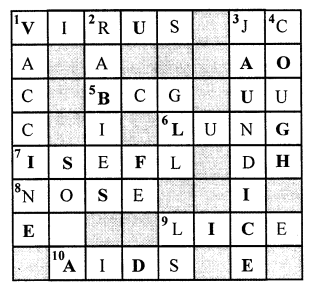
7. Given below is a crossword puzzle. Read the clues across and clues down, and fill up the blank squares. Check up your performance with the correct solution given at the end.
Clues across
1. Category of pathogen that causes diseases, like common cold and mumps.
5. This is the vaccine for preventing tuberculosis.
6. An organ usually affected by tuberculosis.
7. Jumbled spelling of one of the most common insects which visits our exposed foods and contaminates them.
8. Cover this part of your body by a handkerchief while sneezing to prevent droplet infection to others.
9. These may readily grow in your hair, if you do not wash it regularly.
10. A disease that weakens the body’s defence system against infections.
Answer:
Clues down
- Germ or germ-substance introduced into the body to prevent occurrence of an infectious disease.
- A disease caused by an infected dog, and which affects the central nervous system.
- A disease in which the eyes, the skin and the urine turn yellow.
- The disease pertussis is popularly known as whooping
Long Answer Questions
Question 1.
Describe the ways in which communicable diseases are transmitted through various indirect methods.
Answer:Communicable diseases can spread indirectly in several ways. One way is through contaminated objects, like a doorknob touched by someone sick and then by someone else. Another route is via vectors, such as mosquitoes transmitting malaria or dengue. Diseases can also travel through the air on tiny droplets released when someone coughs or sneezes, which others can then inhale. Finally, contaminated food and water can also lead to the spread of illnesses like cholera or typhoid.
Question 2.
List 3 ways by which you should keep your environment clean.
Answer:Bin It Right: Always use trash cans and recycle what you can. This prevents waste from harming our land and water.
Cut Back, Use Again, Recycle: Aim to use less stuff, give old things new life, and recycle paper, plastic, and glass. This means less waste overall.
Save Our Resources: Be mindful of your water and electricity use. This helps protect nature’s resources and prevents pollution from making energy.