

History is our collective memory as a species. It’s how we learn from the triumphs and mistakes of those who came before us. And that word, “historia,” perfectly captures its essence – that initial spark of curiosity, the desire to investigate and understand.
And you’re spot on about the sources! Imagine holding a brittle manuscript, the very paper touched by hands centuries ago. Or deciphering an inscription etched in stone, a silent testament to a bygone era. And then there’s archaeology, like detective work in the dirt, unearthing clues that whisper stories of daily life long ago – the tools they used, the homes they built, even the pots they cooked in. It’s amazing how these physical remnants can bring the past to life!
It’s the archaeologists who are the meticulous excavators, carefully bringing these fragments to light. And then come the historians, the storytellers who weave these pieces together, using their knowledge and critical thinking to understand the context and meaning of the past. They’re like interpreters of time, helping us make sense of where we came from.
And the story of our own land, India, is so rich! It’s wonderful to know how the mighty Indus River, or Sindhu as it was known, lent its name to our nation. It paints a picture of ancient connections and how different cultures interacted. And “Bharat,” rooted in the Rigveda, connects us to a deep and venerable past.
Finally, grasping the concept of BC is like navigating a timeline in reverse before reaching that pivotal point. It’s a fundamental tool for placing events in their proper sequence.
Exercise
I. Fill in the blanks:
- People who write history are known as———– .
Ans : Historians
- By ———— we mean the study of the remains of the ancient past.
Ans : Archaeology
- The two ———– tell us about life and society in the ancient past, besides being religious books.
Ans : Great epics
- Old buildings which are important historically are known as———-.
Ans : Monuments
- Meghadoot was written by——— .
Ans : Kalidasa
II. Match Column A with Column B:
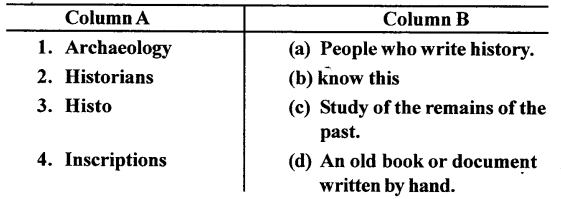

Answer:
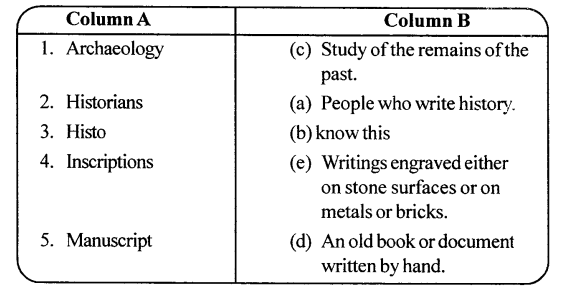
III. Answer the following questions briefly :
Question 1.
What is history? What is the origin of the word ‘history’?
Answer:It’s not a passive reception of dates and names, but a dynamic journey of exploration. We become detectives of the past, sifting through fragments of evidence – artifacts, writings, traditions – to construct a narrative.
And that’s where the real magic lies, doesn’t it? It’s in that act of piecing things together, of trying to understand the motivations, the challenges, and the triumphs of those who came before us. It’s about recognizing that the present moment isn’t some isolated event, but the latest chapter in a long and intricate story, shaped by countless decisions and circumstances. By engaging with history in this active way, we gain a deeper understanding not only of the past but also of ourselves and the possibilities for the future.
Question 2. Why do we study history? Give two reasons. Answer:
Answer:We delve into the study of history for a multitude of compelling reasons, but two stand out as particularly significant. Firstly, history serves as a profound teacher, offering invaluable lessons gleaned from the triumphs and tribulations of those who came before us. By examining past events, we can identify recurring patterns, understand the consequences of different actions, and ultimately make more informed decisions in our own lives and as a society. It provides a crucial context for understanding the present, illuminating the roots of our current institutions, cultures, and challenges.
It allows us to understand our heritage, appreciate the diverse tapestry of human experience, and recognize the contributions of various civilizations and individuals. By learning about our collective past, we develop a stronger sense of belonging and a more nuanced understanding of the world and our place within it.
Question 3. Which period in history is called prehistoric? Answer:
Answer:This vast expanse of time encompasses all human activity and societal development that occurred before the invention of writing systems, meaning our understanding of this period relies heavily on archaeological evidence, anthropology, and other non-written sources.
Question 4.
Name two sources of history. What do literary sources include?
Answer: Historical study indeed weaves together the stories told in written records – from ancient epics to personal letters – with the tangible clues unearthed by archaeology, like pottery shards and building foundations. Each type of evidence offers a unique window into the past, and when combined, they paint a richer and more complete picture of bygone eras.
Question 5.
Give one example each of religious and secular literature.
Answer:Religious texts, such as the ancient Vedas, provide a window into the spiritual beliefs and practices of bygone eras. In contrast, secular writings, a prime example being the Arthashastra, delve into the practicalities of governance, economics, and societal organization, offering perspectives on worldly affairs rather than the sacred.
Question 6.
What do we mean by culture?
Answer :culture shapes everything from the stories we tell around a fire to the way we organize our communities and even the things we find beautiful or meaningful. It’s the invisible thread that connects people who share a common heritage and a way of navigating the world. It’s constantly evolving, too, influenced by new ideas, interactions with other cultures, and the passage of time. Question 7.
Explain the term archaeology.
Answer : It’s like being a detective, piecing together the stories of people who lived long before us by carefully uncovering the clues they left behind. Every shard of pottery, every ancient tool, every foundation of a forgotten building whispers secrets about how our ancestors lived, what they believed, and how their societies were structured.1 It’s a fascinating way to connect with the past and understand the long journey of humankind. What aspects of archaeology particularly pique your interest.
V. Distinguish between
- Archaeological sources and literary sources.
Ans :
| Feature | Archaeological Sources | Literary Sources |
| Nature | These are direct physical remains or material objects found on or under the earth. | These are written records and texts produced by people of the past. |
| Form | Consist of artifacts, buildings, coins, inscriptions, and fossils. | Consist of manuscripts, books, religious texts, and travelogues. |
| Language | They do not “speak” a language (except for inscriptions); they must be interpreted. | They are written in specific scripts and languages (e.g., Sanskrit, Prakrit, Latin). |
| Reliability | Generally considered more reliable and unbiased as they are physical proof. | Can be biased or exaggerated depending on the author’s perspective. |
| Scope | Only source for Prehistory (the period before writing was invented). | Available only for the Historical period (after writing was invented). |
2. Monuments and inscriptions.
Ans :
| Feature | Monuments | Inscriptions (Epigraphs) |
| Definition | Physical structures, buildings, or ruins that have historical significance. | Words or symbols carved or engraved onto hard, durable surfaces. |
| Examples | Temples, palaces, forts, stupas, and burial grounds (e.g., The Taj Mahal, Sanchi Stupa). | Writings on stone pillars, rocks, copper plates, or temple walls (e.g., Ashoka’s Edicts). |
| Main Information | Details about architecture, art, engineering, and the wealth of a kingdom. | Details about administration, royal orders, dates, and social laws. |
| Stability | These are large, immobile sites that can be damaged by weather or war over time. | Generally considered more reliable as they are difficult to alter or erase once carved. |
| Primary Study | Studied through Archaeology (general physical remains). | Specifically studied through Epigraphy (the study of inscriptions). |
3. Religious and secular literature.
Ans :
| Feature | Religious Literature | Secular Literature |
| Primary Theme | Focused on gods, rituals, and spiritual beliefs of a particular faith. | Focused on non-religious matters like law, politics, science, and history. |
| Purpose | To provide moral guidance, explain theology, or document religious traditions. | To record historical events, provide entertainment, or document social and scientific progress. |
| Types of Texts | Includes scriptures, hymns, prayers, and myths. | Includes biographies, travelogues, dramas, poems, and legal codes. |
| Examples | The Vedas, Ramayana, Bible, Quran, and Tripitakas. | Arthashastra (politics), Indica (travelogue), and plays by Kalidasa or Shakespeare. |
V. Given below are some drawings. Circle those which you think below to prehistory.
VI. Picture study — This picture shows a valuable source of history.
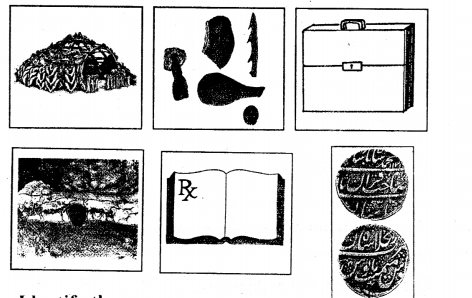
1.Identify the source
Ans..The picture shows coins.
2.How do you think these are useful ?
Ans. Coins are a valuable source of history because they can tell us about:
- Rulers and Dynasties: Coins often bear the names and images of rulers, helping us track the lineage and chronology of dynasties.
- Economic History: The materials used in coins (gold, silver, copper) and their weight can indicate the economic prosperity of a period.
- Trade and Commerce: The presence of coins from one region in another can reveal trade routes and connections.
- Religious and Cultural Beliefs: Coins may feature symbols, deities, or inscriptions that reflect the religious and cultural beliefs of the time.
3.What do you understand by the term ‘numismatics’ ?
Ans. It’s a field that combines history, art, and economics to understand the past through these objects.
Additional Questions
A. Fill in the blanks.
- History is a record of ————–and events of the past, arranged in ————— order.
Ans : people, places , chronological
- Prehistory is the history of the period before ——— was invented.
Ans : writing
- The sources of history can be broadly classified into ———- sources and ———
Ans : archaeological , literary
- The study of coins is known as ———— .
Ans : numismatics
- Edicts are ————- issued by kings.
Ans : royal commands
- Inscriptions are ————- on solid objects.
Ans : engravings
- Handwritten records of the past are known as ———–.
Ans : Manuscripts
- Literary source material can be divided into ———– literature and ———
Ans : religious , secular , literature
- The Greek ambassador in Chandragupta Maurya’s court was ———–.
Ans : Magasthenes
- The Chinese travelers who came to India were ———- and
Ans : Fa Hien , Hiuen Tsang
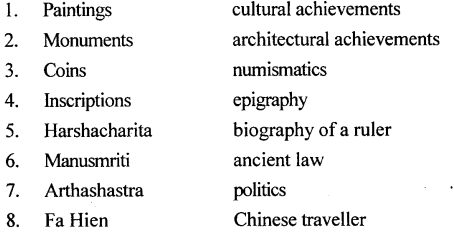
B. Match the following.

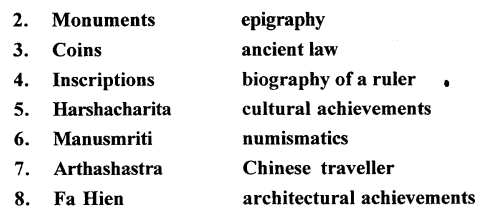
Answer:
C. Answer the following questions.
Question 1.
What is history? Why do we study history?
Answer:History, in essence, is the story of humankind’s past. It’s the narrative of events, actions, and ideas that have shaped the world we live in today. It’s not just a collection of dates and names, but rather an exploration of how societies have evolved, cultures have interacted, and challenges have been overcome (or not!).
We study history for a multitude of compelling reasons. Firstly, it provides us with context. By understanding the roots of our present-day institutions, beliefs, and problems, we gain a deeper appreciation for why things are the way they are. Secondly, history offers valuable lessons. Examining past successes and failures can provide insights and guidance for navigating current and future challenges. Furthermore, it fosters critical thinking skills as we analyze evidence, interpret different perspectives, and form our own conclusions. Finally, history connects us to our shared human heritage, fostering empathy and a sense of belonging to something larger than ourselves.
Question 2.What is the difference between prehistory and history?
Answer: Our understanding of this era relies heavily on archaeological evidence, such as tools, artifacts, and fossils. History, on the other hand, begins with the advent of writing, allowing us to learn about the past through written documents, inscriptions, and literature. In short, prehistory is the time before written words, while history is the time after they emerged.
Question 3.
How many groups can the sources of history be broadly divided into? Name them.
Answer:History’s sources mainly fall into Primary Sources – direct stuff from the time like documents, artifacts, and personal accounts – and Secondary Sources – interpretations and analyses of those primary sources, such as history books and articles.
Question 4.
What is archaeology? Why is it so important for the study of prehistory?
Answer:Archaeology serves as the primary, and often the only, way to understand prehistory since writing didn’t exist then. By studying the physical remnants of past societies – their tools, pottery, and buildings – archaeologists piece together insights into their cultures, technologies, and daily lives, providing invaluable knowledge about the vast majority of human history. 1
Question 5.
What are monuments?
Answer:Monuments are indeed preserved structures or sites that carry historical, cultural, or architectural significance, frequently commemorating important figures, happenings, or concepts. 1
Question 6.
Name five archaeological objects that provide important clues to the history of humans in the Ancient Period.
Answer:Here are five archaeological objects offering key insights into ancient human history:
- Stone tools: Revealing early technological skills and subsistence strategies.
- Pottery shards: Indicating settlement patterns, trade, and artistic expression.
- Burial sites: Providing information about social structures, rituals, and beliefs.
- Cave paintings: Offering glimpses into early symbolic thought and daily life.
- Fossilized remains: Showing physical evolution and migration patterns of early humans.
Question 7.
Why is the study of coins considered an important source of ancient history?
Answer:The study of coins, also known as numismatics, is an important source of ancient history for several key reasons:
- Chronological Evidence: Coins often bear inscriptions with the names of rulers, and sometimes even dates, helping to establish timelines and the sequence of dynasties.
- Political History: Coins can reveal the extent of a ruler’s influence, their titles, and even depict political alliances or conquests through shared symbols or inscriptions.
- Economic History: The metal content, weight, and denominations of coins reflect the economic conditions, trade networks, and monetary systems of the time.
- Cultural and Religious Insights: Coins frequently feature religious symbols, deities, and artistic styles prevalent during a specific period, offering valuable information about the beliefs and culture of the people.
- Artistic Development: The designs and craftsmanship on coins showcase the artistic skills and aesthetic sensibilities of different eras.
- Propaganda and Communication: Rulers often used coins to disseminate their image, achievements, and political messages to the wider population
Question 8.
What information do we get from inscriptions?
Answer:Inscriptions, writings etched on durable materials like stone or metal, offer valuable historical insights. 1 They reveal rulers’ names and accomplishments, administrative systems, religious practices, social structures, economic activities, languages, land grants, and significant events with their dates
Question 9.
Why are inscriptions a reliable source of information?
Answer:Inscriptions are considered reliable because they are primary sources that were engraved at the time of the events they describe. 1 This makes them direct evidence, less prone to alterations or biases that can occur in later written accounts. 2 Their durability, especially when on stone or metal, ensures the information survives for long periods, offering a relatively untampered record from the past. 3
Question 10.
What are manuscripts? On what surfaces were they ; written?
Answer:Manuscripts are handwritten documents, often old texts or early versions of writings. 1 They were written on various surfaces like palm leaves, the bark of birch trees, cloth, animal skin (like parchment), and much later, paper
Question 11.
How many categories can you divide literary sources into? Name them.
Answer:Religious and secular literature serve as crucial primary sources, providing valuable glimpses into the beliefs, practices, societal norms, daily life, customs, governance, and intellectual currents of their respective eras
Question 12.
What do you understand about secular literature? Give two examples.
Answer:Secular literature refers to writings that are not religious in nature. It deals with worldly subjects, human experiences, and societal issues rather than religious doctrines or spiritual themes.
Two examples of secular literature are:
- Plays by William Shakespeare: His dramas, like “Hamlet” or “Romeo and Juliet,” explore themes of love, loss, ambition, and revenge, focusing on human psychology and relationships within a societal context, not religious teachings. 1
- Novels by Jane Austen: Her works, such as “Pride and Prejudice,” depict the social customs, romantic relationships, and daily lives of the English gentry, offering insights into human behavior and social dynamics without a religious focus.
D. State whether the following are true or false.
- History is only a record of great kings and queens.
Ans : False - The study of old inscriptions is known as epigraphy.
Ans : True - Banabhatta wrote Harshacharita.
Ans : True - Panchatantra is a part of religious literature.
Ans : False - The Angas are the religious literature of the Buddhists.
Ans : False
E. Picture study.
The picture below is a painting from a manuscript of the Rig Veda showing the various gods and goddesses worshiped.
1. What kind of source of history is this?
Ans. This painting from the Rig Veda manuscript is indeed a primary source. Think of it as a direct window into the past. It’s an original piece of art from that period, giving us a firsthand look at the religious beliefs and the gods and goddesses who held significance when the Rig Veda was being written down. It’s a visual key that unlocks a bit of their spiritual world for us today.
2.Is this religious or secular in nature?
Ans. This is clearly religious in nature. The painting depicts gods and goddesses being worshipped, which is a central aspect of religious practice and belief
3. What kind of information does this source of history reveal?
Ans. his painting from the Rig Veda manuscript serves as a primary historical source because it directly reflects the religious beliefs of the Rig Vedic period. It visually showcases the specific gods and goddesses they worshipped, giving us a firsthand look at their pantheon and perceived importance. Beyond just names, the artwork reveals how these deities were imagined and depicted, including their forms and symbolic representations. The painting’s artistic style itself offers clues about the artistic skills and traditions of that era. Furthermore, being part of a manuscript illuminates the practices of knowledge preservation through writing and illustration. Ultimately, this image provides a valuable window into the broader cultural context of the Rig Vedic civilization, revealing their values, myths, and understanding of the world as seen through their divine figures.