
- Symbols of Elements: This section introduces the internationally recognized shorthand notations for elements, usually one or two letters derived from their English or Latin names (e.g., H for Hydrogen, O for Oxygen, Na for Sodium). Students learn to recognize and write common elemental symbols.
- Valency: This concept explains the combining capacity of an element, or how many chemical bonds an atom of that element can typically form. Students are introduced to common valencies of various elements.
- Radicals: This section introduces groups of atoms that act as a single unit in chemical reactions and carry a charge (polyatomic ions) or are neutral (though less common at this level as a focus). Examples like sulfate (SO42−), nitrate (NO3−), and hydroxide (OH−) are likely covered.
- Chemical Formulae: Students learn how to write chemical formulae for compounds by combining the symbols of the constituent elements and using their valencies to determine the correct ratios of atoms. Rules for writing formulae (e.g., criss-cross method) for simple ionic and covalent compounds are likely taught.
- Chemical Equations: This section introduces how to represent chemical reactions using symbols and formulae. Students learn the basic structure of a chemical equation (reactants on the left, products on the right, connected by an arrow). Balancing chemical equations might be introduced at a basic level to show that the number of atoms of each element remains the same during a reaction.
In short, the chapter aims to equip students with the basic “language” needed to understand and describe chemical substances and reactions using symbols, valencies, formulae, and equations. It lays the foundation for further study in chemistry by providing a systematic way to communicate chemical information.
EXERCISE
Question 1.
(a) Define chemical reaction.
(b) What is a chemical equation?
(c) Why do we need to balance chemical equations?
Ans:
(a) Chemical reaction: Atoms and molecules rearrange to form new substances with different properties.
(b) Chemical equation: Symbolic representation of a chemical reaction using formulas for reactants and products.
(c) Balancing equations: Necessary to obey the Law of Conservation of Mass, ensuring the same number of each type of atom on both sides.
Question 2.
State four conditions necessary for chemical reactions to take place.
Ans:
Four conditions often needed for chemical reactions:
- Contact: Reactants must physically meet.
- Energy: Enough activation energy to start bond breaking.
- Orientation: Reactants must collide in the right way.
- Conditions: Suitable temperature, pressure, catalyst, or solvent.
3. Differentiate between :
(a) Reactants and products.
| Feature | Reactants | Products |
| Definition | Substances that undergo a chemical change during a reaction. | Substances that are formed as a result of a chemical reaction. |
| Timeline | Present at the beginning of the reaction. | Present at the end of the reaction. |
| Equation Side | Written on the left side of the arrow (A+B→). | Written on the right side of the arrow (→C+D). |
| Quantity | Their concentration decreases as the reaction progresses. | Their concentration increases as the reaction progresses. |
| Bonds | Existing chemical bonds are broken. | New chemical bonds are formed. |
(b) Chemical reaction and chemical equation.
| Feature | Chemical Reaction | Chemical Equation |
| Nature | It is a process or an actual physical event where substances transform. | It is a symbolic representation or a written record of that process. |
| Observation | Can be observed in a lab (e.g., color change, heat, or bubbles). | Viewed on paper or a screen using symbols and formulas. |
| Components | Involves the actual breaking and forming of chemical bonds. | Involves chemical symbols (H,O,Na), formulas (H2O), and coefficients (2,3). |
| Requirement | Needs specific conditions (temperature, pressure) to occur. | Needs to be balanced to satisfy the Law of Conservation of Mass. |
(c) A balanced and a skeletal chemical equation.
| Feature | Skeletal Chemical Equation | Balanced Chemical Equation |
| Definition | A simple representation using chemical formulas that shows what is reacting. | An equation that shows the exact ratio of atoms required for the reaction. |
| Atom Count | The number of atoms on the reactant side is not equal to the product side. | The number of atoms for each element is exactly the same on both sides. |
| Law of Conservation | It does not satisfy the Law of Conservation of Mass. | It strictly follows the Law of Conservation of Mass. |
| Coefficients | Usually contains no coefficients (the big numbers in front). | Uses coefficients to ensure atom counts are equal. |
Question 4.
Write word equations for the following skeletal equations:
(a) KClO3 → KCl + O2
(b) Zn + HCl → ZnCl2 + H2
(c)FeCl2 + Cl2 → FeCl3
(d) CO + O2 → CO2
(e) Ca + O2 → CaO
(f) Na + O2 → Na2O
(g) NaOH + H2SO4 → Na2SO4 + H2O
(h) AgBr → Ag + Br2
(i) KNO2 → KNO2 + O2
Ans:
(a) 2KClO3 → 2KCl+ 3O2
(b) Zn + 2HCl → ZnCl2 + H2
(c) 2FeCl2 + Cl2 → 2FeCl3
(d) 2CO + O2 → 2CO2
(e) 2Ca + O2 → 2CaO
(f) 4Na + O2 → 2Na2O
(g) 2NaOH + H2SO4 → Na2SO4 + 2H2O
(h) 2AgBr → 2Ag + Br2
(i) 2KNO3 → 2KN02 + O2
Question 5.
Balance the following chemical equations :
(a) FeS + HCl → FeCl2 + H2S
(b) Na2CO3 + HCl → NaCI + H2O + CO2
(c) H2 + O2 → H2O
(d) Na20 + H20 → NaOH
Ans:
(a) FeS + 2HCl → FeCl2 + H2S
(b) Na2CO3 + 2HCl → 2NaCl + H2O + CO2
(c) 2H2+ O2 → 2H2O
(d) Na2O + H2O → 2NaOH
Question 6.
What information do you get from the equation H2+ Cl2 → 2HCl ?
Ans:
The equation H2+Cl2→2HCl tells us that hydrogen and chlorine react to form hydrogen chloride. Specifically, one molecule (or mole) of hydrogen reacts with one molecule (or mole) of chlorine to produce two molecules (or moles) of hydrogen chloride. For gases, this also represents a 1:1:2 volume ratio.
Question 7.
Write your observations for the following chemical reactions and name the products formed :
(a) When sugar is heated.
(b) When manganese dioxide is added to potassium chlorate and heated.
(c) When dilute acetic acid is poured on baking soda.
(d) When an aqueous solution of sodium chloride is mixed with an aqueous solution of silver nitrate.
(e) When ammonium chloride is heated with sodium hydroxide.
(f) When water is added to quick lime?
Ans:
(a) Heating Sugar: The white crystalline sucrose undergoes thermal decomposition. Initially, it melts into a colorless liquid, which subsequently dehydrates and carbonizes upon further heating, resulting in the formation of black, amorphous carbon (charcoal). Simultaneously, water vapor is released, along with trace amounts of other volatile decomposition products.
(b) Manganese Dioxide and Potassium Chlorate Heated: The mixture of black manganese dioxide (catalyst) and white potassium chlorate undergoes accelerated thermal decomposition when heated. The manganese dioxide remains chemically unchanged. The other product is potassium chloride.
(c) Dilute Acetic Acid on Baking Soda: The reaction between colorless dilute acetic acid and white solid baking soda (sodium bicarbonate) results in immediate and vigorous effervescence, indicating the release of a colorless and odorless gas, carbon dioxide. The solid baking soda disappears as it reacts to form sodium acetate (in solution) and water, in addition to the gaseous product.
(d) Sodium Chloride and Silver Nitrate Solutions: When a colorless aqueous solution of sodium chloride is mixed with another colorless aqueous solution of silver nitrate, an immediate precipitation reaction occurs, forming a dense, white, curdy solid, silver chloride. The other product, sodium nitrate, remains dissolved in the aqueous solution.
(e) Ammonium Chloride Heated with Sodium Hydroxide: Heating a mixture of white solid ammonium chloride and white solid sodium hydroxide results in the evolution of a colorless gas with a characteristic sharp, pungent odor, ammonia. The reaction also produces sodium chloride (a white solid upon evaporation of any moisture) and water.
(f) Water Added to Quick Lime: The addition of liquid water to white solid quick lime (calcium oxide) initiates a vigorous exothermic reaction, accompanied by hissing and the release of significant thermal energy. The quick lime reacts to form a white solid or milky suspension of calcium hydroxide (slaked lime).
Question 8.
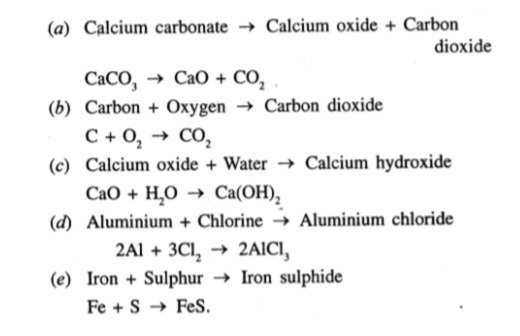
Write symbolic representation for the following word equations and balance them :
(a) Calcium carbonate → Calcium oxide + Carbon dioxide
(b) Carbon + Oxygen → Carbon dioxide
(c) Calcium oxide + Water → Calcium hydroxide
(d) Aluminium + Chlorine → Aluminium chloride
(e) Iron + Sulphur → Iron sulphide
Ans:
OBJECTIVE TYPE QUESTIONS
1. Fill in the blanks:
(a) The substances which undergo chemical change are called———–.
Ans : reactants
(b) The substances formed as a result of a chemical reaction are called———-.
Ans : products
(c) During a chemical reaction transfer of ————- takes place.
Ans : energy
(d) The basic conditions necessary for a chemical reaction is———-.
Ans : close contact
(e) In some chemical reactions an insoluble ———– is formed when two solutions are mixed.
Ans : precipitate
2. Write ‘true’ or ‘false’ for the following statements :
(a) No new substance is formed during a chemical reaction : True
(b) Hydrogen sulphide has rotten egg smell : True
(c) When potassium iodide solution is added to lead acetate solution a red precipitate is formed : False
(d) A black residue is formed when sugar is heated : True
(e) When iron and sulphur are heated together a grey mass is formed which is attracted by a magnet : False
(f) A chemical equation gives only qualitative information of a chemical reaction : False
MULTIPLE CHOICE QUESTIONS
1. A chemical equation is a statement that describes a chemical change in terms of
(a) symbols and formulae
(b) energy
(c) number of atoms
(d) colours
2. Balancing a chemical equation is based on
(a) Law of conservation of mass
(b) Mass of reactants and products
(c) Symbols and formulae
(d) None of the above
3. Copper carbonate when heated, it turns :
(a) Blue
(b) Green
(c) Black
(d) Yellow