
This chapter on “Major Crops” for 6th graders likely breaks down the different kinds of plants we grow. It probably starts by sorting them into groups like food crops (the stuff we eat directly, like rice, wheat, and beans) and cash crops (things grown to sell, like cotton, tea, and sugarcane). You might also learn about plantation crops, which are grown on big farms, often for export, like tea and rubber. Oh, and don’t forget fruits and veggies!
Then, the chapter probably talks about what helps these plants grow. Things like the weather (how hot, rainy, and sunny it is), the soil they’re planted in, and even the shape of the land matter a lot. Plus, things like having enough workers, machines, and ways to water the plants are important too.
For example, lots of rice in hot, wet Asia, wheat in cooler places like parts of North America and India, and cotton in warm areas with dark soil. They’d probably mention where you find tea, coffee, and rubber too.
The chapter might also touch on different ways of farming. Like growing just enough for your family (subsistence farming) versus growing a lot to sell (commercial farming), and those big plantations for single crops.
Finally, you might get a quick introduction to the Green Revolution, which was all about new ways to grow more food.
EXERCISES
EXERCISES
A. Fill in the blanks
- There are three main crop growing seasons in India — ————–
Ans : Kharifrabi and zaid.
- Cash crops are grown for cash or for ——— purposes.
Ans : commercial
- ———– is the crushed sugar cane fibre that is used for the manufacture of paper and fibre boards.
Ans : Bagasse
- Use of a ———— of seeds led to a spectacular increase in crop production in India in the 1960s.
Ans : new variety
- The ———- led to farmers taking loans and incurring large debts.
Ans : green revolution
B. Match the columns
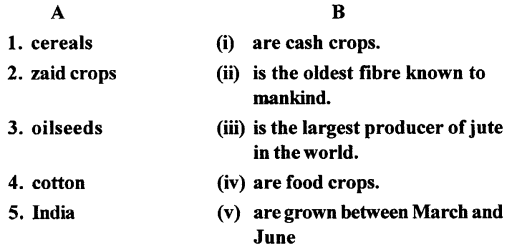
Ans :
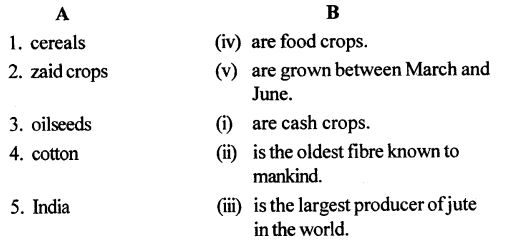
C. Answer the following questions in brief
Question 1. What are kharif crops ? Give one example.
Answer:
Kharif crops, also known as monsoon crops, are crops that are grown during the rainy season in India. These crops require a lot of water and a hot climate to grow.
Key Features:
- Sowing Season: They are sown at the beginning of the South-West monsoon, usually in June or July.
- Harvesting Season: They are harvested at the end of the monsoon season, typically in September or October.
- Climate Required: These crops need high temperatures and plenty of rainfall.
Ex. Maize (Corn) , Cotton
Question 2. Which are the major rice-producing regions in India ?
Answer: The big rice-growing areas in India are mainly the north-eastern plains, coastal regions, and the delta regions of rivers like the Ganga, Brahmaputra, and Godavari.
Question 3. What are cash crops ? Give two examples.
Answer: Cash crops are grown primarily to be sold for money, not just for the farmer’s own use. Two examples are cotton and sugarcane.
Question 4. What climatic conditions are suitable for the cultivation of cotton ?
Answer:Cotton loves warm, sunny weather with moderate rainfall and well-drained black soil.
Question 5. What are the climatic conditions required for growing tea?
Answer:Tea needs a cool, humid climate with plenty of rainfall and sloping land for drainage.
Question 6. Name the major coffee producing regions of India.
Answer:The main coffee areas in India are in the hills of Karnataka, Kerala, and Tamil Nadu.
Question 7. What are high yielding varieties of seeds ?
Answer:High-yielding varieties are special seeds bred to give you way more harvest than the usual ones. Think of them as super seeds for bigger crops!
D. Answer the following questions in one or two paragraphs
Question 1.
What are the crop-growing seasons in India ? List the different types of crops that grow in each season.
Answer:India has three main crop seasons. The Kharif season (June-October, during the rains) brings us rice, maize, jowar, bajra, cotton, groundnut, and pulses like moong and urad. Then comes the cooler Rabi season (October-March) with wheat, barley, mustard, gram, and linseed. Finally, the short summer Zaid season (March-June) is for quick-growing veggies like cucumber, watermelon, muskmelon, and fodder.
Question 2.
Write a brief note on the cultivation of wheat in India.
Answer:Wheat is a super important crop grown in India during the winter (Rabi) months. It loves the cooler weather and good soil found in places like Punjab, Haryana, Uttar Pradesh, and Madhya Pradesh. Farmers usually plant it around October or November, and it’s ready to harvest by March or April. Sunshine and just the right amount of water help it grow well. India grows a lot of wheat, and it’s a staple food for many people here. New farming methods have really helped us grow even more wheat over time.
Question 3.
What is sugarcane ? What are the different products that are made from sugar cane ?
Answer:Sugarcane is a big, juicy grass whose stems are full of sweetness. We squeeze out this juice to make sugar, the kind we use in our food. But that’s not all! Sugarcane also gives us jaggery (a more rustic sugar), thick, dark molasses, and even some types of drinks like rum.
Question 4.
What are the main areas of tea production in India and in the world ?
Answer:In India, the prime tea-growing regions are in the northeast, famous for Assam’s strong black tea and Darjeeling’s fragrant varieties, and in the south, with significant production in the Nilgiris and Kerala. On a global scale, major tea producers include China (its birthplace!), Sri Lanka (known for Ceylon tea), and Kenya.
Question 5.
Describe the climatic conditions required for growing coffee.
Answer:if you want to see tea growing in India, head to Assam and Darjeeling in the northeast, or the hilly areas of Kerala and Tamil Nadu down south.
Question 6.
Give any three climatic conditions most suitable for growing rubber.
Answer:Coffee plants are a bit picky about the weather. They enjoy it warm and moist, with regular rainfall that isn’t too intense. Hilly areas that offer some shade from the strongest sunlight are often perfect for growing coffee.
Question 7: What was the Green Revolution? List its main features.
Answer:The Green Revolution was a big push to grow more food, especially in countries like India, starting in the 1960s. It used new methods to boost crop production.
Main Features:
- New Seeds: Using special high-yielding varieties of seeds that produced much more grain.
- More Water: Expanding irrigation systems to ensure crops get enough water.
- Chemical Help: Using more fertilizers and pesticides to make plants grow better and fight off pests.
- Modern Tools: Introducing tractors and other machinery to help with farming.
Question 8: Why was the Green Revolution not beneficial for poor farmers?
Answer:Reasons it wasn’t always good for poor farmers:
- Costly Supplies: The new seeds, fertilizers, and pesticides cost money that poor farmers often didn’t have.
- Need for Water: Increased irrigation required money for pumps or access to reliable water sources, which poor farmers might lack.
- Unequal Access: Wealthier farmers could afford the new technologies and benefited more, widening the gap between them and poorer farmers.
- Land Ownership: Farmers with small plots of land often couldn’t afford the investments or didn’t see enough extra yield to make it worthwhile.
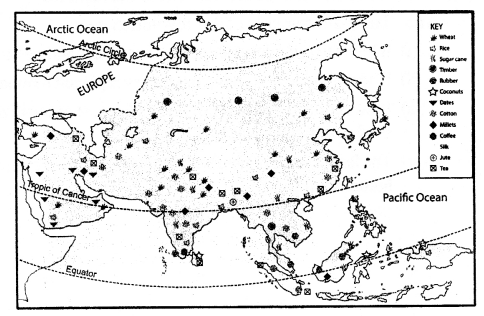
E. On an outline map of Asia mark the following
- Rice growing regions in green
- Wheat growing regions in pink
- Sugar cane growing regions in red
- Cotton growing regions in purple
- Jute growing regions in brown
- Tea growing regions in yellow
- Coffee growing regions in orange
- Rubber growing regions in blue
Answer:
F. Picture Study
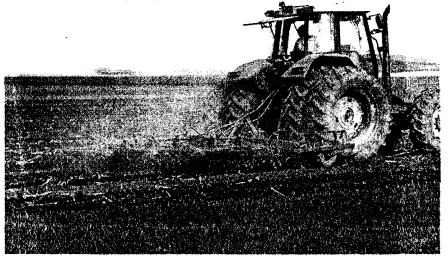
Question 1.
Identify the agricultural movement.
Answer:Based on the image showing a tractor tilling a field, the agricultural movement in question is likely the Green Revolution.
Question 2. Who supervised this movement in India?
Answer: While the Green Revolution involved the collaborative efforts of many scientists, policymakers, and farmers, key figures who played a significant role in its supervision and implementation in India include:
- M. S. Swaminathan: Often referred to as the “Father of the Green Revolution in India” for his crucial role in introducing and adapting high-yielding wheat varieties.
- C. Subramaniam: The then Minister of Agriculture who championed the policies and provided the political will necessary for the Green Revolution’s success.
Question 3. List any four demerits of this movement.
Answer: While the Green Revolution significantly increased food production, it also had several negative consequences:
- Environmental Degradation: The heavy use of chemical fertilizers and pesticides led to soil degradation, water pollution, and the loss of biodiversity.
- Water Depletion: The cultivation of water-intensive crops like wheat and rice, coupled with inefficient irrigation practices, led to the depletion of groundwater resources in many regions.
- Health Issues: The excessive use of chemical pesticides and fertilizers posed health risks to farmers and consumers through contamination of food and water sources.