
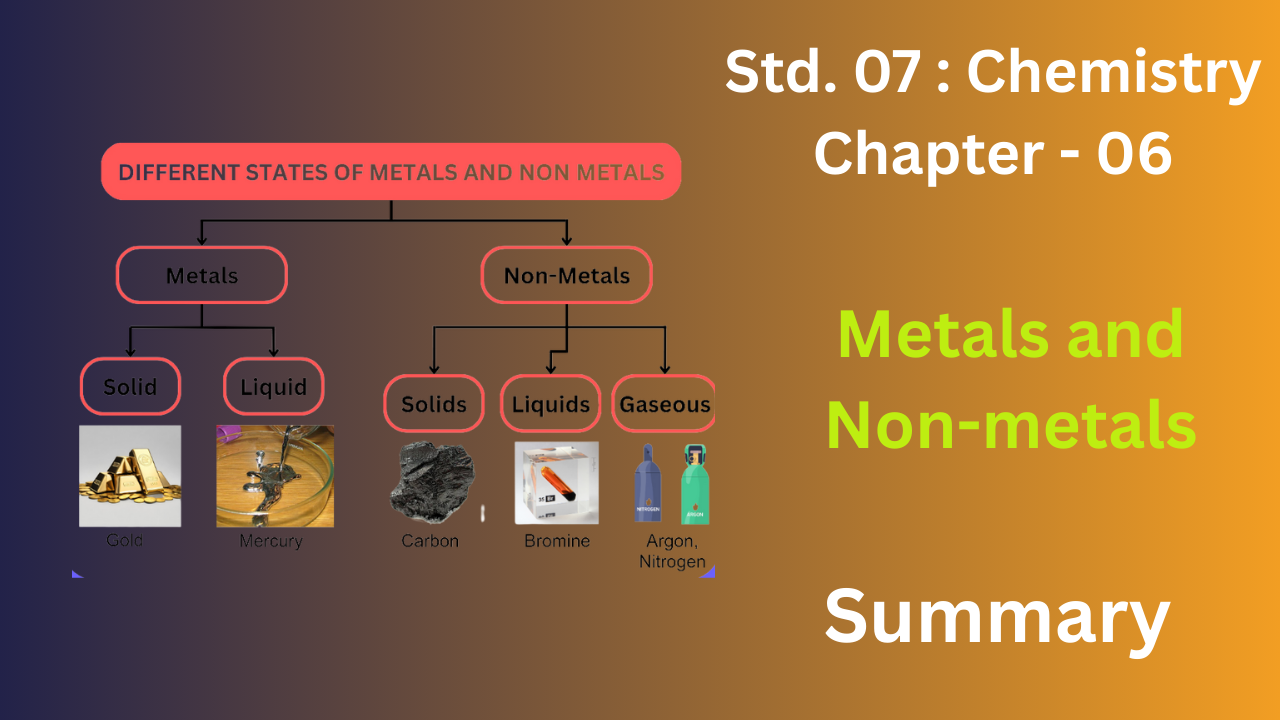
The chapter likely begins by defining metals as elements generally known for their hardness, luster, malleability, ductility, and excellent conductivity of heat and electricity. It elaborates on these physical attributes with familiar examples like the hardness of iron, the shininess of copper, the ability of aluminum to be hammered into sheets, the drawing of copper into wires, and the electrical conductivity of silver. Common metallic elements such as iron, copper, aluminum, gold, and silver are typically introduced to provide concrete illustrations of this elemental category.
Conversely, the chapter introduces non-metals as elements that generally lack the characteristic properties of metals. They are often described as brittle, dull in appearance, and poor conductors of heat and electricity, with graphite being a notable exception. The chapter likely highlights that non-metals can exist in various states of matter at room temperature, including solids (like sulfur), liquids (like bromine), and gases (like oxygen). Common non-metallic elements such as carbon, oxygen, nitrogen, sulfur, and chlorine are presented to exemplify this group.
To further solidify understanding, the chapter probably includes a direct comparison of the physical properties of metals and non-metals, perhaps through a table, to clearly delineate the key differences between them. Furthermore, it likely discusses the practical applications of both metals (e.g., in construction, wiring, and aerospace) and non-metals (e.g., in respiration, fertilizers, and various industrial processes involving carbon), emphasizing their significance in everyday life and technological advancements.
advancements.
EXERCISE
1. Name a metal
- that is most malleable : Pure gold
- that is brittle : Zinc
- as precious as gold : Platinum
- that can be cut with knife : Sodium
- used in making electric cables : Copper
- used as a thermometric liquid : Mercury
- that is the best conductor of electricity : Silver
2. Name a non-metal that is :
- a good conductor of heat and electricity : Graphite (Carbon)
- hardest naturally occurring substance : Diamond (Carbon)
- used to kill germs in water : Chlorine
- lustrous : Iodine
- used for filling into electric bulbs : Argon
- used for cancer therapy : Radon
- liquid at room temperature : Bromine
3. Mention two uses of the following metals and non-metals
(a) Iron :
Iron: Construction, Manufacturing.
Oxygen: Respiration, Industrial processes.
(b) Aluminium :
Aerospace Industry: Due to its lightweight and high strength-to-weight ratio, it’s crucial in aircraft and spacecraft construction.
Packaging: Used extensively for food and beverage cans and foil due to its non-toxicity and corrosion resistance.
(c) Gold :
Jewelry: Highly valued for its beauty, luster, and resistance to tarnishing, making it a primary material for rings, necklaces, and other adornments.
Electronics: Used in connectors, switches, and circuitry in electronic devices due to its excellent conductivity and resistance to corrosion.
(d) Oxygen :
Respiration: Essential for the breathing process of most living organisms, providing the energy needed for life.
Medical Applications: Used in hospitals for patients with breathing difficulties and during surgical procedures.
(e) Iodine :
Antiseptic: Used in tinctures and solutions to disinfect wounds and skin before surgery.
Thyroid Health: An essential component for the production of thyroid hormones, crucial for metabolism and development; often added to salt to prevent deficiency.
4. Give reasons :
(a) Magnesium is used in fire works.
Ans :
Magnesium is a constituent of fireworks owing to its combustion property, which yields an exceptionally luminous and intense white light. This characteristic makes it invaluable for generating brilliant white flashes, shimmering sparks, and radiant trails that contribute significantly to the aesthetic impact of pyrotechnic displays.
The efficacy of magnesium in this application stems from its ability to:
- Readily ignite in atmospheric air upon reaching its ignition temperature, facilitating its use in explosive compositions.
- Produce a visually striking effect characterized by the emission of intensely bright light during its exothermic reaction with oxygen.
(b) Aluminium is used in making aircrafts.
Ans :
Lightweight: Aluminium is significantly lighter than steel, which is crucial for aircraft to reduce fuel consumption and increase efficiency and payload capacity.
High Strength-to-Weight Ratio: When alloyed with other metals, aluminium can achieve strength comparable to steel while still being much lighter. This allows for strong yet light aircraft structures.
Corrosion Resistance: Aluminium forms a natural oxide layer that protects it from corrosion, essential for the longevity and safety of aircraft exposed to various weather conditions.
(c) Copper is used in making electric cables.
Ans :
Superior Electrical Conductivity: Copper exhibits exceptionally high electrical conductivity, surpassed only by silver among all metals. This inherent property facilitates the efficient transmission of electrical current with minimal energy dissipation as heat.
Excellent Ductility and Malleability: Copper possesses remarkable ductility, enabling it to be readily drawn into thin, elongated wires of varying diameters, a crucial requirement for cable manufacturing. Additionally, its malleability allows it to be shaped and formed without fracturing.
(d) Graphite is used in the leads of pencils
Ans :
Softness: Graphite is a soft, flaky form of carbon. This allows it to easily leave a dark mark on paper when pressure is applied. The layers of carbon atoms in graphite can slide past each other, depositing on the paper’s surface.
Dark Mark: Graphite produces a grey to black mark, making it suitable for writing and drawing.
(e) Impure diamond is used to cut glass
Ans :
Hardness: Diamond, even in its impure form (like industrial diamonds), is the hardest naturally occurring substance.
Scratching: To cut a material, you need something harder than it to scratch and create a fracture line. Glass is significantly softer than diamond (glass has a Mohs hardness of around 5.5, while diamond has a Mohs hardness of 10).
(f) Gold is mixed with copper and nickel.
Ans :
Hardness and Durability: Adding copper and nickel to gold makes the resulting alloy significantly harder and more resistant to scratches, dents, and general wear and tear. This is essential for jewelry that is worn daily.
Malleability and Ductility: While pure gold is very malleable (can be hammered into thin sheets) and ductile (can be drawn into wires), alloying it can improve its workability for certain manufacturing processes. The right proportions of copper and nickel help the gold hold its shape better when being molded.
(g) Tungsten is used in electric bulbs.
Ans :
Tungsten is used in electric bulb filaments because it has a very high melting point, high electrical resistance (heats up to glow), low evaporation at high temperatures, and can be made into thin wires.
5. Name the metals present in the following alloys
- Brass— Copper and zinc
- Bronze— Copper and tin
- Duralumin— Aluminium and copper
- Stainless steel— Iron, chromium, nickel
6. Give four differences between metals and non-metals with reference to their
(a) Melting point and boiling point,
(b) Conductivity of heat and electricity,
(c) Malleability
(d) Solubility
| Metals | Non-metals | |
| Melting point and boiling point | Metals have both high melting point and boiling point. | Non-metals have both low melting and low boiling point. |
| Conductivity of heat and electricity | They are good conductors of heat and electricity. | Nofi-metals are bad conductors of heat and electricity. |
| Malleability | Metals are ususally malleable. | All non-metal are non- malleable. |
| Solubility | Metals are generally insoluble in water and other organic solvents. | They are both soluble and insoluble |
OBJECTIVE TYPE QUESTIONS
1. Fill in the blanks :
(a) The most ductile metal is———–.
Ans : silver
(b) A metal stored in kerosene oil is———-.
Ans : sodium
(c) Tungsten metal is a poor conductor of———-.
Ans : heat
(d) ———-is a soft metal.
Ans : Pure gold
(e) ————is the hardest compound known to us.
Ans : Silicon carbide
(f) A non-metal used to purify water is————.
Ans : phosphorus
(g) A metal that gives dazzling effect to crackers when they explode is———–.
Ans : magnesium
(h) A chemical compound that makes up the striking heads of match sticks is———–.
Ans : sulphur
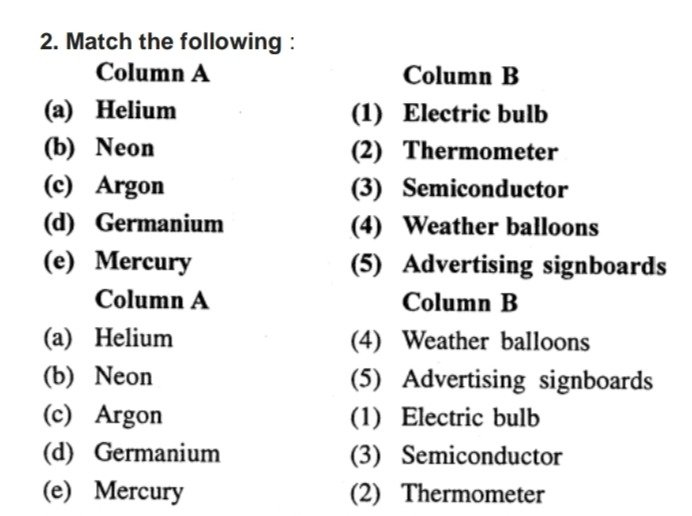
2. Match the following :
3. Write ‘true’ or ‘false’ for the following statements :
(a) Silver is used to make electric cables : False
(b) Iodine acts as an antiseptic in the form of tincture of iodine : True
(c) Sodium can be cut with a knife : True
(d) Antimony is a metal : False
(e) Sand is an oxide of silicon : True
MULTIPLE CHOICE QUESTIONS
1. The noble gas used in advertising signboards is
Ans :
(a) Helium
(b) Neon
(c) Argon
(d) Krypton
2. A metal with melting point less than 50°C is
Ans :
(a) Gallium
(b) Iron
(c) Gold
(d) Aluminium
3. A metal which is neither ductile nor malleable is
Ans :
(a) Copper
(b) Silver
(c) Zinc
(d) Aluminium
4. Rust is a hydrated oxide of iron which is
Ans :
(a) Reddish brown
(b) Green
(c) White
(d) Black
5. Aluminium is not used to make :
Ans :
(a) Foils
(b) Wires
(c) Fireworks
(d) Utensils
6. A metalloid used in the manufacture of microchips used in computer is :
Ans :
(a) Antimony
(b) Germanium
(c) Silicon
(d) Arsenic
7. A metalloid used to make glass :
Ans :
(a) Sulphur
(b) Germanium
(c) Silicon
(d) Antimony