
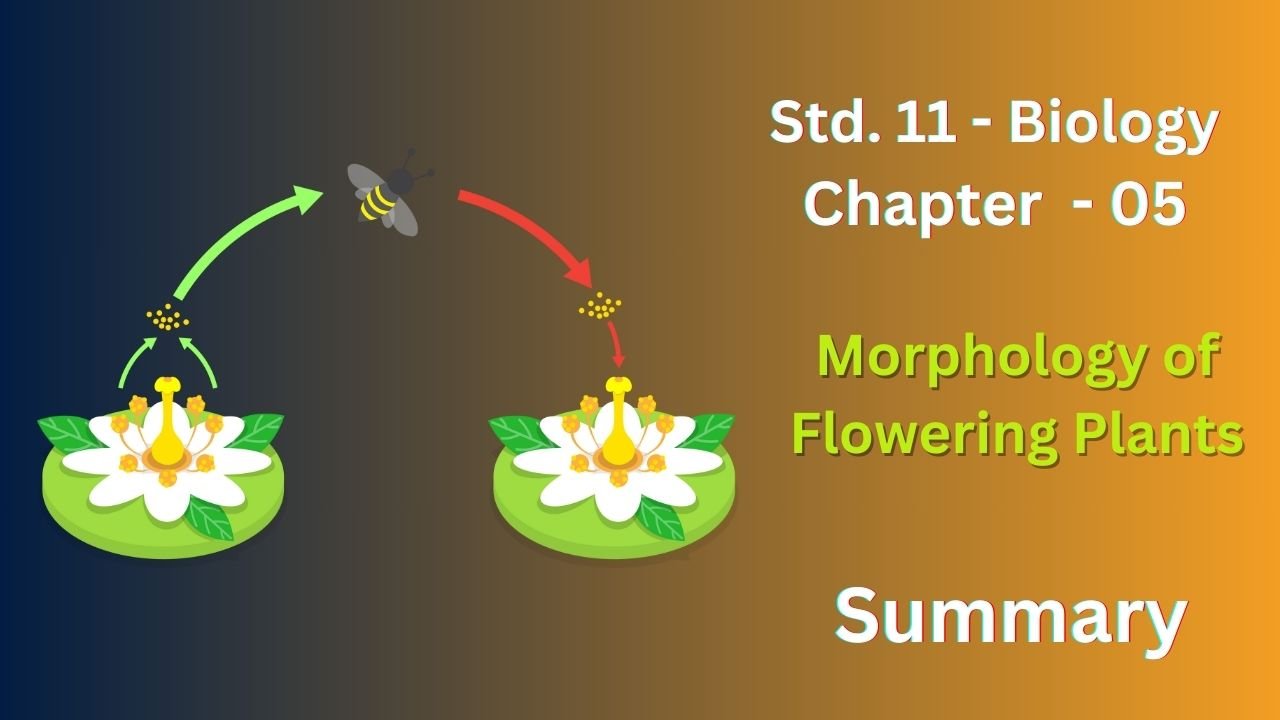
NCERT Solutions for Class 11 Biology Chapter 5
Morphology of flowering plants is the study of their external structure and form. This chapter delves into the various parts of a flowering plant, from the root system to the reproductive units.
Root System:
- Taproot: A single, main root that grows vertically downward (e.g., carrot).
- Fibrous Root System: Numerous, thread-like roots that grow in all directions (e.g., wheat).
- Adventitious Roots: Roots that arise from any part of the plant other than the radicle (e.g., aerial roots, prop roots).
Shoot System:
- Stem: The main axis of the plant, supporting the leaves, flowers, and fruits.
- Leaves: The photosynthetic organs of the plant, typically green and containing chlorophyll.
- Flowers: The reproductive units of a flowering plant, consisting of petals, sepals, stamens, and carpels.
- Fruits: The ripened ovaries of a flower, containing seeds.
Flower Structure:
- Calyx: The outermost whorl of sepals, usually green and protective.
- Corolla: The second whorl of petals, often brightly colored to attract pollinators.
- Androecium: The male reproductive whorl, consisting of stamens (filament and anther).
- Gynoecium: The female reproductive whorl, consisting of carpels (ovary, style, and stigma).
Fruits and Seeds:
- Fruits: The ripened ovaries, containing seeds. They can be fleshy or dry.
- Seeds: The reproductive units of a plant, containing the embryo and endosperm (nutrient storage tissue).
Seed Germination: The process by which a seed develops into a new plant.
Key Points:
- The morphology of flowering plants is adapted to their specific environments and functions.
- Understanding plant morphology is essential for identifying and classifying plants, as well as for agricultural and horticultural practices.
- The study of plant morphology provides insights into the evolutionary relationships between different plant groups.
NCERT Solutions for Class 11 Biology Chapter 5
Exercise
1. How is a pinnately compound leaf different from a palmately compound leaf?
Ans :
Pinnately compound and palmately compound leaves are two different types of compound leaves, which are leaves divided into multiple leaflets.
Pinnately compound leaf:
- The leaflets are arranged along a central axis or petiole like the feathers on a pinnate.
- The central axis can be unipinnate (with a single row of leaflets) or bipinnate (with two rows of leaflets).
- Examples of pinnately compound leaves include rose, neem, and mango.
Palmately compound leaf:
- The leaflets radiate from a single point at the end of the petiole, resembling the fingers of a palm.
- The number of leaflets varies, but it’s often five or seven.
- Examples of palmately compound leaves include castor, silk cotton, and neem.
NCERT Solutions for Class 11 Biology Chapter 5
2. Explain with suitable examples the different types of phyllotaxy.
Ans :
- Alternate:
- Arrangement: One leaf arises from each node, alternating with the leaves on adjacent nodes.
- Examples: Sunflower, mango, rose
- Opposite:
- Arrangement: Two leaves arise from each node, opposite each other.
- Examples: Hibiscus, jasmine, tulsi
- Whorled:
- Arrangement: More than two leaves arise from each node, arranged in a whorl.
- Examples: Nerium (oleander), Calotropis (milkweed)
NCERT Solutions for Class 11 Biology Chapter 5
3. Define the following terms:
(a) aestivation (b) placentation (c) actinomorphic (d) zygomorphic (e) superior ovary (f) perigynous flower (g) epipetalous stamen
Ans :
a) Aestivation: It can be valvate, imbricate, twisted, or quincuncial.
(b) Placentation: The arrangement of ovules within an ovary. It can be marginal, basal, parietal, axile, or free-central.
(c) Actinomorphic: A flower that can be divided into two equal halves along any plane passing through the center.
(d) Zygomorphic: A flower that can be divided into two equal halves only along one specific plane.
(e) Superior Ovary: An ovary that is positioned above the attachment point of the petals and sepals.
(f) Perigynous Flower: A flower in which the sepals, petals, and stamens are fused to form a cup-like structure around the ovary.
(g) Epipetalous Stamen: A stamen that is attached to the petal.
NCERT Solutions for Class 11 Biology Chapter 5
4. Differentiate between
(a) Racemose and cymose inflorescence (b) Apocarpous and syncarpous ovary
Ans :
(a) Racemose and cymose inflorescence
| Feature | Racemose Inflorescence | Cymose Inflorescence |
| Growth Pattern | Indeterminate growth, new flowers continue to develop at the tip | Determinate growth, oldest flowers are at the tip and new flowers develop laterally |
| Order of Flowering | Oldest flowers at the base, youngest at the tip | Oldest flowers at the tip, youngest at the base |
| Example | Raceme, spike, corymb, panicle | Cyme, scorpioid cyme, thyrse |
(b) Apocarpous and syncarpous ovary
| Feature | Apocarpous Ovary | Syncarpous Ovary |
| Carpels | Multiple free carpels | Carpels fused together |
| Ovules | Each carpel has its own ovary and ovules | Ovules are united in a single ovary |
| Fruit Formation | Each carpel forms a separate fruitlet | A single fruit forms from the fused carpels |
| Example | Strawberry, buttercup | Tomato, pea, rose |
NCERT Solutions for Class 11 Biology Chapter 5
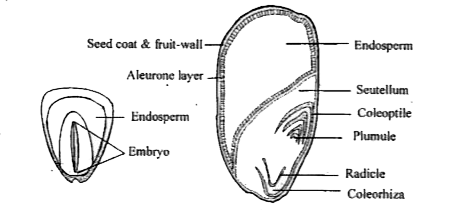
5. Draw the labelled diagram of the following: (i) gram seed (ii) V.S. of maize seed
Ans :
(i) gram seed

(ii) V.S. of maize seed
NCERT Solutions for Class 11 Biology Chapter 5
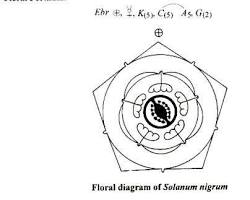
6. Take one flower of the family Solanaceae and write its semi-technical description. Also draw their floral diagram.
Ans :
Solanum nigrum (Black Nightshade)
Floral Description:
- Flower: Complete, bisexual, actinomorphic.
- Calyx: Five sepals, united, persistent, valvate aestivation.
- Corolla: Five petals, united, valvate aestivation, white or greenish-white.
- Androecium: Five stamens, epipetalous, didynamous.
- Fruit: Berry, usually black or purple.
- Seeds: Numerous, endospermic.
NCERT Solutions for Class 11 Biology Chapter 5
7. Describe the various types of placentations found in flowering plants.
Ans :
There are several different types of placentation found in flowering plants:
- Marginal:
- Ovules are positioned along the edge of the ovary.
- Example: Pea, bean
- Axile:
- Ovules are attached to the central axis of the ovary, which is formed by the fused carpels.
- Example: Tomato, cotton
- Parietal:
- Ovules are connected to the inner lining of the ovary.
- Example: Cucumber, mustard
- Free-central:
- Ovules are free and attached to a central column in the ovary.
- Example: Primrose, Dianthus
- Basal:
- Ovules are anchored to the base of the ovary.
- Example: Sunflower, marigold
NCERT Solutions for Class 11 Biology Chapter 5
8. What is a flower? Describe the parts of a typical angiosperm flower
Ans :
A flower is the reproductive organ of a flowering plant. It is where the process of pollination and fertilization takes place, leading to the production of seeds and fruits.
Parts of a Typical Angiosperm Flower:
- Petals: Colorful structures that attract pollinators.
- Sepals: Green, leaf-like structures that protect the flower bud.
- Stamens: Male reproductive organs consisting of:
- Filament: The stalk that supports the anther.
- Anther: The part that produces pollen grains.
- Carpel: Female reproductive organ consisting of:
- Stigma: The sticky tip that receives pollen.
- Ovary: The enlarged base that contains the ovules.
NCERT Solutions for Class 11 Biology Chapter 5
9. Define the term inflorescence. Explain the basis for the different types inflorescence in flowering plants.
Ans :
Inflorescence refers to the pattern in which flowers are arranged on a plant. It refers to the way flowers are grouped or clustered together on a stem.
Basis for Different Types of Inflorescence:
Inflorescences can be classified based on several factors, including:
- Growth pattern:
- Indeterminate: New flowers continue to develop at the tip of the inflorescence.
- Determinate: The oldest flowers are at the tip, and new flowers develop laterally.
- Arrangement of flowers:
- Racemose: Flowers are arranged in a linear or unbranched fashion.
- Cymose: Flowers are arranged in a branched fashion, with the oldest flowers at the base and the youngest at the tip.
- Presence or absence of bracts:
- Bracts are modified leaves that support or protect the flowers.
- Type of flowers:
- Whether the flowers are solitary or grouped together.
10. Describe the arrangement of floral members in relation to their insertion on thalamus.
Ans :
The arrangement of floral members in relation to their insertion on the thalamus is known as floral insertion. There are three main types of floral insertion:
- Perigyny:
- The ovary is semi-inferior, meaning it is partially embedded in the thalamus.
- The sepals, petals, and stamens are fused to form a cup-like structure around the ovary.
- Examples: Plum, peach, cherry
- Epigyny:
- The ovary is inferior, meaning it is completely embedded in the thalamus.
- Examples: Cucumber, pumpkin, apple
NCERT Solutions for Class 11 Biology Chapter 5
FAQ’s
What is the main focus of Class 11 Biology Chapter 5?
This chapter explains the external structure and forms of flowering plants, including roots, stems, leaves, flowers, fruits, and seeds.
Why is studying the morphology of flowering plants important?
It helps students identify plant parts, understand their functions, and classify plants scientifically based on visible features.
What topics are covered in Chapter 5 Morphology of Flowering Plants?
Key topics include types of roots, stem modifications, leaf forms, inflorescence, flower structure, fruit types, and seed morphology.
How do these concepts help in further Biology studies?
A clear understanding of plant morphology builds the foundation for botany, plant physiology, taxonomy, and advanced biological classification.
Are diagrams important for Class 11 Biology Chapter 5?
Yes, diagrams are essential as they help visualize plant structures and improve understanding and retention for exams.