1. The Need for Negative Numbers
In our daily lives, we often encounter values that are “less than zero.”
- Temperature: 5°C below freezing point is written as -5°C.
- Finances: A loss of ₹500 is written as -500.
- Elevation:100m below sea level is written as -100m.
2. What are Integers?
The collection of whole numbers and their negatives is called Integers. They are denoted by the letter Z or I.
- Positive Integers: 1, 2, 3, 4, …….
- Negative Integers: -1, -2, -3, -4, …..
- Zero (0): Zero is an integer, but it is neither positive nor negative.
3. The Number Line
The number line is the most important tool for visualizing integers.
- Positive numbers are to the right of zero.
- Negative numbers are to the left of zero.
- Rule: Any number to the right is always greater than the number to its left.
- Example: 2 > -5 and -1 > -10.
4. Absolute Value (Modulus)
The absolute value of an integer is its numerical distance from zero, regardless of its sign. It is denoted by two vertical bars $|x|$.
- 5 = 5
- -5 = 5
- The absolute value is always non-negative.
5. Operations on Integers
A. Addition
- Same Signs: Add the values and keep the common sign.
- (+5) + (+3) = +8
- (-5) + (-3) = -8
- Different Signs: Subtract the smaller numerical value from the larger and use the sign of the larger number.
- (-7) + (+3) = -4 (Since 7 – 3 = 4 and 7 is larger)
B. Subtraction
To subtract an integer, add its additive inverse (opposite).
- a – b = a + (-b)
- Example: 5 – (-3) = 5 + 3 = 8
6. Properties of Addition
- Closure Property: The sum of two integers is always an integer.
- Commutative Property: a + b = b + a.
- Associative Property: (a + b) + c = a + (b + c).
- Additive Identity: 0 is the identity (a + 0 = a).
- Additive Inverse: The opposite of a is -a because a + (-a) = 0.
EXERCISE 6
Question 1.
Fill in the blanks :
(i) Negative of -20 is ……….
(ii) Negative of 0 is …………
(iii) Negative of 8 is ………..
(iv) If 10 represents gain of ₹ 10, then -10 represents …………..
(v) If going south is negative then going north is …………
(vi) Because 5 < 7, therefore -5 ……….. -7. (vii) If 3 > -2, then 3 is on the ………….. of –
2.
(viii) If -8 < -6, then -8 is on the …………. of-6.
Solution :
(i) Negative of -20 is 20
- The negative of a negative number is always positive.
- -(-20) = 20.
(ii) Negative of 0 is 0
- Zero is unique because it is neither positive nor negative. Its opposite is itself.
(iii) Negative of 8 is -8
- The opposite (negative) of a positive number is a negative number.
(iv) If 10 represents gain of ₹ 10, then -10 represents Loss of ₹ 10
- In mathematics, “negative” usually represents the opposite direction or action. If gain is positive, loss is negative.
(v) If going south is negative then going north is positive
- North and South are opposite directions. If one is negative, the other must be positive.
(vi) Because 5 < 7, therefore -5 > -7
- This is a very important rule! When you multiply or consider the negative of numbers, the inequality sign flips.
(vii) If 3 > -2, then 3 is on the right of -2
- On a horizontal number line, the greater number is always placed to the right.
(viii) If -8 < -6, then -8 is on the left of -6
- Since -8 is smaller than -6, it must be placed to the left on the number line.
Question 2.
Use a number line to write the following integers in ascending (increasing) order :
(i) -5, 8, 0, -9, 4, -14 and 12
(ii) -6, 7, 0, -9, 5 and 9
Solution :
(i) -5, 8, 0, -9, 4, -14 and 12
Draw a number line for integers,, as shown below, and mark on it all the given integers.

Clearly, the given integers in the ascending order are :
-14 < -9 < -5 < 0 < 4 < 8 < 12
(ii) -6, 7, 0, -9, 5 and 9
Draw a number line for integers, as shown below, and mark on it all the given integers.
Clearly, the given integers in the ascending order are :
-9 < -6 < 0 < 5 < 7 < 9

Question 3.
Use a number line to write the following integers in descending (decreasing) order :
(i) -10, 0, 3, -4, 12, 11, -1 and 5
(ii) -4, 3, -8, -12, -7 and 6.
Solution :
(i) -10, 0, 3,-4, 12, 11,-1 and 5
Draw a number line for integers, as shown below, and mark on it all the given integers.

Clearly, the given integers in the descending order are :
6 > 3 > 0 > -7 > -8 > -10 > – 12
(ii) -4, 3, -8, -12, -7 and 6.
Draw a number line for integers, as shown below, and mark on it all the given integers.

Clearly, the given integers in the descending order are :
6 > 3 > -4 > -7 > -8 > -12
Question 4.
Add:
(i) 13 and 15
(ii) -13 and 15
(iii) 13 and -15
(iv) -13 and -15
Solution :
(i) 13 and 15
- Rule: Both are positive (same signs). Add the numbers and keep the positive sign.
- 13 + 15 = 28
(ii) -13 and 15
- Rule: Different signs. Subtract the smaller number from the larger number (15 – 13 = 2) and keep the sign of the larger number (15 is positive).
- -13 + 15 = 2
(iii) 13 and -15
- Rule: Different signs. Subtract the smaller number from the larger number (15 – 13 = 2) and keep the sign of the larger number (15 is negative).
- 13 + (-15) = -2
(iv) -13 and -15
- Rule: Both are negative (same signs). Add the numbers (13 + 15 = 28) and keep the negative sign.
- (-13) + (-15) = -28
Question 5.
Add:
(i) 259 from 214
(ii) -528 and -243
(iii) -623 and 326
(iv) 258 and -473
(v) -622 and -254
(vi) 257 and -254
Solution :
(i) 259 and 214
- Rule: Both are positive. Simply add them.
- 259 + 214 = 473
(ii) -528 and -243
- Rule: Both are negative (Same Signs). Add the numerical values and keep the negative sign.
- (528 + 243) = 771
- Result: -771
(iii) -623 and 326
- Rule: Different Signs. Subtract the smaller number from the larger (623 – 326 = 297) and keep the sign of the larger number (623 is negative).
- Result: -297
(iv) 258 and -473
- Rule: Different Signs. Subtract the smaller from the larger (473 – 258 = 215) and keep the sign of the larger number (473 is negative).
- Result: -215
(v) -622 and -254
- Rule: Both are negative (Same Signs). Add the numerical values and keep the negative sign.
- (622 + 254) = 876
- Result: -876
(vi) 257 and -254
- Rule: Different Signs. Subtract the smaller from the larger (257 – 254 = 3) and keep the sign of the larger number (257 is positive).
- Result: 3
Question 6.
Subtract :
(i) 5 from 8
(ii) -5 from 8
(iii) 4 from -7
(iv) -8 from -2
(v) -3 from 12
(vi) -6 from -3
Solution :
(i) 5 from 8
- Expression: 8 – 5
- Rule: Simple subtraction of positive numbers.
- Result: 3
(ii) -5 from 8
- Expression: 8 – (-5)
- Rule: Subtracting a negative is the same as adding a positive (8 + 5).
- Result: 13
(iii) 4 from -7
- Expression: -7 – 4
- Rule: Both numbers are now negative. Add the values (7 + 4) and keep the negative sign.
- Result: -11
(iv) -8 from -2
- Expression: -2 – (-8)
- Rule: Becomes -2 + 8 Since signs are different, subtract 2 from 8 and keep the positive sign (from 8).
- Result: 6
(v) -3 from 12
- Expression: 12 – (-3)
- Rule: Becomes 12 + 3.
- Result: 15
(vi) -6 from -3
- Expression: -3 – (-6)
- Rule: Becomes -3 + 6. Subtract 3 from 6 and keep the positive sign.
- Result: 3
Question 7.
Subtract:
(i) -123 from 453
(ii) -78 from -12
(iii) 329 and -124
(iv) -222 from 0
Solution :
(i) Subtract -123 from 453
- Expression: 453 – (-123)
- Step: The double negative becomes a plus: 453 + 123
- Result: 576
(ii) Subtract -78 from -12
- Expression: -12 – (-78)
- Step: This becomes -12 + 78.
- Rule: Since the signs are different, subtract 12 from 78 (78 – 12 = 66). Since 78 is the larger absolute value and is positive, the answer is positive.
- Result: 66
(iii) Subtract 329 and -124
- Expression: 329 – (-124)
- Step: This becomes 329 + 124.
- Result: 453
(iv) Subtract -222 from 0
- Expression: 0 – (-222)
- Step: This becomes 0 + 222.
- Result: 222
Question 8.
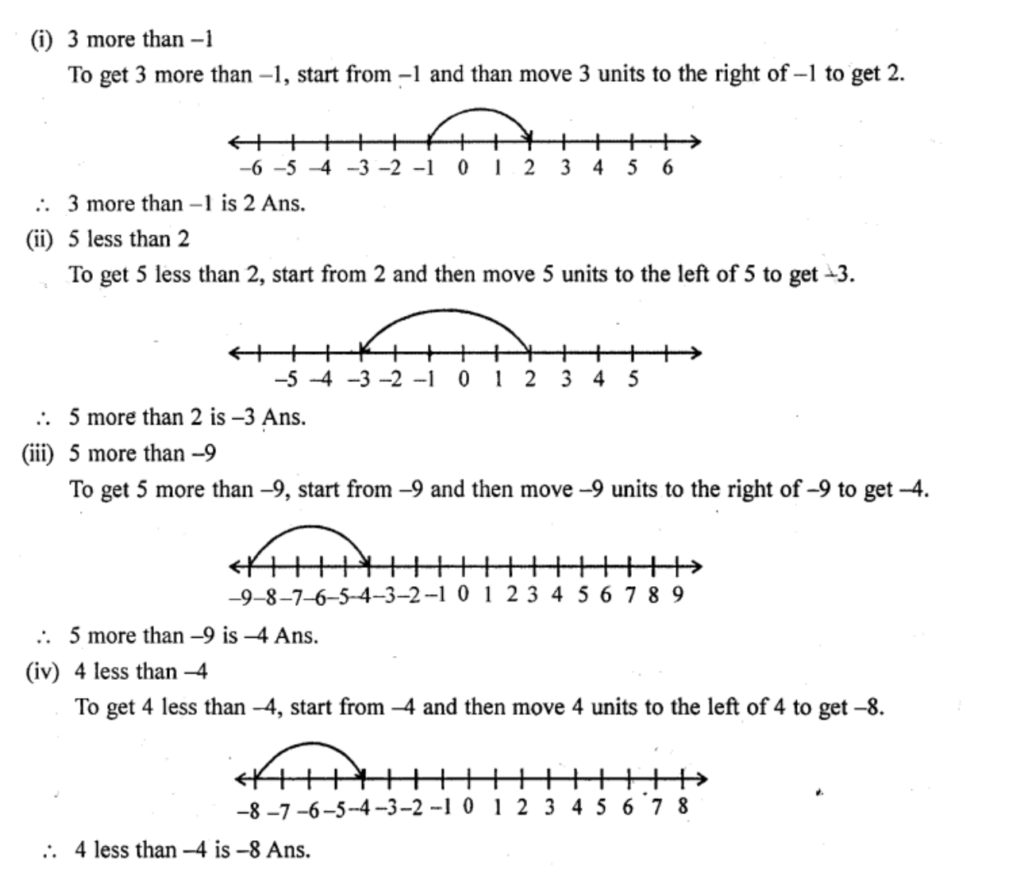
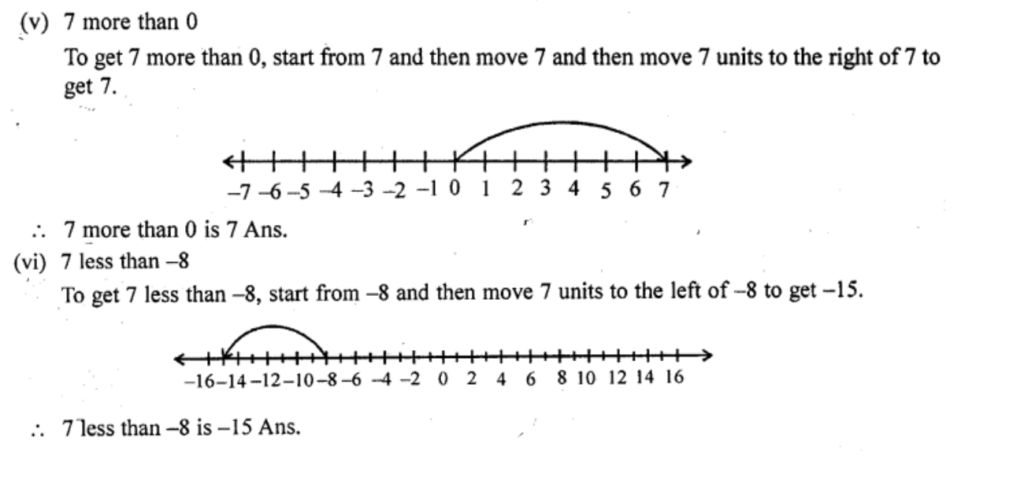
Using a number line, find the integer which is :
(i) 3 more than -1
(ii) 5 less than 2
(iii) 5 more than -9
(iv) 4 less than -4
(v) 7 more than 0
(vi) 7 less than -8
Solution :