1. Structure of a Number Line
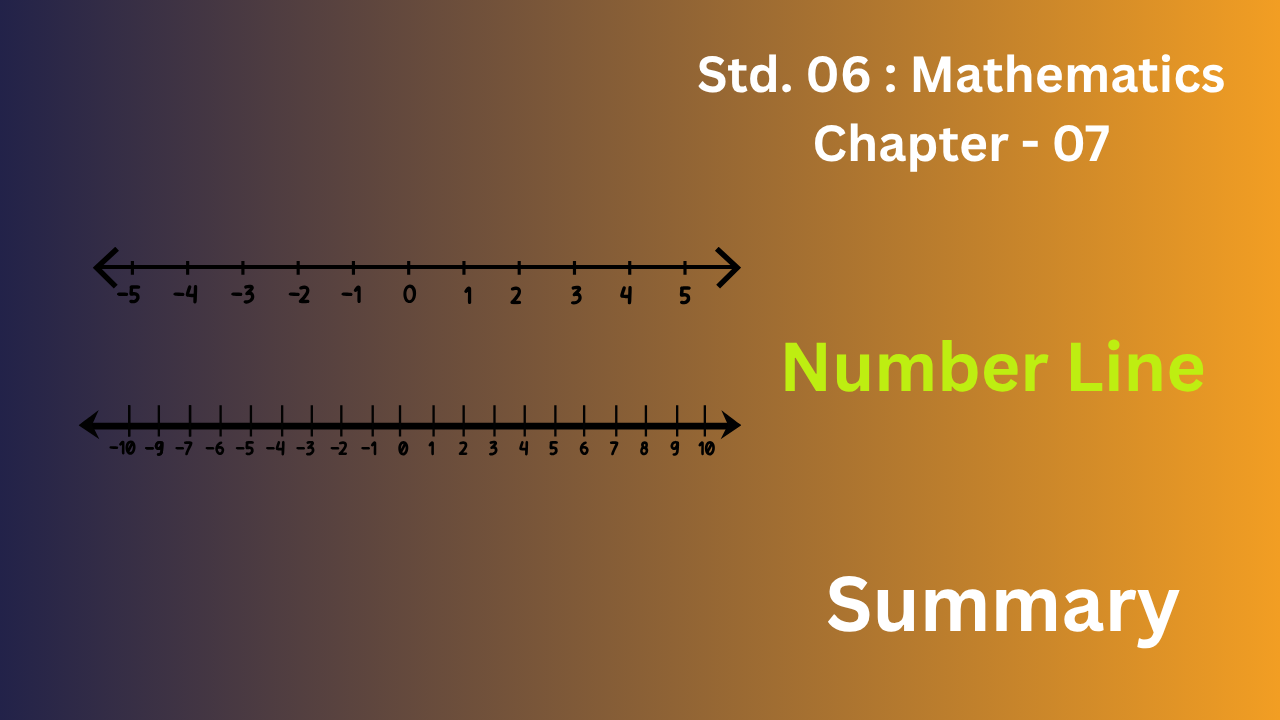
A number line is a straight line where every point corresponds to a specific number.
- The Origin: The point labeled 0 is the starting point.
- Positive Direction: Numbers to the right of zero are positive (1, 2, 3, ……).
- Negative Direction: Numbers to the left of zero are negative (-1, -2, -3, …….).
- Equality of Units: The distance between any two consecutive integers (e.g., between 1 and 2) is always equal and is called a unit distance.
2. Comparing Numbers
The number line makes it very easy to see which number is “bigger.”
- Rule of Right: Any number that lies to the right of another number is always greater.
- Example: 5 is to the right of 2, so 5 > 2.
- Example: -1 is to the right of -5, so -1 > -5.
- Rule of Left: Any number that lies to the left of another number is always smaller.
3. Successor and Predecessor
- Successor: To find the successor, move one unit to the right (+1).
- The successor of -3 is -2.
- Predecessor: To find the predecessor, move one unit to the left (-1).
- The predecessor of -3 is -4.
4. Operations on the Number Line
A. Addition
To add a positive number, you move to the right.
- To solve 2 + 3: Start at 2 and jump 3 units to the right. You land on 5.
- To solve -4 + 2: Start at -4 and jump 2 units to the right. You land on -2.
B. Subtraction
To subtract a positive number, you move to the left.
- To solve 6 – 4: Start at 6 and jump 4 units to the left. You land on 2.
- To solve 1 – 3: Start at 1 and jump 3 units to the left. You land on -2.
5. Absolute Value (Modulus)
On a number line, the absolute value is simply the distance between a number and zero, regardless of direction. Since distance cannot be negative, the absolute value is always positive or zero.
- |-7| = 7 (because it is 7 units away from zero).
EXERCISE 7(A)
Question 1.
Fill in the blanks, using the following number line :

(i) An integer, on the given number line, is ………… than every number on its left.
(ii) An integer, on the given number line, is greater than every number to its …………..
(iii) 2 is greater than – 4 implies 2 is to the ………….. of – 4.
(iv) -3 is ………….. than 2 and 3 is ………. than – 2.
(v) – 4 is ………….. than -8 and 4 is …………… than 8.
(vi) 5 is …………. than 2 and -5 is …………… than – 2.
(vii) -6 is …………. than 3 and the opposite of -6 is ………… than opposite of 3.
(viii) 8 is …………. than -5 and -8 is ……….. than -5.
Solution :
(i) An integer, on the given number line, is greater than every number on its left.
(ii) An integer, on the given number line, is greater than every number to its left.
(iii) 2 is greater than – 4 implies 2 is on the right of – 4.
(iv) – 3 is less than 2 and 3 is greater than -2.
(v) – 4 is greater than -8 and 4 is less than 8.
(vi) 5 is greater than 2 and – 5 is less than – 2.
(vii) -6 is less than 3 and the opposite of -6 is greater than opposite of 3.
(viii) 8 is greater than -5 and -8 is less than -5.
Question 2.
In each of the following pairs, state which integer is greater :
(i) -15, -23
(ii) -12, 15
(iii) 0, 8
(iv) 0, -3
Solution :
(i) -15, -23
- Logic: On a number line, -15 is closer to zero and lies to the right of -23. In negative numbers, the one with the smaller numerical value is actually greater.
- Greater Integer: -15
(ii) -12, 15
- Logic: Every positive integer is always greater than every negative integer. Since 15 is positive and -12 is negative, 15 is further to the right.
- Greater Integer: 15
(iii) 0, 8
- Logic: Zero is less than every positive integer. Since 8 is a positive counting number, it lies to the right of zero.
- Greater Integer: 8
(iv) 0, -3
- Logic: Zero is greater than every negative integer. On the number line, 0 is to the right of -3.
- Greater Integer: 0
Question 3.
In each of the following pairs, which integer is smaller :
(i) o, -6
(ii) 2, -3
(iii) 15, -51
(iv) 13, 0
Solution :
(i) 0, -6
- Logic: Zero is greater than every negative integer. On the number line, -6 is to the left of 0.
- Smaller Integer: -6
(ii) 2, -3
- Logic: Every negative integer is smaller than every positive integer. Since -3 is negative and 2 is positive, -3 lies to the left.
- Smaller Integer: -3
(iii) 15, -51
- Logic: Even though 51 is a large number, the minus sign (-) makes it very small. Every negative integer is smaller than every positive integer.
- Smaller Integer: -51
(iv) 13, 0
- Logic: Zero is smaller than every positive integer. Since 13 is a positive counting number, 0 lies to its left.
- Smaller Integer: 0
Question 4.
In each of the following pairs, replace * with < or > to make the statement true:
(i) 3 * 0
(ii) 0 * -8
(iii) -9 * -3
(iv) 3 * 3
(v) 5 * -1
(vi) -13 * 0
(vii) -8 * -18
(viii) 516 * -316
Solution :
(i) 3 > 0
- Reason: Every positive integer is greater than zero.
(ii) 0 > -8
- Reason: Zero is always greater than any negative integer.
(iii) -9 < -3
- Reason: On the number line, -9 is further to the left than -3. (The larger the negative number “looks,” the smaller it actually is).
(iv) 3 = 3
- Note: Since the question asks for < or >, this pair is likely a typo in your textbook or meant to be compared as equal. If you must choose, they are exactly the same value.
(v) 5 > -1
- Reason: A positive integer is always greater than a negative integer.
(vi) -13 < 0
- Reason: Every negative integer is less than zero.
(vii) -8 > -18
- Reason: -8 is closer to zero (to the right) than -18.
(viii) 516 > -316
- Reason: A positive number (516) is always greater than a negative number (-316).
Question 5.
In each case, arrange the given integers in ascending order using a number line.
(i) – 8, 0, – 5, 5, 4, – 1
(ii) 3, – 3, 4, – 7, 0, – 6, 2
Solution :
i) – 8, 0, – 5, 5, 4, – 1

- Identify the negatives: Between -8, -5, and -1, the number -8 is the furthest to the left.
- The Center: 0.
- Identify the positives: 4 comes before 5.
Ascending Order:
– 8, – 5, – 1, 0, 4, 5
(ii) 3, – 3, 4, – 7, 0, – 6, 2

- Identify the negatives: Between -7, -6, and -3, the number -7 is the furthest to the left.
- The Center: 0.
- Identify the positives: 2 comes first, then 3, then 4.
Ascending Order:
– 7, – 6, – 3, 0, 2, 3, 4
Question 6.
In each case, arrange the given integers in descending order using a number line.
(i) -5, -3, 8, 15, 0, -2
(ii) 12, 23, -11, 0, 7, 6
Solution :
(i) -5, -3, 8, 15, 0, -2

- Identify the largest positives: Between 15 and 8, 15 is the furthest right.
- The Center: 0.
- Identify the negatives: Moving left from zero, we first meet -2, then -3, and finally -5.
Descending Order:
15, 8, 0, -2, -3, -5
(ii) 12, 23, -11, 0, 7, 6

- Identify the largest positives: Among 23, 12, 7, and 6, 23 is the furthest right.
- The Center: 0.
- Identify the negative: There is only one negative integer, -11, which is the smallest and goes last.
Descending Order:
23, 12, 7, 6, 0, -11
Question 7.
For each of the statements, given below, state whether it is true or false :
(i) The smallest integer is 0.
(ii) The opposite of -17 is 17.
(iii) The opposite of zero is zero.
(iv) Every negative integar is smaller than 0.
(v) 0 is greater than every positive integer.
(vi) Since, zero is neither negative nor positive ; it is not an integer.
Solution :
(i) The smallest integer is 0. — FALSE
- Reason: Integers go infinitely in both directions. Negative integers like -1, -100, and -1,000,000 are all smaller than 0. There is no “smallest” integer.
(ii) The opposite of -17 is 17. — TRUE
- Reason: The “opposite” (or additive inverse) of a number is the same distance from zero but on the other side of the number line. The opposite of a negative is always positive.
(iii) The opposite of zero is zero. — TRUE
- Reason: Zero is the only integer that is its own opposite because it is the center point of the number line.
(iv) Every negative integer is smaller than 0. — TRUE
- Reason: On a horizontal number line, all negative integers lie to the left of zero. Any number to the left is always smaller.
(v) 0 is greater than every positive integer. — FALSE
- Reason: Zero is actually smaller than every positive integer (1, 2, 3, …….). Positive integers lie to the right of zero.
(vi) Since, zero is neither negative nor positive; it is not an integer. — FALSE
- Reason: While it is true that zero is neither positive nor negative, it is still very much a member of the Integer family. The set of integers includes {…….., -2, -1, 0, 1, 2, }.
EXERCISE 7(B)
Use a number line to evaluate each of the following :
Question 1.
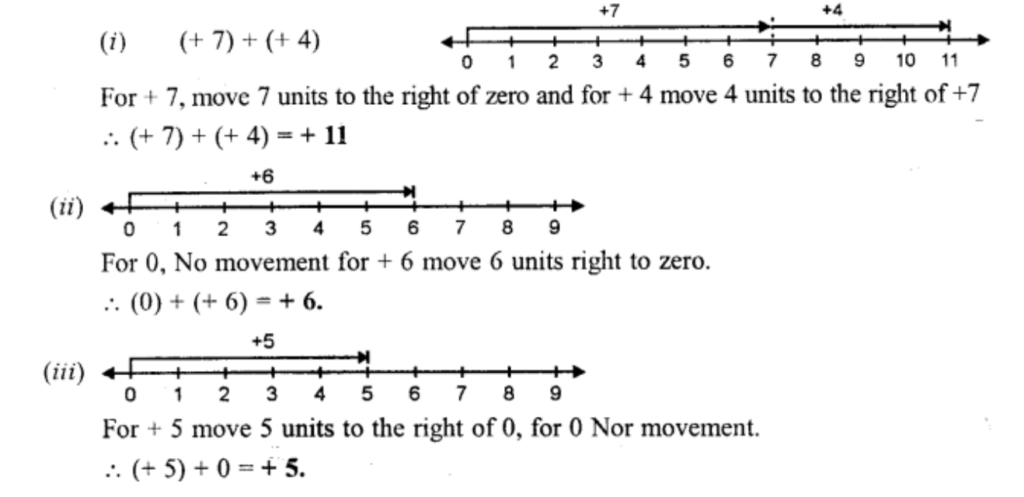
(i) (+ 7) + (+ 4)
(ii) 0 + (+ 6)
(iii) (+ 5) + 0
Solution :
Question 2.
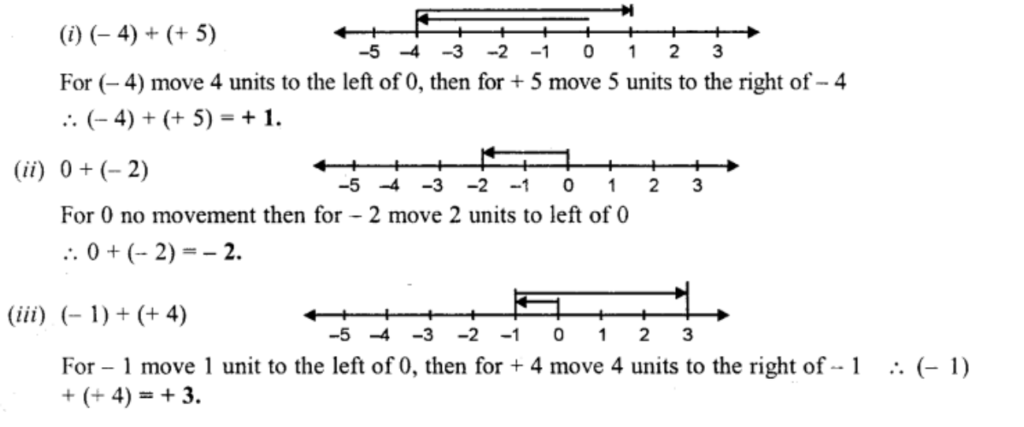
(i) (-4) + (+5)
(ii) 0 + (-2)
(iii) (-1) + (-4)
Solution :
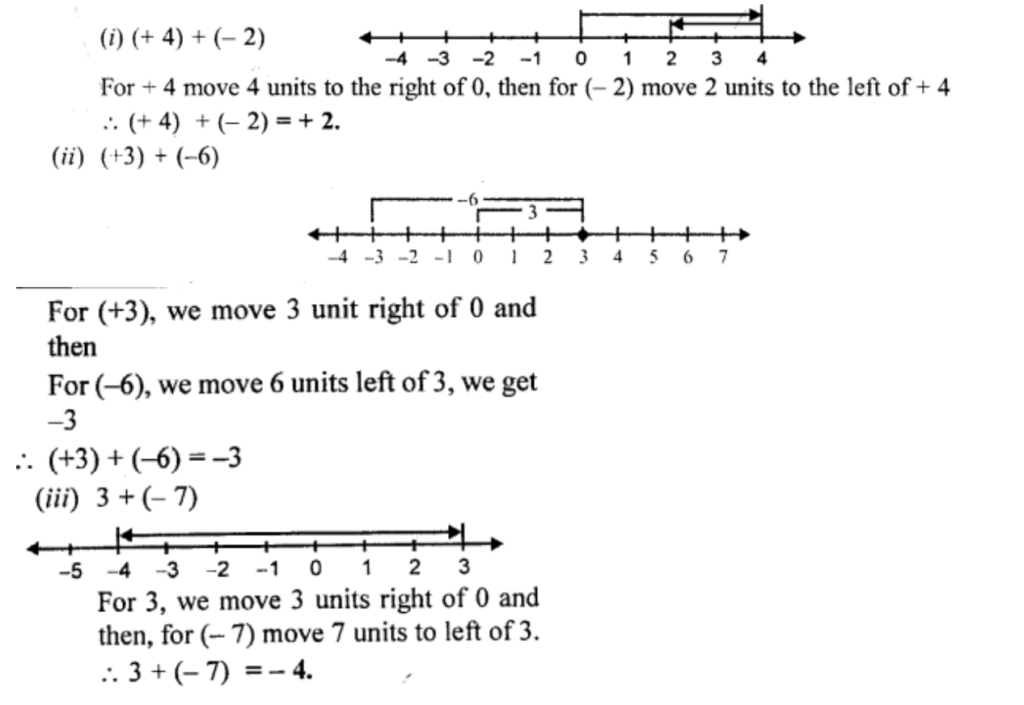
Question 3.
(i) (+ 4) + (-2)
(ii) (+3) + (-6)
(iii) 3 + (-7)
Solution :
Question 4.
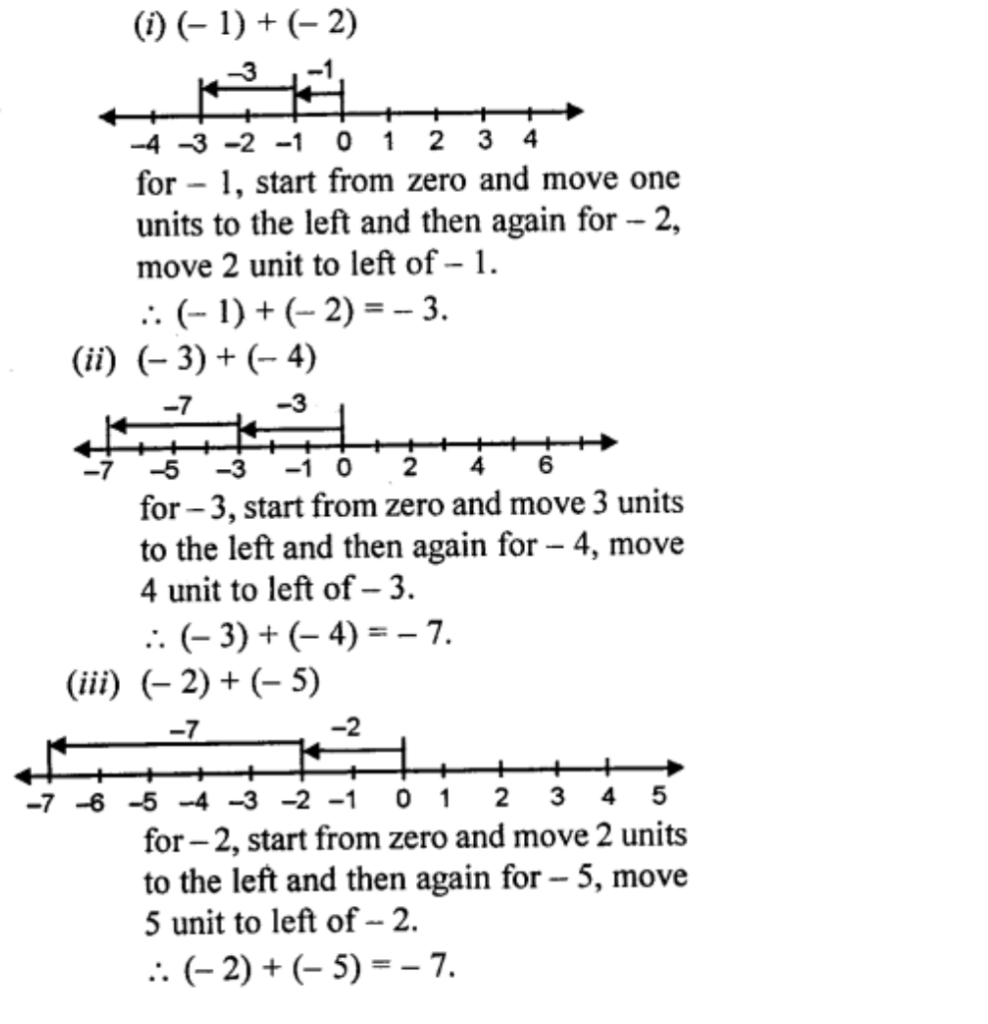
(i) (-1) + (-2)
(ii) (-2) + (-5)
(ii) (-3) + (-4)
Solution :
Question 5.
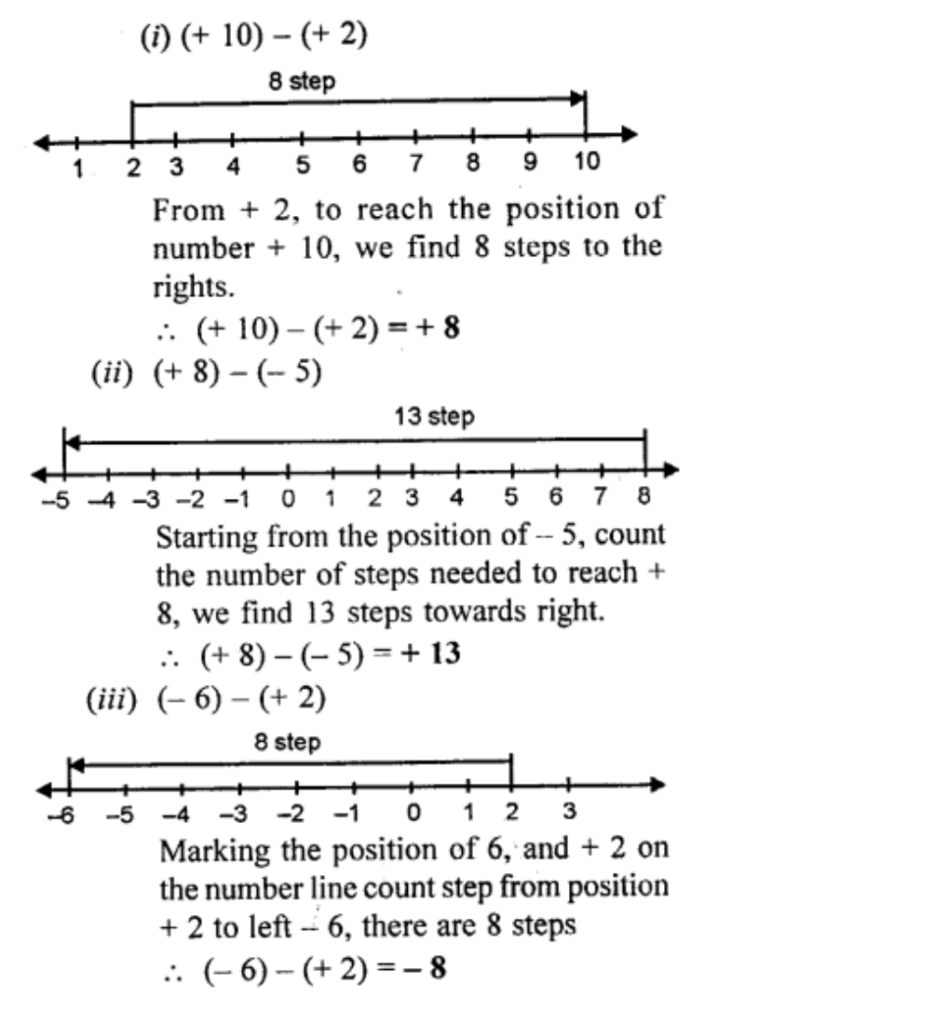
(i) (+ 10) – (+2)
(ii) (+8)- (-5)
(iii) (-6) – (+2)
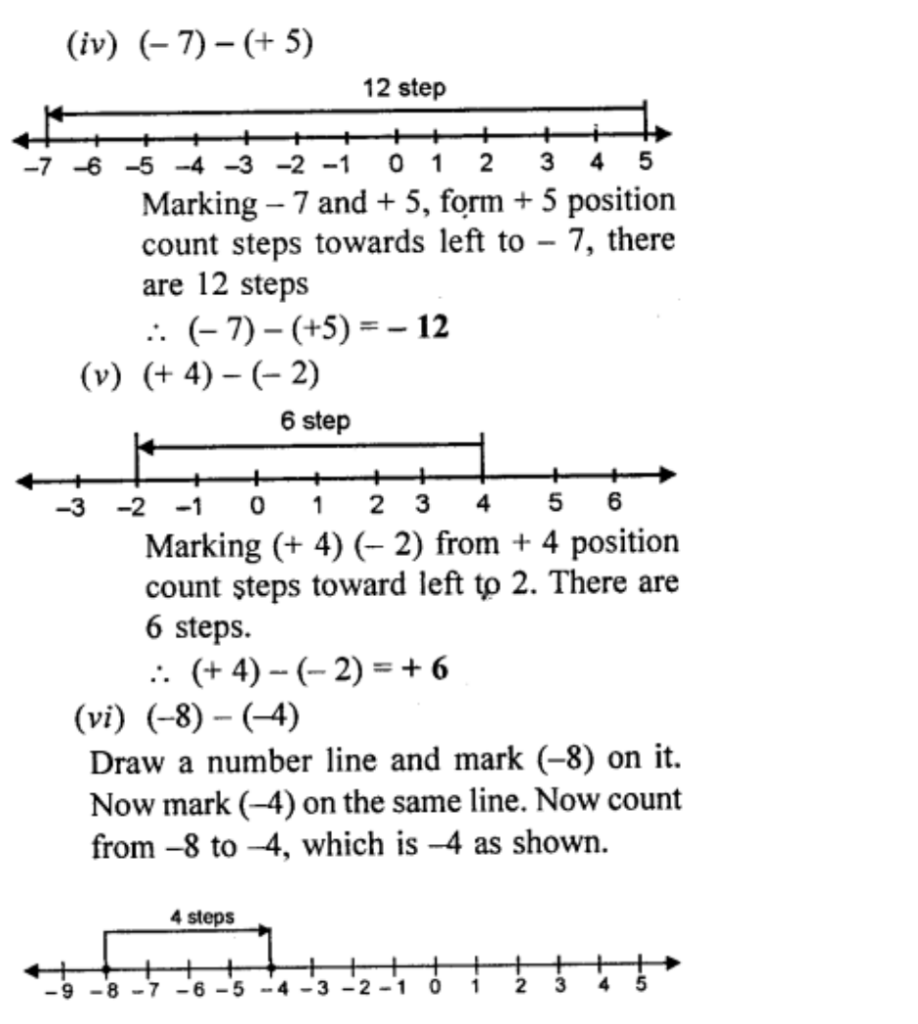
(iv) (-7) – (+5)
(v) (+4) – (-2)
(vi) (-8) – (-4)
Solution :
Question 6.
Using a number line, find the integer which is :
(i) 3 more than -1
(ii) 5 less than 2
(iii) 5 more than -9
(iv) 4 less than -4
(v) 7 more than 0
(vi) 7 less than -8
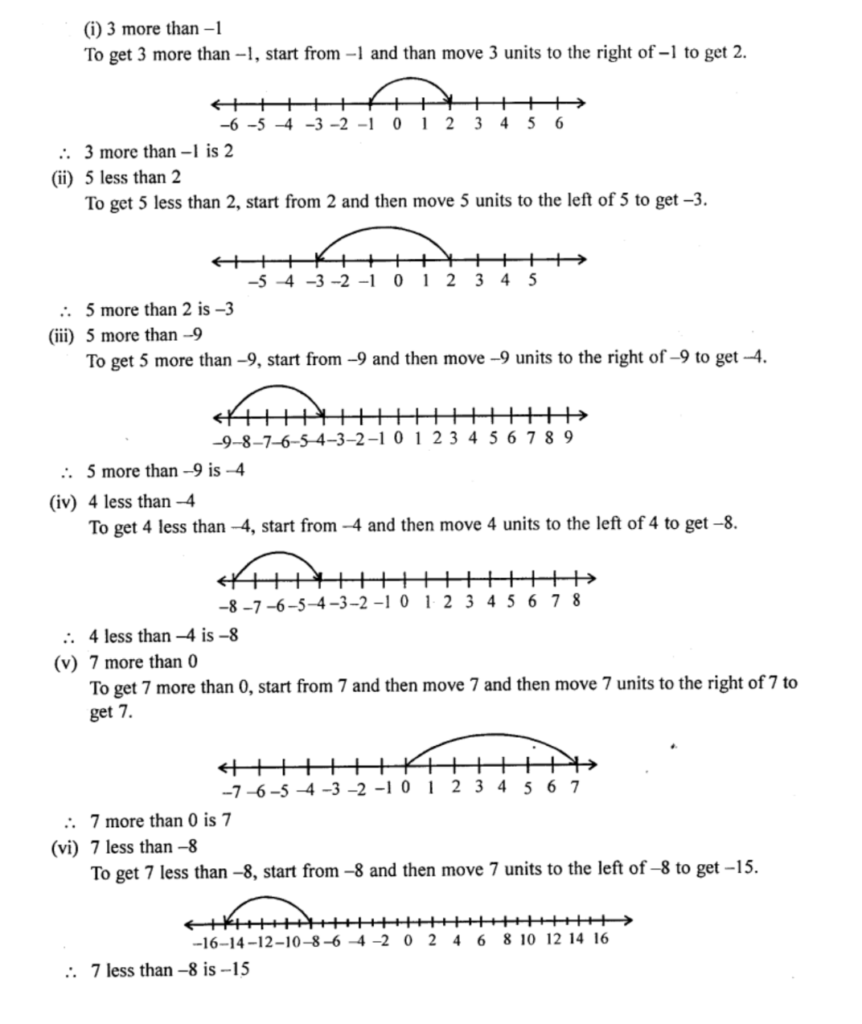
Solution :