
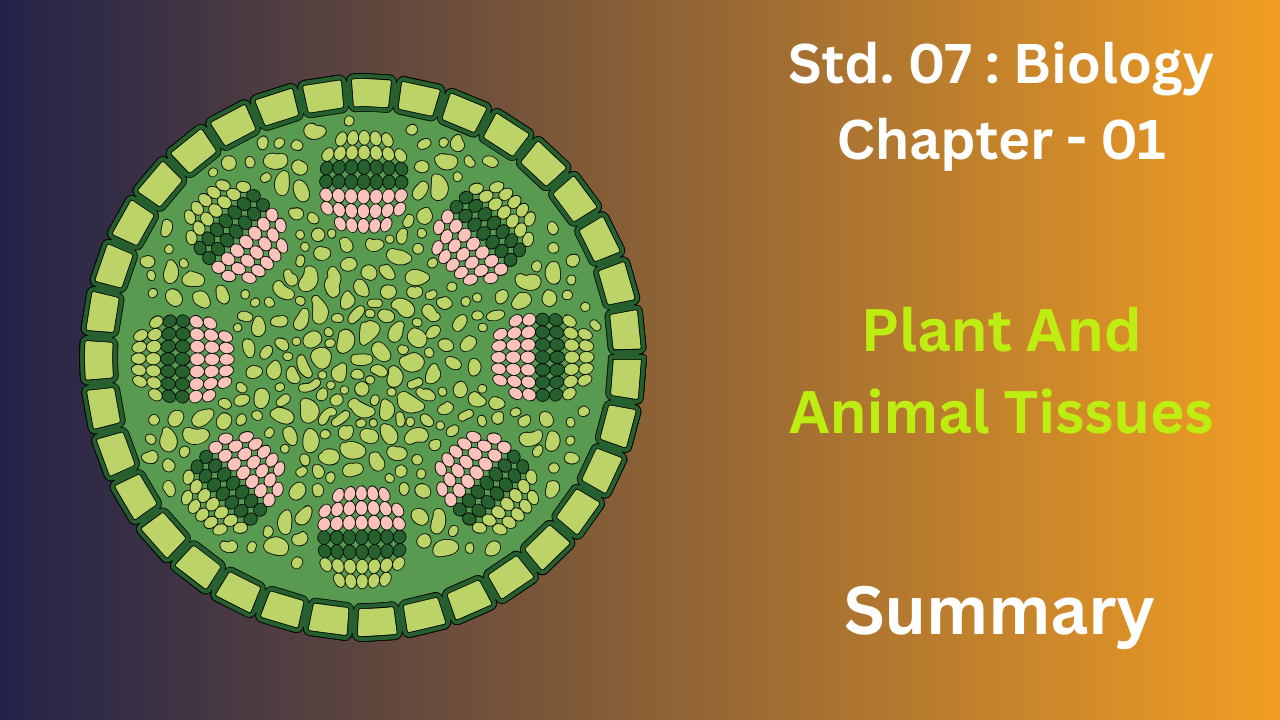
Plant Tissues: Divided into meristematic (actively growing) and permanent (specialized, non-dividing). Permanent tissues include simple types like parenchyma (storage, support), collenchyma (flexibility), and sclerenchyma (strength), and complex types like xylem (water transport) and phloem (food transport).
Animal Tissues: Main types are epithelial (covering, lining, protection, etc.), connective (support, connection; includes blood, bone, cartilage, fat), muscular (movement; skeletal, smooth, cardiac), and nervous (communication).
Both plant and animal tissues are groups of similar cells performing specific functions crucial for the organism’s survival and organization.
MULTIPLE CHOICE QUESTIONS
1. Put a tick (✓) against the most appropriate alternative in the following statements.
(i) A group of similar cells to perform a specific function forms a
(a) organ
(b) species
(c) organ system
(d) tissue
(ii) The fine branches given out from the cell body of a nerve cell are
(a) dendrites
(b) cyton
(c) axon
(d) neurons
(iii) Fluid connective tissue of humans is
(a) blood and cartilage
(b) lymph and plasma
(c) blood and lymph
(d) stroma and matrix
Short Answer Questions
Question 1.
1. Define the following terms:
- Tissue
- Organ
Ans:
Tissue: Biologically, a tissue is a cohesive assembly of comparable cells collaborating to execute a particular task. These cells typically share a common origin and are arranged to operate in unison. In the animal kingdom, the primary tissue categories are epithelial, connective, muscular, and nervous. Within plants, key tissue types encompass meristematic, parenchyma, collenchyma, sclerenchyma, xylem, and phloem.
Organ: An organ represents a specialized structure within a multicellular organism, formed by the integration of various tissues that function in concert to carry out a specific task or a set of related tasks. In the biological hierarchy, an organ is situated between the level of a tissue and that of an organ system. Examples in animals include the heart, lungs, stomach, and kidneys, while in plants, these include roots, stems, leaves, and flowers.
2. Answer the following:
Question 2(i).
What is a meristematic tissue ? How is it different from permanent tissues ?
Ans:
Found in growing regions like root and shoot tips, buds, and cambium, these cells have dense cytoplasm, a large nucleus, thin walls, and small vacuoles. Their main role is to produce new cells that will differentiate into specialized permanent tissues.
Permanent tissues originate from meristematic tissues and have lost the ability to divide. Their cells are differentiated and specialized for specific functions like photosynthesis, transport, storage, and support. Composed of mature, living or dead cells, they often have thicker walls and larger vacuoles than meristematic cells. They form the main plant body and perform all functions except active growth in length and width, which is carried out by meristematic tissues.
Question 2(ii).
Which living material would you take to demonstrate meristematic tissue ?
Ans:
To demonstrate meristematic tissue using living material, you would take sprouting seeds, such as green gram (mung beans) or onion bulbs with developing roots.
Here’s why:
- Sprouting Seeds: When seeds germinate and begin to sprout, the root and shoot tips are areas of rapid cell division and growth. The very tip of the growing root is rich in apical meristem, which is responsible for increasing the length of the root. You can easily observe this actively growing region under a microscope.
- Onion Bulbs with Developing Roots: Similarly, when an onion bulb is placed in water, it starts to develop roots from its base. The tips of these developing roots contain apical meristem, which is actively dividing to allow the roots to grow longer. These root tips are also a good source of meristematic tissue for observation.
In both cases, the root tips are particularly good for demonstrating apical meristematic tissue due to their active and easily accessible growth. You would need to carefully dissect the root tip and prepare a slide to observe the cells under a microscope.
Question 2(iii).
What is the function of meristematic tissue ?
Ans:
The core function of meristematic tissue is the creation of new cells through swift and continuous division. These nascent cells then undergo a process of specialization and maturation, developing into various permanent tissues with specific functions within the plant.
Fundamentally, meristematic tissue drives plant growth, both in length (primary growth at the tips of roots and shoots, facilitated by apical and intercalary meristems) and in width or thickness (secondary growth in woody plants, driven by lateral meristems like the vascular cambium). Additionally, it plays a role in the repair of injured tissues and the formation of new plant structures such as leaves, buds, and flowers.
Question 3.
State whether the following statements are True or False.
(i) A tissue is formed of only one type of cells.
Ans. True
(ii) Only one type of tissue forms an organ.
Ans. False.
Correct: Two or more types of tissue form an organ.
(iii) Permanent tissue is made up of undifferentiated and dividing Cells.
Ans. False.
Correct: Meristematic tissue is made up of undifferentiated and dividing cells.
(iv) Meristematic tissue is found at growing tips of a plant.
Ans. True
(v) Phloem is formed of dead tubular cells.
Ans. False.
Correct: Phloem is formed of living tubular cells.
Question 4.
Fill in the blanks by selecting suitable words from the list given below:
“Thin – walled, collenchyma, vascular, tissues, conducting”
- A group of different tissues working together to perform a function is called an organ.
- Xylem and phloem form the conducting tissue.
- Conducting tissue is also called vascular tissue.
- Cells are elongated and thick at the comers in collenchyma tissue.
- Parenchyma is composed of large thin-walled cell
Question 5.
Match the items given is column A with those given in column B:
Column A
(i) Fibrous connective tissue
(ii) Fluid connective tissue
(iii) Supportive connective tissue
(iv) Ligament
(v) Tendon
Column B
(a) blood
(b) cartilage
(iii) Supportive connective tissue
another bone.
(d) areolar tissue
(e) connects a muscle
with a bone.
Question 6.
How do you rank the following among cells, tissues, organs, or organism ?
- Amoeba : organism
- Euglena: organism
- Skin : organ
- Lungs : organ
- Neuron : tissue
- Cardiac muscles: Ti1ue
Question 7.
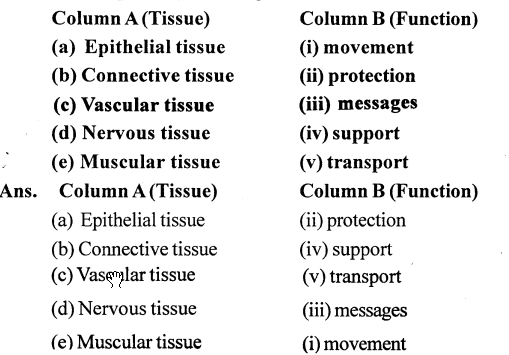
Each of the tissues listed in Column A is related to one of the functions given in Column
B. Match the lines correct pairs by drawing
Question 8.
Name the kind of tissue that
- Carries oxygen around your body — Blood tissue.
- Brings about movements in animals — muscular tissue.
- Transports food to different parts of plant— phloem.
- Transports water in plants — xylem.
- Supports an animal’s body — connective tissue (supportive)
- Binds different tissues together — Fibrous connective tissue.
- Conducts messages from one part of the body to another — nervous tissue.
Question 9.
Based on the following information, identify the three types of epithelial tissue in the figures given below :
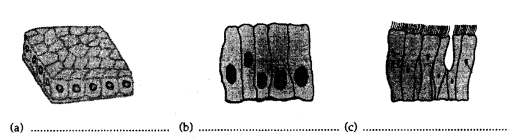
(i) Cuboidal epithelium : It consists of a single layer of cuboidal cells.
(ii) Columnar epithelium: It is composed of tall, cylindrical cells with oval nuclei usually placed at the base of the cells.
(iii) Ciliated epithelium : It consists of cells being hair-like cilia on their free surface.
Ans:
(i) fig. b (ii) fig. a (iii) fig. C
Question 10.
Write three differences between the two principal vascular tissues found in plants.
Ans:
Transportation Content: Xylem’s primary role is to conduct water and dissolved inorganic nutrients in an upward direction from the roots. Conversely, phloem’s main function is to transport sugars (produced during photosynthesis) and other organic substances throughout the plant, with movement occurring in both upward and downward directions.
Cellular Composition: The principal conducting cells of xylem, namely tracheids and vessel elements, are non-living at their functional maturity. Their thick, often lignin-reinforced walls provide structural support. In contrast, phloem’s conducting cells, sieve tube elements, are living cells, although they lack a nucleus at maturity, and are associated with metabolically active companion cells.
Transport Mechanism: Water movement in xylem is largely a passive process, driven by transpiration pull, the cohesive and adhesive properties of water, and root pressure, requiring minimal energy expenditure by the plant. Conversely, the translocation of sugars in phloem is an active process that necessitates metabolic energy, as explained by the pressure flow hypothesis involving active loading and unloading of sugars.