

The “Rise of Kingdoms and Republics” chapter in your Class 6 history book basically tells the story of how things went from small tribal groups to bigger kingdoms in ancient India. It probably talks about how iron tools helped farming get better, leading to more food and bigger settlements called Janapadas. Then, some Janapadas got really strong and turned into the Mahajanapadas, with Magadha being a key player.
The chapter likely explains that back then, some places had kings who passed their power down, while others were like early democracies with elected leaders, like the Lichchhavis. It’ll probably focus on why Magadha became so powerful – things like its location, resources like iron and elephants, and ambitious kings like Bimbisara. You’ll also likely learn about the Nanda dynasty that ruled Magadha and maybe a bit about Alexander the Great’s brief visit and how it shook things up. The chapter might even give you a sneak peek at Chandragupta Maurya before he built his big empire.
Basically, it’s all about how India’s political map started to take shape, moving towards bigger states and different ways of ruling.
Exercise
I. Fill in the blanks:
- More powerful territories in the 6th century were referred to as————.
Ans : Mahajanapadas
- In ————- kingship was hereditary.
Ans : monarchy
- ———— emerged as the most powerful kingdom in North India in the sixth century BC.
Ans : Magadha
- ————- invaded India in 326 BC.
Ans : Alexander the Great
- ———— impressed Alexander by his bravery and wisdom.
Ans : Porus
- A new school of art called ——— developed, as a result of Alexander’s invasion of India.
Ans : Gandhara
II. Match Column A with Column B:
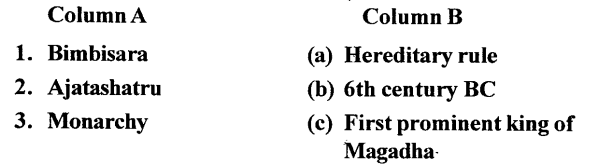

Answer:
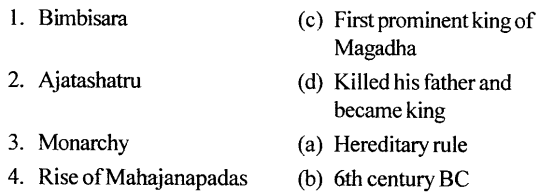
III. Long Answer type Questions:
Question 1.
What were the main advantages that helped Magadha to emerge as the most powerful kingdom?
Answer:Magadha’s rise to power wasn’t by chance; it had some serious advantages going for it. First off, its location was a winner. Being surrounded by rivers like the Ganga and Son meant fertile land for great harvests and easy transportation for trade and moving armies around. Plus, the nearby iron ore deposits gave them a real edge in making strong weapons and tools. Magadha also had ambitious and smart rulers who weren’t afraid to use clever strategies and build a strong military. They also had elephants in their forests, which were like ancient tanks in warfare. All these factors combined to make Magadha the top dog in ancient India
Question 2.
What policy did Bimbisara follow to extend his territories?
Answer:Bimbisara was a smart ruler who used two main strategies to build his kingdom. 1 He made peaceful alliances by marrying princesses from powerful neighboring kingdoms like Kosala and Lichchavi. 2 This gave him influence and security without fighting. 3 At the same time, he didn’t hesitate to use his army to conquer weaker neighbors like Anga, directly adding their land to his territory. 4 This two-pronged approach helped Magadha grow strong
IV. Short Answer type Questions:
- What is meant by the term Janapada ?
Ans.The term “Janapada” literally means “the land where the Jana (tribe or people) put their foot.” In ancient India, during the Vedic period (roughly 1500-600 BCE), it referred to a settled territory or a rudimentary state with defined boundaries where a specific tribe or community resided. These Janapadas were the primary political and territorial units, evolving from semi-nomadic tribal settlements as people became more rooted to the land. They represented the initial stages of organized political life in the Indian subcontinent, preceding the larger and more powerful Mahajanapadas. - Name the three most important Mahajanapadas.
Ans. Magadha was the real up-and-comer, the one to watch. They had these sharp-minded kings, a seriously tough army, and their location gave them a real edge. Ultimately, they were the ones who went on to build the very first major empire in India.
Then you had Kosala, famous for its strong kings and a really important city, Ayodhya – you know, the one from the Ramayana stories! They were often butting heads with their neighbor, Magadha.
And out in central India was Avanti, another powerful kingdom with the significant city of Ujjain. It sounds like Avanti was a happening place for trade and culture back in the day.
- Name the king who conquered Anga ?
Ans. Bimbisara, the ambitious king of Magadha, was the one who successfully brought Anga under his control. He strategically defeated its ruler, Brahmadatta, a move that significantly expanded Magadha’s growing power and influence. It was a smart and decisive victory for Bimbisara!
- Name the Magadhan king who killed his father ?
Ans.Ajatashatru was the Magadhan king who famously killed his father, Bimbisara, to seize the throne.
5. Name a few towns that grew up in early days.
Ans. Jericho: Super old, like 11,000 years old!
Damascus: Another really ancient one, maybe 8,000 to 10,000 years old, and a big deal for culture and trade.
Athens: Been around for at least 5,000 years, was a Mycenaean hot spot, and then the birthplace of philosophy and democracy.
Rome: Started around 625 BC and grew into a massive empire.
Byblos: An old Phoenician port, possibly inhabited since 5000 BC, important for trade and the Phoenician alphabet.
6. Name the territories conquered by Bimbisara and Ajatashatru.
Ans : Bimbisara, through strategic conquests and matrimonial alliances,notably annexed Anga and received Kashi as dowry.Ajatashatru, known for his aggressive expansionist policy, conquered Kosala and the powerful Vajji confederacy, including Vaishali.
V. Give reasons why
1.Bimbisara married princesses of his neighboring kingdoms.
Ans.Bimbisara married princesses from neighboring kingdoms primarily to strengthen his political position. These strategic marriages helped him build alliances, avoid conflicts, and expand his influence and territory.
2.Deposits of iron in Magadha helped it become a powerful kingdom.
Ans. Access to iron gave Magadha’s blacksmiths the ability to craft much better farming tools and more powerful weapons than their rivals who used copper or bronze. These superior tools led to bigger harvests, supporting a larger population and army. The stronger iron weapons gave Magadha a military advantage, allowing them to conquer neighbors and build a large empire. Controlling iron resources also boosted their economy and potentially limited other kingdoms. Essentially, iron provided Magadha with the key resources for both economic success and military power, setting the stage for their dominance in ancient India
Additional Questions
A. Fill in blanks.
- The ———- Aryan tribes of the Early Vedic Period roamed about in search of new pastures. In the Later Vedic Period they began to cultivate the land.
Ans : pastoral
- Large kingdoms were known as ———– and the more powerful among these were known as———.
Ans : Janapadas , mahajanapadas
- The four powerful kingdoms in the Later Vedic Period were ———-, ———–, ———- and———–.
Ans : Vatsa, Avanti, Kosala , Magadha
- The first important king of Magadha was———–.
Ans : Bimbisara
- Alexander invaded India during the reign of the ————–.
Ans : Magadha
- Dhana Nanda was overthrown by————-.
Ans : Chandragupta Maurya
- ————the ruler of Taxila, offered to help Alexander to defeat————.
Ans : Ambhi , Porus
- Alexander’s invasion led to the establishments of ————— trade routes by land and sea.
Ans : four different
- India’s cultural contact with the Greeks led to the development of a style of art known as the————.
Ans : Gandhara School of Art
- The power of the small states in north-western India was ———— by Alexander’s invasion.
Ans : shattered
B. Match the following.
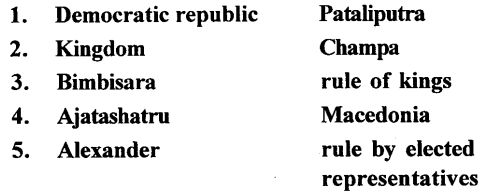
Answer:
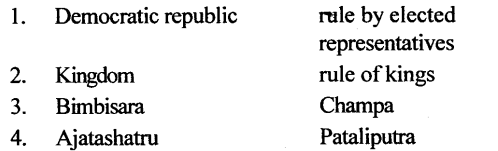

C. Answer the following questions.
Question 1.
State the reasons for the emergence of the mahajanapadas.
Answer :The emergence of the Mahajanapadas was a key development in ancient Indian history. Here’s a summary of the main reasons:
- Agricultural Advancements: The use of iron tools led to increased agricultural production. This created surplus food, supporting larger populations and allowing for specialized labor.
- Economic Growth: Increased agricultural surplus led to economic prosperity, which in turn facilitated trade and the growth of urban centers.
- Political Developments: Some Janapadas grew stronger than others. They expanded their territories, often through warfare, leading to the formation of larger, more powerful states – the Mahajanapadas.
- Shift in Social Organization: People started identifying more with their territory (Janapada) rather than just their tribe (Jana). This territorial identity helped in the formation of larger political entities.
Question 2.
How many mahajanapadas are mentioned in the religious texts of the 6th century BCE?
Answer:The religious texts of the 6th century BCE, particularly Buddhist and Jain canonical works, mention sixteen major kingdoms or republics known as the mahajanapadas. 1 These were powerful entities that dominated the political landscape of ancient India during that era
Question 3.
How did the conquest of Anga benefit Magadha?
Answer:The conquest of Anga proved to be a significant boon for Magadha in several ways. Primarily, it expanded Magadha’s territory eastward, granting it control over the fertile plains of Anga. This acquisition of new land meant increased agricultural output, which in turn supported a larger population and provided surplus resources. By controlling these routes, Magadha could boost its trade and commerce, generating more wealth and revenue. The conquest also eliminated a potential rival, securing Magadha’s eastern flank and allowing it to focus on further expansion and consolidation of power in the region.
Question 4.
Why was Alexander unable to conquer Magadha?
Answer:Alexander the Great’s inability to conquer Magadha stemmed from a combination of factors. Firstly, his army, after years of relentless campaigning far from home, was weary and homesick. They had faced tough resistance in India already and were reluctant to engage in another major and potentially protracted war against a powerful and largely unknown kingdom. Secondly, the Nanda dynasty, which ruled Magadha at the time, possessed a formidable and well-equipped army, reportedly much larger than what Alexander’s forces had encountered so far in India. Accounts suggest a massive infantry, cavalry, and even war elephants, which would have presented a daunting challenge. Finally, the geographical distance and the natural barriers like the vast Ganges River also played a role. Crossing such a significant obstacle with a tired army facing a strong enemy in unfamiliar territory was a risk Alexander was ultimately unwilling to take.
Question 5.
Mention briefly the effects of Alexander’s invasion.
Answer:Although Alexander did not conquer Magadha, his invasion of northwest India had several notable effects. It led to increased political fragmentation in the regions he did conquer, as the existing small kingdoms were either overthrown or weakened, creating a power vacuum. This instability indirectly paved the way for the rise of the Mauryan Empire a few decades later, as Chandragupta Maurya was able to capitalize on the weakened state of the northwest. The invasion also fostered greater contact and exchange between India and the Hellenistic world. This interaction led to some diffusion of Greek artistic styles, coinage practices, and philosophical ideas into India, though the extent of this influence is still debated by historians. Finally, Alexander’s campaign left a lasting historical memory, shaping the way both Indian and Western sources viewed this period and contributing to the historical narratives of both cultures.
D. State whether the following are true or false.
- Magadha belonged to the Iron Age.
Ans : False - Alexander was the king of Rome.
Ans : False - The capital city of Magadha was Pataliputra.
Ans : True - Mahapadma Nanda was the last king of the Nanda dynasty.
Ans : False - Ambhi and Porus were allies.
Ans : False
F. Picture study.
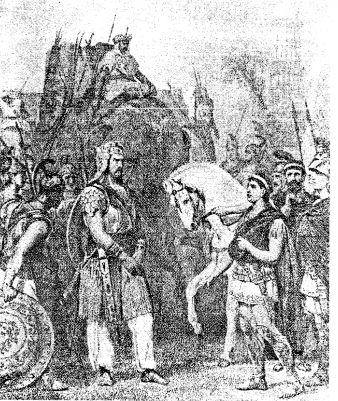
This is a painting of two important kings who became friends after war.
Question 1.
Can you identify the two rulers in this painting ?
Answer:The two figures depicted in this painting are very likely Alexander the Great and King Porus. The scene strongly suggests a moment following their famous clash during the Battle of the Hydaspes River. 1 While they were initially adversaries on the battlefield, historical accounts suggest that Alexander, impressed by Porus’s bravery and stature, eventually reinstated him as a satrap of his own kingdom, forging a kind of alliance or at least a working relationship between them. 2
Question 2.
Give an account of the earlier developments that led to this event.
Answer:The event depicted, likely the aftermath of the Battle of the Hydaspes between Alexander and Porus, was the culmination of Alexander’s eastward military campaign. Having conquered much of Persia and Central Asia, Alexander’s ambition led him to invade the Indian subcontinent. He crossed the Indus River and engaged in battles with various local rulers, gradually advancing his army. Porus, a powerful Indian king ruling the region between the Jhelum (Hydaspes) and Chenab rivers, decided to resist Alexander’s advance, leading to the fierce battle shown in the image.
Question 3.
Name the most powerful kingdom in India during this time. Which dynasty ruled this kingdom?
Answer: Based on the historical context of Alexander’s invasion (around 326 BCE), the most powerful kingdom in India at that time was Magadha. 1 The dynasty that ruled this kingdom was the Nanda dynasty. 1 They had built a formidable empire in the eastern Ganges plains, known for its large army and wealth, which was a significant reason why Alexander’s weary forces ultimately decided not to advance further eastward.
Question 4.
Who overthrew the last ruler of this dynasty ? Name the empire established by him.
Answer:the final ruler of the Nanda dynasty met his end at the hands of Chandragupta Maurya. Guided by the astute counsel of his wise advisor, Chanakya – also widely recognized as Kautilya – Chandragupta systematically dismantled the Nanda governance.