
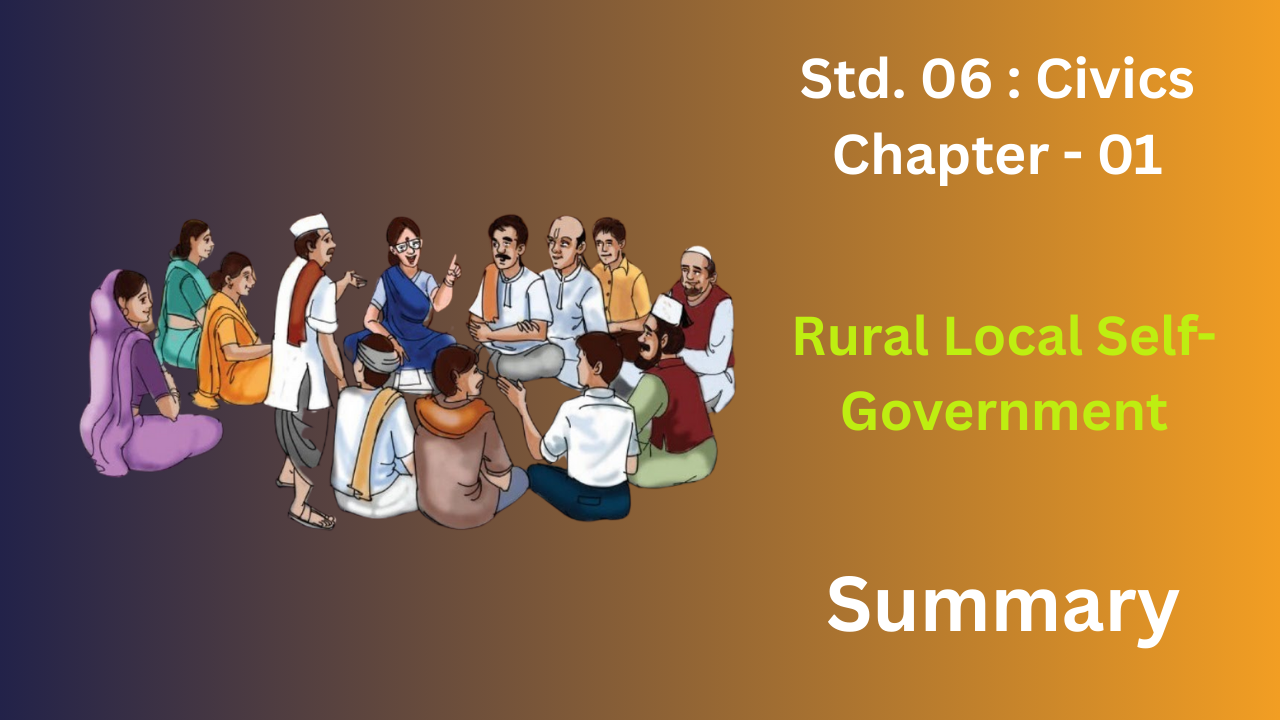
It explains the Panchayati Raj system, which is a three-tiered structure for governing villages. Here’s a summary of the key points:
1. Meaning of Local Self-Government:
- It means that people at the village level govern themselves and manage their own affairs.
- This helps in solving local problems effectively and ensures development according to the needs of the villagers.
2. Panchayati Raj System:
- Gram Panchayat (Village Level): It’s the main team in charge of running things smoothly in a village or a few small neighboring ones. They handle everyday needs and make sure the local area is taken care of.
- Panchayat Samiti (Block Level): This acts as a link between the Gram Panchayat and the Zila Parishad, coordinating activities at the block level (a cluster of villages). It is also known as Block Samiti or Mandal Parishad.
- Zila Parishad (District Level): Zila Parishad as the top boss for all the villages in a district. It’s the highest level of the local government in rural areas. Its main job is to look after the big picture and make sure the whole district develops properly.
3. Gram Sabha and Gram Panchayat:
- Gram Sabha:. It’s a crucial body where villagers can directly participate in decision-making.
- Gram Panchayat: imagine the entire village getting together for a big meeting – that’s the Gram Sabha making the important decisions. Now, the Gram Panchayat is like the hardworking team that takes those decisions and actually makes them happen. They’re the ones on the ground, handling the daily tasks, fixing things, and looking after what the village needs day-to-day. They’re basically the village’s own local crew, keeping things running smoothly.
- Functions: The Gram Panchayat performs essential functions like providing clean drinking water, maintaining roads and drainage, looking after sanitation and health facilities, providing primary education, keeping records of births and deaths, and organizing fairs and festivals.
- Sources of Income: The Gram Panchayat gets funds through taxes on houses, shops, and fairs, fees, grants from the government, and fines collected by the Nyaya Panchayat.
4. Nyaya Panchayat:
- This is a system of local courts in some villages to settle minor disputes among villagers, providing quick and inexpensive justice.
5. Panchayat Samiti (Block Samiti):
- Functions: It makes arrangements for primary and adult education, looks after healthcare, helps farmers with irrigation and seeds, promotes cottage industries, and undertakes welfare activities like providing clean water and sanitation.
6. Zila Parishad:
- Functions: It supervises the work of the Gram Panchayats and Block Samitis, advises the state government on their functioning, implements development projects, monitors agricultural production, and prepares development plans for the entire district.
In essence, the chapter emphasizes how the Rural Local Self-Government, through the Panchayati Raj system, empowers villagers to participate in their own governance and development, making democracy more meaningful at the grassroots level.
Exercise
I. Fill in the blanks:
- The Panchayati Raj is a ———- -tier system
Ans : three
- Panchayat means a team of ——— members.
Ans : five
- All the adults of a village constitute———–.
Ans : Gram Sabha
- Nyaya Panchayat can ———– the guilty.
Ans : fine
- Village Panchayats teach the first lesson of———-.
Ans : democracy
- The term of the Block Samiti is———-.
Ans : five years
- The Lok Sabha and Rajya Sabha members chosen from the ———- are also the members of Block Samiti.
Ans : district
- The ——— is the highest institution of the Panchayati Raj in India.
Ans : Zila Parishad
- The Zila Parishad ——— the working of the Block Samiti.
Ans : coordinates
- The state government appoints a ———- to maintain the accounts and keep records of the work done by the institutions of Panchayati Raj.
Ans : secretary
II. Match Column A with Column B:
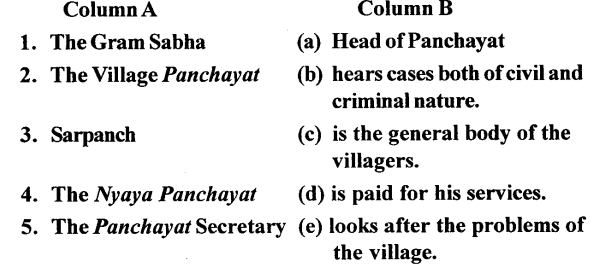
Ans :
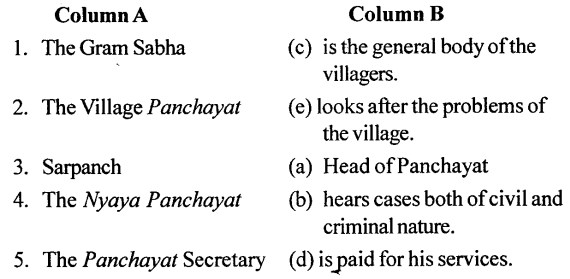
III. State whether the following statements are True or False.
- All people of any age are members of the Gram Sabha.
Ans :False. - Women have been given representation in the Panchayat.
Ans :True - The members of Gram Panchayat vary from state to state.
Ans :True - The first level of local self-government in rural areas is the Panchayat Samiti.
Ans :False. - The Nyaya Panchayat can impose fines.
Ans :True - The members of the Block Samiti are elected for a period of four years.
Ans :False - Zila Parishad works at the village level.
Ans :False - The chairpersons of the Block Samitis become the members of Zila Parishad.
Ans :True - The Zila Parishad has the responsibility of implementing the development programmes in the district.
Ans :True - The state government gives financial grants to the Panchayats.
Ans :True
IV. Answer the following questions:
Question 1. What do you mean by ‘Panchayat’ ?
Ans : Panchayat simply means a council of five people, traditionally elders, chosen by the village to make decisions and handle local issues. Nowadays, it refers to the elected local government body at the village level.
Question 2. How do Panchayats help villagers ?
Ans : Panchayats directly help villagers by looking after their everyday needs like clean water, roads, schools, and health. They also settle small disagreements locally, ensuring development that truly benefits the village.
Question 3. What are the advantages of Village Panchayats?
Ans : Village Panchayats are great because they let villagers handle their own problems directly. This means solutions are often a better fit for what the community actually needs. Plus, it gives everyone a voice and a chance to be part of making their village better.
Question 4. Explain the importance of local self-government?
Ans : Local self-government is super important because it brings the government closer to the people. It allows communities to decide what’s best for them and manage their own development. This makes things more efficient and ensures that local needs are actually met.
Question 5.
Name the three institutions of the Panchayati Raj. At what levels do they work ?
Ans :The Panchayati Raj system has three main parts: the Gram Panchayat for the village, the Panchayat Samiti for a group of villages, and the Zila Parishad for the entire district.
Question 6.
Explain briefly the composition and functions of a Block Samiti ?
Ans :People chosen by the village leaders and members form this team. They work to make life better in those villages by supporting things like schools, health, farming, and local businesses.
Question 7. How is the Zila Parishad formed? What are its main functions?
Ans : The Zila Parishad, the top tier of rural local government at the district level, is formed by elected members from all the Block Samitis (or Panchayat Samitis) within the district. Its main jobs include overseeing the work of the Gram Panchayats and Block Samitis, advising the state government on rural issues, planning and implementing development projects for the entire district (like roads, schools, and healthcare), and keeping an eye on agriculture and overall progress.
Question 8. What has the Panchayati Raj done so far for the rural areas?
Ans : So far, the Panchayati Raj system has been a big step in giving villagers a voice in their own development and governance. It has helped in addressing local needs more directly, like ensuring clean water, better roads, and improved sanitation in many areas. It has also empowered local communities, including women and marginalized groups, by giving them a platform to participate in decision-making. However, there’s still progress to be made in making it even more effective across all rural areas.
Question 9. Discuss the relationship between the state government and the Panchayati Raj?
Ans : The relationship between the state government and the Panchayati Raj is like a guiding hand. The state government creates the laws and provides the framework for the Panchayati Raj institutions to function. It also provides financial support through grants and schemes. In return, the Panchayati Raj bodies implement the state government’s policies at the local level and provide feedback on the needs and challenges faced by rural communities. It’s a partnership where the state sets the broad direction, and the local bodies tailor and execute it on the ground.
Additional Questions
A. Fill in the blanks:
- The Indian government functions at the ——— , ——- and ———.
Ans : central, state government and local self government levels.
- The union government deals with matters of ————importance.
Ans : national
- All ———— members of the village are members of the gram sabha.
Ans : Adult
- The nyaya panchayat cannot send people to————–.
Ans : Jail
- The gram panchayat makes the villagers more ———- and self-sufficient.
Ans : responsible
B. Match the following:
Ans :
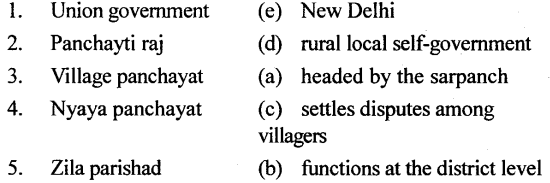
C. Choose the correct answer:
1. The union government of India is based in New Delhi/ Mumbai/Kolkata.
Ans: The union government of India is based in New Delhi.
2. Rural refers to towns/villages/cities.
Ans: Rural refers to villages.
3. The panchayati raj is a two/three/five tier system.
Ans: The panchayati raj is a three tier system.
4. One third/One sixth/One fourth of the seats of the gram panchayat are reserved for women.
Ans: One third of the seats of the gram panchayat are reserved for women.
5. The panchayat/block samiti/zila parishads is the local self government body at the block level.
Ans: The block samiti is the local self-government body at the block level.
D. State whether the following are true or false:
1. The Local self-government deals with matters of national importance.
Answer:False.
Correct: The Local self-government deals with matters of locality.
2. Panchayats are elected for 2 years.
Answer:False.
Correct : Panchayats are elected for 3 to 5 years.
3. The village panchayat is the basic unit of the panchayati raj system.
Answer:True.
4.The Panchayat provides primary education.
Answer:True.
E. Answer the following questions in one or two words/ sentences:
Question 1.
What are the three tiers of the panchayati raj system?
Answer:The way rural areas are governed through the Panchayati Raj system has a clear three-level setup:
- Right at the village level, you’ll find the Gram Panchayat.
- Moving up a level to the block, it’s the Panchayat Samiti that takes charge.
- And at the very top, looking after the whole district, is the Zila Parishad.
Question 2.
Who is the head of the village panchayat?
Answer:The leader of the village panchayat goes by two common names: Sarpanch and Pradhan. So, if you hear either of those terms, they’re talking about the head of the village council.
Question 3.
Mention any one optional function of the gram panchayat.
Answer:Beyond its essential duties, a Gram Panchayat can also choose to take on additional responsibilities depending on the village’s needs and available resources. One such optional function could be looking after and developing village forests and pastures. This might involve planting new trees, maintaining grazing lands, or preventing illegal logging, contributing to the environmental well-being of the village.
Question 4.
What does the nyaya panchayat do?
Answer:The Nyaya Panchayat serves as a village-level court in some rural areas. Its main purpose is to resolve minor disagreements and disputes among villagers. Think of it as a way to settle small issues locally, without the need to travel to distant and often expensive formal courts. The Nyaya Panchayat aims to provide quick and fair resolutions to problems, helping to maintain peace and harmony within the community.
G Picture study.
This is a village scene representing an important function of the gram panchayat.

Question 1. Name the function.
Ans :Looking at the picture, it appears to show children in a classroom setting. Therefore, the function represented is providing education or running schools.
Question 2. Is it a compulsory or an optional function?
Ans :Providing primary education is generally considered a compulsory function of the Gram Panchayat.
Question 3. Mention four compulsory functions of the village panchayat.
Ans :Besides running schools, the Gram Panchayat has a bunch of other must-do tasks to keep village life going. These include:
- Making sure everyone has clean water to drink.
- Taking care of the village roads and walkways so people can get around.
- Keeping the village clean and making sure there’s proper drainage.
- Recording when people are born and when they pass away in the village.
Question 4. Mention two optional functions of the panchayat.
Ans :Two examples of optional functions that a Gram Panchayat may undertake, depending on available resources and local needs, are:
- Establishing and maintaining libraries and reading rooms.
- Promoting cottage and small-scale industries.