
Sound is a form of energy that produces the sensation of hearing in our ears. It needs a material medium (solid, liquid, or gas) to travel and cannot propagate through a vacuum.
1. Production and Propagation of Sound
Production: Sound is produced by vibrating bodies. For example, the vibrating strings of a guitar, the vibrating air column in a flute, or the vibrating vocal cords in our throat.
Propagation: When an object vibrates, it forces the particles of the surrounding medium to vibrate. These particles transfer their energy to the neighbouring particles, creating a wave. The sound travels in the form of a longitudinal wave.
Longitudinal Wave: A wave where the particles of the medium vibrate back and forth along the direction of the wave’s propagation. This creates regions of compression (high pressure) and rarefaction (low pressure).
2. Characteristics of a Sound Wave
A sound wave can be described by its graphical representation, which is similar to a longitudinal wave.
Compression (C): The region where particles are temporarily close together, creating high pressure and high density.
Rarefaction (R): The region where particles are temporarily spread apart, creating low pressure and low density.
Wavelength (λ): The distance between two consecutive compressions or two consecutive rarefactions. Its SI unit is the metre (m).
Frequency (ν): The number of complete waves (or cycles) produced per second. It is the same as the rate of vibration of the source. Its SI unit is Hertz (Hz). The frequency of a sound wave determines its pitch.
Time Period (T): The time taken to produce one complete wave. It is the reciprocal of frequency (T = 1/ν). Its SI unit is the second (s).
Amplitude (A): The magnitude of maximum displacement of particles from their mean position. It determines the loudness or intensity of the sound. A higher amplitude means a louder sound.
Wave Velocity (v): The speed at which the sound wave travels through a medium. It is given by the formula: v = νλ.
3. Reflection of Sound Waves & Echo
Reflection: Sound waves obey the laws of reflection, just like light.
Echo: An echo is the repetition of a sound caused by the reflection of sound waves from a large, hard surface like a cliff or a tall building.
Condition for Hearing Echo: To hear a distinct echo, the reflecting surface must be at least 17 metres away from the source. This is because the human ear can distinguish between two sounds only if they are received at least 0.1 seconds apart.
4. The SONAR Principle
SONAR (Sound Navigation and Ranging) is a technology that uses ultrasonic waves to detect and locate underwater objects, measure ocean depth, and navigate.
Working Principle:
A transmitter sends out ultrasonic waves (high-frequency sound waves beyond human hearing) through the water.
These waves travel and get reflected by objects or the seabed.
The reflected waves (echo) are detected by a receiver.
By measuring the time taken (t) for the echo to return and knowing the speed of sound in water (v), the distance (d) to the object is calculated using the formula: d = (v × t) / 2.
5. Characteristics of Sound
We can distinguish between different sounds based on three characteristics:
Loudness: It is the subjective measure of the sound energy reaching the ear per second. It depends on the amplitude of the vibrating body. A higher amplitude produces a louder sound. Its unit is the decibel (dB).
Pitch: It is the characteristic that distinguishes a shrill sound from a grave one. It depends on the frequency of the sound wave. A higher frequency results in a higher pitch (e.g., a woman’s voice), and a lower frequency results in a lower pitch (e.g., a man’s voice).
Quality or Timbre: It is the characteristic that allows us to distinguish between two sounds of the same loudness and pitch, produced by different instruments. For example, a note of the same pitch and loudness sounds different when played on a violin and a piano. This is due to the presence of overtones along with the fundamental note.
6. Types of Sound Waves (Based on Frequency)
Humans cannot hear them (e.g., vibrations from earthquakes).
Audible Sound Waves: Sound waves with a frequency between 20 Hz and 20,000 Hz. This is the normal hearing range for humans.
Ultrasonic Waves: Sound waves with a frequency above 20,000 Hz. Humans cannot hear them, but they have many applications (e.g., cleaning, sonar, medical imaging).
7. Natural Vibrations, Forced Vibrations, and Resonance
Natural Vibrations: When a body vibrates with its own natural frequency without any external force, it is called a natural vibration.
Forced Vibrations: When a body is made to vibrate by an external vibrating force, it is called forced vibration.
Resonance:. When the frequency of the externally applied force matches the natural frequency of a body, the body begins to vibrate with a very large amplitude. This phenomenon is called resonance.
Example: A soldier breaking step while marching over a bridge to prevent resonance, which could cause the bridge to oscillate violently and collapse.
TEST YOURSELF
Objective Questions :
1. Write true or false for each statement :
(a) When sound propagates in air, it does not carry energy with it.
Ans: False
(b) In a longitudinal wave, compression and rarefaction are formed.
Ans: True
(c) The distance from one compression to nearest rarefaction is called wavelength.
Ans: False
(d) The frequency is measured in second.
Ans: False
(e) The quality of a sound depends on the amplitude of wave.
Ans: False
(f) The pitch of sound depends on frequency.
Ans: True
(g) Decibel is the unit of pitch of a sound.
Ans: False
2. Fill in the blanks :
(a) The time period of a wave is 2 s. Its frequency is ______.
(b) The pitch of a stringed instrument is increased by ______ tension in string.
(c) The pitch of a flute is decreased by ______ length of air column.
(d) Smaller the membrane, ______ is the pitch.
(e) If a drum is beaten hard, its loudness ______.
(f) A tuning fork produces sound of ______ frequency.
Ans.
(a) The time period of a wave is 2 s. Its frequency is 0.5 s⁻¹.
(b) The pitch of a stringed instrument is increased by increasing tension in string.
(c) The pitch of a flute is decreased by increasing length of air column.
(d) Smaller the membrane, higher is the pitch.
(e) If a drum is beaten hard, its loudness increases.
(f) A tuning fork produces sound of single frequency.
3. Match the following :
| Column A | Column B |
| (a) Amplitude | (i) Number of vibrations per second |
| (b) Frequency | (ii) Characteristic of sound which distinguishes a feeble sound from a loud sound of same frequency |
| (c) Loudness | (iii) Maximum displacement of a particle from its mean position |
| (d) Pitch | (iv) The pattern of vibration of a body |
| (e) Wave form | (v) Time taken to complete one vibration |
Ans.
| Column A | Column B |
| (a) Amplitude | (iii) Maximum displacement of a particle from its mean position |
| (b) Frequency | (v) Time taken to complete one vibration |
| (c) Loudness | (ii) Characteristic of sound which distinguishes a feeble sound from a loud sound of same frequency |
| (d) Pitch | (i) Number of vibrations per second |
| (e) Wave form | (iv) The pattern of vibration of a body |
4. Select the correct alternative :
(a) Sound can not travel in :
(i) solid
(ii) gas
(iii) liquid
(iv) vacuum
Ans: (iv) vacuum
(b) When sound travels in form of a wave :
(i) the particles of medium move from the source to the listener
(ii) the particles of medium remain stationary
(iii) the particles of medium start vibrating up and down
(iv) the particles of medium transfer energy without leaving their mean positions
Ans: (iv) the particles of medium transfer energy without leaving their mean positions
Ans:
(c) The safe limit of loudness of audible sound is :
(i) 0 to 80 dB
(ii) 120 dB
(iii) above 80 dB
(iv) above 120 dB
Ans: (i) 0 to 80 dB
(d) The unit of loudness is :
(i) cm
(ii) second
(iii) hertz
(iv) decibel
Ans: (iv) decibel
(e) In a piano, pitch is decreased by :
(i) using thicker string
(ii) increasing tension
(iii) reducing length of string
(iv) striking it hard
Ans: (i) using thicker string
B. Short/Long Answer Questions :
1.How does sound travel in air ?
Ans: When an object vibrates, it pushes air particles together, creating high-pressure areas called compressions.
These particles then push into their neighbors, passing the energy along and leaving behind low-pressure, stretched-out areas called rarefactions.
This chain reaction of compressions and rarefactions forms a sound wave. When this wave hits your ear, it makes your eardrum vibrate. Your brain then understands these vibrations as sound.
2.What is a longitudinal wave ?
Ans: A longitudinal wave is one where the medium’s particles vibrate parallel to the wave’s direction of travel.Imagine compressing and releasing a slinky’s coils along its length; the pulse that moves through it is a longitudinal wave. Sound moving through air is a prime example of this wave type.An illustration of wave resonance is when soldiers break step on a bridge. This prevents their rhythmic marching from matching the bridge’s natural frequency, which could cause dangerous, amplified oscillations.
3.Explain the mechanism of formation of a longitudinal wave when source vibrates in air.
Ans: When a source vibrates in air:
Forward Motion: It pushes air particles together, creating a high-pressure region called a compression.
Backward Motion: It pulls away from air particles, creating a low-pressure region called a rarefaction.
These repeating compressions and rarefactions move through the air, transferring energy. Because the air particles vibrate back and forth in the same direction the wave travels, the sound produced is a longitudinal wave.
4.Define the following terms :
(a) Amplitude
(b) Frequency
(c) Time period
Ans: (a) Amplitude
Amplitude is the maximum displacement of a vibrating particle or wave from its rest or mean position. It indicates the energy carried by the wave—larger amplitude means more energy.
(b) Frequency
Frequency is the number of complete vibrations or cycles produced by a source in one second. It is measured in hertz (Hz). Higher frequency means more cycles per second.
(c) Time Period
Time period is the time taken to complete one full cycle of vibration or oscillation. It is the reciprocal of frequency and is measured in seconds.
5.Obtain relationship between the time period and frequency.
Ans: Relationship between Time Period and Frequency
The time period (T) is the time taken to complete one oscillation.
They are reciprocals of each other.
The formula is:
T=1f
or
f=1T
Unit of Time Period (T): second (s)
Unit of Frequency (f): hertz (Hz)
6.Name three characteristics of a musical sound.
Ans: The three main characteristics of a musical sound are:
Pitch: This is what lets us tell a high note from a low note. Think of a flute playing a tune and then a tuba playing a low, rumbling note—the flute has a high pitch, and the tuba has a low pitch. Scientifically, pitch is determined by the frequency of the sound wave, which is how fast the air vibrates. Faster vibrations create a higher pitch, and slower vibrations create a lower pitch.
Loudness (or Volume): This is how strong or faint a sound feels to us. It’s the difference between a gentle whisper and a powerful shout from a singer. A sound wave with greater energy and a larger amplitude will sound louder to our ears, while a wave with less energy and a smaller amplitude will sound softer.
Timbre (pronounced “TAM-ber”): This is the unique quality or “color” of a sound that lets us tell different instruments apart, even when they are playing the exact same note at the same loudness. For example, if a piano and a violin both play a middle C, you can instantly identify which is which because of their timbre. This characteristic is shaped by the complex mixture of the main pitch and all the other softer, higher pitches (called overtones) that an instrument naturally produces.
7.Name the quantity from below which determines the loudness of a sound wave :
(a) Wavelength
(b) Frequency
(c) Amplitude
Ans: (c) Amplitude
Think about the last time you heard a whisper and compared it to a shout. Both may have been the same pitch, or note, but one was clearly louder. The difference lies in the amplitude of the sound wave.
In simple terms, amplitude is the “size” or “height” of a wave. It measures how far the wave moves from its resting position to its peak. You can picture it like a wave in the ocean: a small, gentle ripple has a low amplitude, while a massive, crashing tidal wave has a very high amplitude.This concept is directly responsible for how we perceive loudness. A sound wave that is created with a lot of energy, like a slammed door or a powerful guitar strum, will have a large, forceful amplitude. Our ears and brain interpret this powerful vibration as a loud sound.
Conversely, a sound made with very little energy, like the delicate pluck of a single string or a person whispering, produces a wave with a small, modest amplitude. We hear this as a soft or quiet sound.
So, in essence, the amplitude of a sound wave is its strength card. More amplitude means more energy being carried by the wave, resulting in a louder sound to our ears. Less amplitude means less energy, and a much softer sound.
8.How is loudness related to the amplitude of wave ?
Ans:Loudness is directly related to the amplitude of a sound wave.A sound wave with a larger amplitude carries more energy. Our ears perceive this as a louder sound.A sound wave with a smaller amplitude carries less energy. Our ears perceive this as a softer or quieter sound.In simple terms, if you hit a drum harder (increasing amplitude), the sound produced is louder.
9.If the amplitude of a wave is doubled, what will be the effect on its loudness ?
Ans: When a sound wave’s amplitude doubles, loudness increases.This occurs because loudness depends on the square of the amplitude. Doubling the amplitude (2 times) makes the loudness four times greater (2² = 4).
10.How does the wave pattern of a loud note differ from a soft note ? Draw a diagram.
Ans:
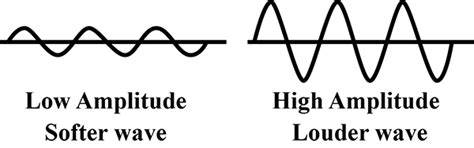
The wave pattern of a loud sound differs from a soft sound primarily in its amplitude.
A loud note has a wave with large amplitude (high peaks and deep troughs).
A soft note has a wave with small amplitude (low peaks and shallow troughs).
The frequency (and thus the pitch) of the note remains the same if it is the same musical note.
Explanation:
The diagram shows that the loud sound wave oscillates much higher and lower from the central line (representing greater air pressure variation) compared to the soft sound wave. The distance between the wave crests (wavelength) is the same for both, indicating the same pitch.
11.Name the unit in which the loudness of sound is expressed.
Ans: The unit used to express the loudness of sound is the decibel (dB).
This unit is named after Alexander Graham Bell, the inventor of the telephone. The “deci” part signifies one-tenth, so a decibel is one-tenth of a bel, the original unit.
It is important to understand that the decibel scale is logarithmic, not linear. This means that an increase of 10 dB represents a sound that is ten times more intense. For example, a quiet library might be around 30 dB, while a normal conversation is about 60 dB. This doesn’t mean the conversation is just “twice as loud”; its sound intensity is actually 1,000 times greater. Because of how our ears perceive sound, this logarithmic scale matches our experience of loudness much more closely than a linear scale would.
12.Why is the loudness of sound heard by a plucked wire increased when mounted on a sound board ?
[Hint : The surface area of vibrating air increases]
Ans: When a plucked wire is mounted on a soundboard, the loudness increases because the wire alone has a very small surface area.The soundboard is a large surface forced to vibrate with the wire. This greatly increases the amount of surface area pushing against the air.A larger vibrating surface can set a much greater volume of air in motion. This transfers more energy into the air, creating a more intense sound wave that we hear as a louder sound.
13.State three factors on which loudness of sound heard by a listener depends.
Ans:
1. The Shake: Amplitude of the Source
Imagine plucking a guitar string. If you give it a gentle tug, it wobbles just a little. This small, gentle vibration creates a soft sound with low amplitude. Now, picture giving that string a strong, forceful pluck. It thrashes back and forth wildly! This large, powerful vibration pushes the air molecules much more forcefully, creating a sound wave with high amplitude. In everyday terms, the harder the shake at the source, the bigger the sound wave, and the louder the noise we perceive. It’s the difference between a gentle tap on a drum and a powerful beat.
2. The Journey: Distance from the Source
Sound is a traveler, and like any traveler, it gets tired. As sound waves spread out from their starting point, the energy they carry becomes spread over a larger and larger area. Think of the ripple from a pebble tossed into a pond. The ripples are strong and close together near the center, but as they move outward, they become wider, weaker, and eventually fade away. Sound behaves in the same way. The energy that makes up a loud noise gradually dissipates into the environment. This is why a car stereo sounds deafeningly loud when it’s right next to you but fades into the background as it drives down the street.
3. The Pathway: The Medium It Travels Through
Sound needs something to travel through, and what it’s traveling through makes a huge difference. The particles (atoms or molecules) in the material act as messengers, bumping into each other to pass the sound energy along. In a light, gas-filled medium like air, the molecules are spread out. They have to travel further to bump into each other, which causes some energy to be lost along the way.Now, imagine a much denser medium, like water. The molecules in a liquid are packed tightly together. When a sound wave passes through, these closely-packed molecules can transfer the energy of the vibration much more quickly and efficiently from one to the next, with less energy lost. This is why sounds appear louder and can be heard from much farther away underwater. If you’ve ever been in a pool and heard the muffled but distinct thud of someone diving in from the other side, you’ve experienced this principle firsthand.
14.What determines the pitch of a sound ?
Ans: Pitch is how our ears interpret a sound’s frequency.A high-pitched sound is created by a fast-vibrating wave (high frequency), like a whistle.A low-pitched sound comes from a slow-vibrating wave (low frequency), like a drum.Think of a guitar string: a thin, tight string vibrates quickly for a high note, while a thick, loose string vibrates slowly for a low note. The wave’s frequency is the primary reason for a sound’s pitch.
15.Name the characteristic of sound related to frequency.
Ans:. High Frequency: When an object vibrates very quickly, it produces a high number of sound waves per second (high frequency). Our brain interprets this rapid vibration as a high-pitched sound. A classic example is the sharp, piercing sound of a whistle or the tweet of a small bird.
Low Frequency: When an object vibrates more slowly, it produces fewer sound waves per second (low frequency). Our brain interprets this slower vibration as a low-pitched sound. The deep, rumbling sound of thunder or the low note from a large drum are perfect examples of this.
It’s important to note that while pitch is determined by frequency, they are not exactly the same thing. Frequency is an objective, measurable physical quantity (measured in Hertz – Hz). Pitch, however, is the subjective sensation or perception of that frequency by a human listener. In essence, frequency is the cause, and pitch is the effect in our ears and brain.
16.Name and define the characteristic which enables one to distinguish two sounds of same loudness, but of different frequencies, given by the same instrument.
Ans: Think about the last time you heard a door creak open. It started with a low, groaning sound, right? Now, imagine the sharp, quick sound of a bird chirping right outside your window. The biggest difference between that creak and the chirp is their pitch.
In simple terms, pitch is what lets you know if a sound is high or low. It’s the quality that allows you to hum a low note from a bass guitar and then a high note from a flute.
So, what actually makes a sound high-pitched or low-pitched? It all comes down to vibrations.Imagine plucking a thick, loose rubber band. It wobbles back and forth quite slowly. This slow vibration creates a low, deep sound—a low pitch. Now, imagine plucking a thin, tightly stretched rubber band. It vibrates incredibly fast, producing a high, tinny sound—a high pitch.Scientists measure these vibrations per second, which is called frequency. A high-frequency sound means the waves are arriving at your ear very, very quickly, and your brain interprets this as a high pitch. A low-frequency sound has waves that arrive more slowly, which we hear as a low pitch.
You can hear this principle everywhere in life:
The rumble of thunder or a large bass drum are classic examples of low-pitched (low-frequency) sounds.
The tinkling of a triangle, the squeal of a kettle, or a child’s whistle are all high-pitched (high-frequency) sounds.
17.Draw a diagram to show the wave pattern of high pitch note and a low pitch note, but of the same loudness.
Ans:
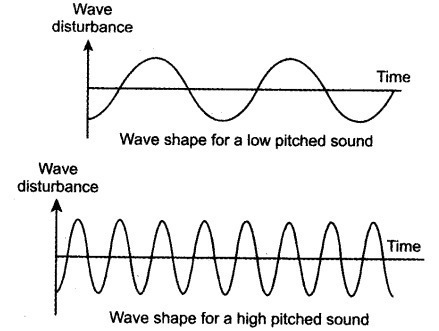
18.How is it possible to detect the filling of a bucket under a water tap by hearing the sound standing at a distance ?
Ans: We all know the sound of water hitting the bottom of an empty bucket. It’s a sharp, clattering splash—loud, high-pitched, and almost frantic. Each drop seems to shatter on impact, echoing in the hollow space.But as the water level begins to rise, something fascinating happens. The air inside the bucket gets trapped by the rising water, and that’s when the magic starts. Instead of shattering on a hard surface, the water plunges into a growing pool, pushing the trapped air into bubbles. These bubbles form and pop continuously, and with each one, the sound changes. That initial sharp clatter softens and deepens, transforming into a rich, low rumble—a gurgling that seems to come from the bucket’s very core.You don’t even have to be watching it. You can be in another room and follow the entire process just by listening. You hear the initial noisy splashing, then the shift into that bubbling, gurgling roar. And then, the final signal: the splashing stops entirely, replaced by that deep, quiet rumble. The moment the high-pitched noise vanishes and only the low gurgle remains, you just know. It’s full. It’s a small, everyday piece of knowledge, learned not by looking, but by listening.
19.The frequencies of notes given by flute, guitar and trumpet are respectively 400 Hz, 200 Hz and 500 Hz. Which one of these has the highest pitch ?
Ans: The trumpet produces the note with the highest pitch. The reason for this comes down to the physics of sound. The pitch we perceive is directly tied to the frequency of the sound wave, which is measured in hertz (Hz). A higher frequency means the sound wave is vibrating more times per second, which our ears interpret as a higher, sharper, or more piercing note.
When we compare the given frequencies:
The guitar plays a note at 200 Hz.
The flute plays a note at 400 Hz.
The trumpet plays a note at 500 Hz.
Since the trumpet’s frequency of 500 Hz is greater than both the flute’s 400 Hz and the guitar’s 200 Hz, it unmistakably creates the highest-pitched sound. This is why the trumpet’s note stands out as the brightest and most sharp-sounding among the three instruments.
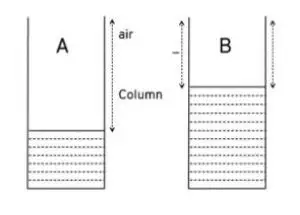
20.Fig. 7.20 shows two jars A and B containing water up to different heights. Which will produce sound of higher pitch when air is blown on them?
Ans:
21.Two identical guitars are played by two persons to give notes of the same pitch. Will they differ in quality ? Give reason for your answer.
Ans: Yes, the notes from the two identical guitars, even when played at the same pitch, will most likely differ in quality (also known as timbre).
Reason:
The quality or timbre of a sound is what allows our ears to distinguish between different sources (like a guitar and a piano) even when they are playing the same note at the same loudness. It is determined by the complex structure of the sound wave, specifically:
The Number of Overtones Present: A musical note is not a single pure frequency (fundamental frequency). It is a rich mixture of the fundamental frequency and a series of higher, quieter frequencies called overtones or harmonics.
The Relative Amplitude of these Overtones: The distinctive sound of a guitar comes from which of these overtones are stronger and which are weaker.
While the two guitars are physically identical, the quality of the sound produced depends on several variable factors related to how they are played and their immediate condition:
The Player’s Technique: The force with which a string is plucked or strummed, the angle of the pick or finger, and the exact position where the string is plucked (near the bridge vs. near the neck) all excite the string differently. This changes the mixture and strength of the overtones, thereby altering the quality.
The Strings: Even on identical guitars, the strings may have slight differences in age, wear, and material, which affect their vibration.
The Guitar’s Condition: Factors like the humidity, temperature, and the slight natural variations in the wood can minutely affect how the body of the guitar resonates and amplifies the sound.
Therefore, due to these human and environmental factors, the sound waves produced by the two guitars will have different overtone structures. This results in the same pitch having a slightly different “colour” or quality, making the two sounds distinct from one another.
22.Two musical notes of the same pitch and same loudness are played on two different instruments. Their wave patterns are as shown in Fig. 7.21.
How do they differ in
(a) loudness,
(b) pitch and
(c) quality ?
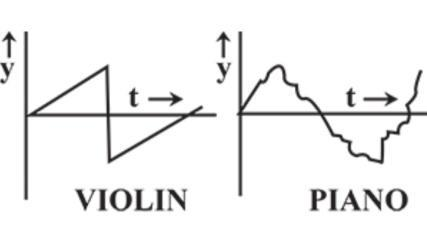
Ans:
(a) Loudness:
The loudness is the same. This is because the amplitude (the height of the waves) of both patterns is equal.
(b) Pitch:
The pitch is the same. This is because the frequency (the number of waves per second, or the distance between wave crests) is identical for both waves.
(c) Quality (or Timbre):
The quality is different. This is because the shape of the wave patterns is different. The violin produces a smoother, more rounded wave, while the piano wave has a more complex and sharper shape. This difference in wave shape is what allows our ears to distinguish between the two instruments, even when they play notes of the same loudness and pitch.
23. Which characteristic of sound makes it possible to recognize a person by his voice without seeing him?
Ans: The characteristic of sound that allows us to recognize a person by their voice without seeing them is the timbre (pronounced “TAM-ber”).Timbre is often described as the unique “quality” or “colour” of a sound. While pitch tells us how high or low a note is, and loudness tells us how intense it is, timbre is what makes two different instruments—or two different people—sound distinct even when they are singing or speaking the same note at the same volume.Every person’s voice has a distinct timbre because of the unique shape and size of their vocal cords, throat, mouth, and nasal cavities. These physical differences create a complex sound wave with a unique blend of the main tone and its overtones. It is this specific recipe of overtones that our brain instantly recognizes as the voice of a particular individual, like a friend or a family member.
24. State the factors that determine
(a) the pitch of a note.
(b) the loudness of the sound heard.
(c) the quality of the note.
Ans:a) Pitch of a note
Pitch is determined by the frequency of vibration.
(b) Loudness of sound
Loudness depends on the amplitude of vibration. Greater amplitude means louder sound, and smaller amplitude means softer sound. It also depends on the ear’s sensitivity.
(c) Quality of the note
Quality or timbre is determined by the waveform. It depends on the number and strength of overtones (harmonics), which is why the same note sounds different on different instruments.
25. Name the characteristic of the sound affected due to a change in its
(a) amplitude
(b) wave form
(c) frequency.
Ans:(a) Change in Amplitude
A change in the amplitude of a sound wave directly affects its loudness.
Higher Amplitude: When the amplitude increases, the sound wave carries more energy, and we perceive this as a louder sound.
Lower Amplitude: When the amplitude decreases, the sound wave has less energy, and we perceive this as a softer or quieter sound.
So, the characteristic affected is Loudness.
(b) Change in Wave Form
The wave form of a sound describes the shape of its wave pattern (e.g., smooth sine wave, jagged square wave, complex musical note). A change in the wave form affects the quality or timbre of the sound.
Timbre is what allows us to distinguish between different musical instruments or voices even when they are playing the same note at the same loudness. For instance, a sine wave sounds pure and plain, while a complex wave from a violin has a rich, textured sound. Therefore, the characteristic affected is Quality (or Timbre).
(c) Change in Frequency
The frequency of a sound wave is the number of complete vibrations or cycles per second. A change in frequency affects the pitch of the sound.
Higher Frequency: An increase in frequency means more cycles per second, which our ears interpret as a higher-pitched sound (like a whistle).
Lower Frequency: A decrease in frequency means fewer cycles per second, which we perceive as a lower-pitched sound (like a drum).
Hence, the characteristic affected is Pitch.
26. Fig. 7.22 shows four waves A, B, C, and D.
Name the wave which shows
(a) a note from a musical instrument,
(b) a soft note,
(c) a shrill note.
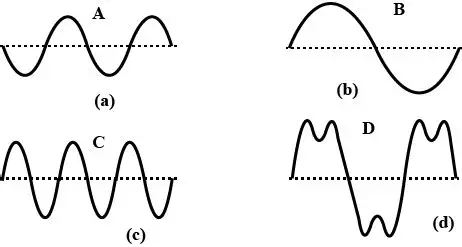
Ans:. (a)-(D) (b)-(A) (c)-(C)
27. How is the pitch of sound in a guitar changed if
(a) thin wire is used,
(b) wire under less tension is used?
Ans: (a) Using a thin wire:
The pitch becomes higher. This happens because a thinner wire has less mass compared to a thicker one. With less material to move, the wire can vibrate much more quickly. Since pitch is determined by the frequency of these vibrations—a higher frequency means a higher pitch—the thinner wire naturally produces a sharper, higher sound.
(b) Using a wire under less tension:
The pitch becomes lower. When you reduce the tension on a wire, it becomes looser and more slack. This looseness makes it harder for the wire to vibrate rapidly, forcing it to oscillate at a slower rate. A slower vibration results in a lower frequency, which our ears perceive as a deeper or lower pitch. You can think of it like a loose guitar string that sounds flabby and deep compared to a tightly tuned one that sounds bright and high.
C. Numericals
1. Two waves of the same pitch have amplitudes in the ratio 1:3 .What will be the ratio of their
(i) loudness,
(ii) pitch?
Ans: We are given that two waves of the same pitch have amplitudes in the ratio 1:3.
(i) Ratio of their Loudness
Loudness is the characteristic of a sound that depends on the amplitude of the wave. It is directly proportional to the square of the amplitude.
Let the amplitudes of the two waves be A1and A2
Given:
A1:A2=1:3
Therefore,
A1/A2=1/3
Since Loudness (L) ∝ (Amplitude)², we can write:
L1/L2=(A1/A2)2
L1/L2=(1/3)2=1/9
So, the ratio of their loudness is
L1:L2=1:9.
(ii) Ratio of their Pitch
Pitch is the characteristic of a sound that depends on the frequency of the wave. A higher frequency corresponds to a higher pitch, and a lower frequency corresponds to a lower pitch.
The problem clearly states that the two waves are of the same pitch. This means their frequencies are identical.
Therefore, the ratio of their pitches is 1:1
2. Two waves have frequencies 256 Hz and 512 Hz, but same amplitude. Compare their
(i) loudness, and
(ii) pitch.
Ans: When comparing the two waves with frequencies of 256 Hz and 512 Hz but the same amplitude, we analyze their loudness and pitch based on the fundamental properties of sound.
(i) Comparison of Loudness
Since it is clearly stated that both waves have the same amplitude, their loudness will be approximately the same.Loudness is our subjective perception of the energy carried by the sound wave, which is directly related to the amplitude. A higher amplitude means a more intense wave and a louder sound. Because this factor is equal for both waves, we perceive them to be equally loud.
(ii) Comparison of Pitch
Frequency refers to how many cycles of a wave pass a point per second, measured in Hertz (Hz).The first wave has a frequency of 256 Hz.The second wave has a frequency of 512 Hz.Since 512 Hz is exactly double the frequency of 256 Hz, the second wave has a much higher pitch. In musical terms, if the 256 Hz wave corresponds to a certain musical note (like middle C), the 512 Hz wave would be the note one octave higher. Therefore, the 512 Hz sound will be perceived as sharper or shriller, while the 256 Hz sound will be perceived as deeper or flatter.