
South America’s weather and landscapes are incredibly varied because it’s such a large continent. You can go from really chilly, almost Arctic-like conditions way down south to very hot, tropical weather near the Equator. The high Andes Mountains also have their own special climate zones.
Because of this mix of climates, you see a wide variety of natural plant life. There are thick rainforests in the Amazon, wide grassy plains called the Pampas, dry deserts along the western edge, and plants that can survive at high altitudes in the Andes.
The continent is also full of different animals that have adapted to these diverse places. Imagine bright, colorful birds in the rainforests, llamas and vicuñas living in the Andes, and unique animals like jaguars and anacondas.
South America has a lot of valuable natural resources too. It has large amounts of minerals like iron ore, copper, and bauxite. The continent also has important energy sources, such as oil and natural gas, and lots of potential for making electricity from its many rivers.
EXERCISES
A. Fill in the blanks.
- The tropical grasslands of Guyana are called———–.
Ans : llanos
- The coca tree is a native ———– tree.
Ans : Peruvian
- The ———- tree grows in Gran Chaco.
Ans : quebracho
- The ———– vegetation in Argentina consists of short, soft and nutritious grasses.
Ans : pampas
- The ———— Islands are inhabited by giant turtles.
Ans : Galapagos
- Wax obtained from ————– palm trees are used for making———.
Ans : carnauba , shoe polish, furniture polish, lipstick and candles
- Quinine is obtained from the bark of ———– trees.
Ans : cinchona
- ———— leads in the production of copper.
Ans : Chile
B. Find the odd one out in each of the following groups and say why.
- Llanos, pampas, campos, selvas
- Rubber, cinchona, pine, ebony
- Tapir, piranha, sloth, puma
- Jaguar, vicuña, llama, alpaca
- Cactus, pine, scrub, prickly pear
Answer:
- Selvas – As all other are grass
- Pine
- Tapir, piranha – piranha is a reptile
- Jaguar – These three belong to camel family
- Pine
C. Match the columns.
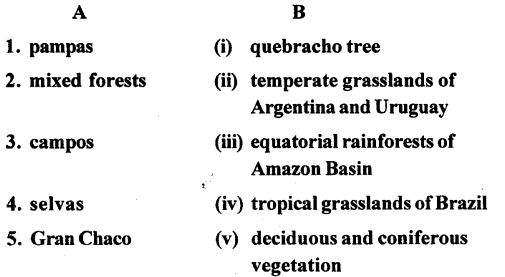
Ans :
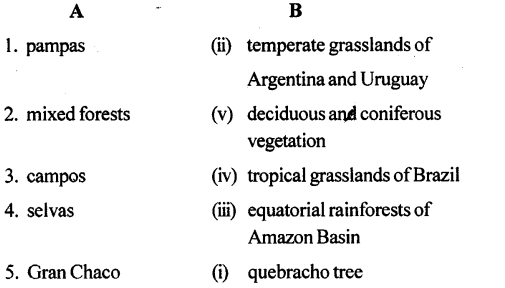
D. Answer the following questions in brief.
Question 1.
How does the shape of the continent affect the climate of th£ southern part of South America ?
Answer:The tapering, narrow shape of southern South America significantly influences its climate. Because it becomes much thinner towards Cape Horn, the oceanic influence becomes very strong. This leads to a cooler, more humid, and often stormy climate in the southern regions compared to the broader, more tropical north. The proximity to the surrounding oceans moderates temperatures and brings in more precipitation.
Question 2.
Mention some of the factors that affect the climate of South America.
Answer:Latitude: Because a large part of the continent lies near the Equator, it experiences warm temperatures. Areas farther south are cooler.
The Andes Mountains: This massive mountain range along the west coast acts like a barrier. It blocks moisture-laden winds from the Pacific, creating dry conditions on the western side and influencing rainfall patterns on the eastern side. The high altitude in the Andes also leads to much colder temperatures.
Ocean Currents: The cold Peru Current flowing along the Pacific coast cools the air and contributes to the aridity of the coastal regions. On the Atlantic side, warmer currents can bring more moisture and warmer temperatures to coastal areas.
Prevailing Winds: Wind patterns, like the trade winds, play a role in distributing heat and moisture across the continent.
Altitude: As you go higher in elevation, the temperature drops. This is why you can find snow-capped peaks even in tropical regions of the Andes.
Distance from the Sea: Areas closer to the oceans tend to have more moderate temperatures and higher humidity compared to inland areas.
Question 3.
Name the summer and winter months in large parts of South America.
Answer:South America is in the Southern Hemisphere, their seasons are opposite to those in the Northern Hemisphere (like North America or Europe).
Generally speaking, the summer months in large parts of South America are from December to February. The winter months typically run from June to August.
Question 4.
Which winds bring heavy rainfall to the Guiana Highlands and Brazil ?
Answer:The Guiana Highlands and Brazil get plenty of rain because of the Northeast and Southeast Trade Winds. These winds gather a lot of moisture as they blow across the Atlantic Ocean. When they hit the highlands and move over Brazil, they’re forced to rise, and this causes the moisture to fall as rain.
Question 5.
Why is Atacama a desert ? Is it a tropical desert or a temperate desert ?
Answer:The Atacama Desert’s super dry conditions come down to a couple of key geographical factors. First off, the massive Andes Mountains act like a giant wall, creating what’s called a “rain shadow.” They stop the moist air blowing in from the Atlantic. As this air goes up and over the mountains, it loses its moisture as rain on the other side, leaving the Atacama high and dry.
Secondly, there’s the chilly Humboldt Current flowing up the Pacific coast of South America. This cold current cools the air right above it, which makes it tough for rain clouds to form. Think of it like this: cool air just can’t hold onto as much water vapor as warm air can. So, even if some moist winds manage to get past the Andes, they’re usually already pretty parched.
Now, about whether it’s tropical or temperate, the Atacama is mostly considered a temperate desert. Even though parts of it are in the tropics, the cold ocean current and its high elevation lead to cooler temperatures than you’d typically find in a hot, tropical desert. You often see fog and low clouds, especially closer to the coast, which is a common feature of temperate coastal deserts that are influenced by cold ocean currents.
Question 6.
Name some of the forest resources from the selvas of South America.
Answer:The lush rainforests of the Amazon basin, known as the Selvas, are a treasure trove of forest resources. Some important ones include valuable hardwoods like mahogany and rosewood, used for furniture and construction. Rubber trees, the source of natural rubber, also thrive here. Various medicinal plants and herbs, crucial for traditional and modern medicine, are found within the Selvas. Additionally, the forests provide nuts like Brazil nuts, fruits, and materials like bamboo and fibers used by local communities and for various industries.
E. Answer the following questions in one or two paragraphs.
Question 1.
Quito is located near the equator yet it has a cool pleasant climate throughout the year. Explain.
Answer:Even though it’s right near the Equator, where you’d expect it to be really hot and sticky, Quito actually has a cool and comfortable climate all year long.The secret to this pleasant weather is its high location in the Andes Mountains. When you climb to such high altitudes, the air gets thinner, and the temperature drops quite a bit. This cooling effect from being so high up is much stronger than the warming effect of being near the Equator. So, even though Quito is in a tropical location, its altitude gives it a consistently mild climate without big swings in temperature throughout the year.
Question 2.
Briefly describe the vegetation and wildlife of the selvas.
Answer:The selvas, or tropical rainforests of South America, are incredibly lush and teeming with life. The vegetation is dense and layered, with towering trees forming a thick canopy that blocks out much of the sunlight. Below, you’ll find a variety of smaller trees, shrubs, vines (like lianas), and epiphytes (plants that grow on other plants, such as orchids and bromeliads). It’s a very humid and hot environment, perfect for this kind of dense, green growth.
The wildlife in the selvas is equally diverse and abundant. You’ll find an amazing array of animals, including colorful birds like macaws and toucans, various species of monkeys, sloths that move slowly through the trees, and predators like jaguars and anacondas. The rivers and waterways are home to creatures like caimans, piranhas, and river dolphins. Insects and amphibians are also incredibly numerous and diverse. It’s truly a biodiversity hotspot!
Question 3.
What do you know about the tropical grasslands of South America?
Answer:The tropical grasslands of South America – truly captivating landscapes shaped by the rhythm of wet and dry seasons! It’s interesting how they take on different names as you move across the continent. You’ve got the Campos stretching across Brazil, a name that rolls right off the tongue. Then there are the Llanos in Venezuela and Colombia, painting a picture of vast, open plains.
It’s quite a contrast, isn’t it? When the rains come, these places burst into a vibrant green, with grasses reaching for the sky. But then the dry season arrives, and the landscape transforms into a more golden hue as the plants conserve their energy.
And it’s not just grasses that thrive here. You’ll also see hardy trees and shrubs dotted across the plains, specially adapted to handle both the downpours and the dry spells. What’s really special is the incredible variety of animals that call these grasslands home – those amazing anteaters and armadillos, the semi-aquatic capybaras, and all sorts of deer and colorful birds flitting about. These grasslands are definitely a key part of South America’s natural richness, and it makes sense that they’re also important for things like raising cattle in certain areas.
Question 4.
Describe the temperate grasslands of South America.
Answer:grassy plains in South America, mostly in Argentina and Uruguay – that’s the Pampas. The weather here is pretty gentle, with warm summers and cool winters, plus enough rain for lots of grass to grow.
This good climate and rich soil mean the Pampas are super important for farming. It’s a prime spot for raising cows and sheep – picture South American cowboys, called gauchos, riding across this land! They also grow grains like wheat and corn here. So, the Pampas are not just lovely open spaces, they’re also a really important farming area.
Question 5.
What kind of wildlife can be found in the Amazon forests?
Answer: the Amazon rainforest is bursting with amazing animals! Imagine seeing sleek jaguars, super chill sloths hanging out in the trees, and cheeky monkeys swinging around. The air is alive with bright macaws and toucans flying by.
If you look in the rivers, you might spot caimans and huge anacondas. And everywhere you look, there are cool insects, colorful poison dart frogs, and tons of different fish, even piranhas! It’s definitely a place packed with all sorts of life!
Question 6.
South America has rich mineral reserves. Write a brief description of the chief mineral deposits.
Answer:South America is indeed home to a wealth of mineral resources. Here’s a quick look at some of the key ones:
- Iron ore: This is abundant, especially in Brazil, and is crucial for steel production.
- Copper: Chile is a major producer, holding a significant share of the world’s copper reserves.
- Bauxite: This is the main source of aluminum, and you’ll find it in places like Brazil and Guyana.
- Silver: Countries like Peru and Bolivia have historically been important sources of silver.
- Gold: Found in various locations across the continent, including Brazil and Peru.
- Oil: Venezuela is known for its large oil reserves.
- Other resources: South America also has other valuable minerals like tin, lead, zinc, and precious stones
G Picture study.
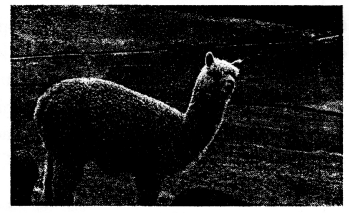
Identify the animal seen in the photograph and answer the following questions
Question 1.
Name an area in South America where you can see it.
Answer:That’s an alpaca in the picture. You can commonly see alpacas in the Andean highlands of South America. Countries like Peru, Bolivia, Ecuador, and Chile are home to them
Question 2.
How do these animals adapt to the climate?
Answer:That furry creature is a Huacaya alpaca, and they’ve got some cool ways to handle their environment. Their super thick, warm fleece is like a natural winter coat, perfect for the cold and often tough conditions up in the high mountains where they live. They’re also built for those high altitudes, with bodies that are good at using oxygen even when the air is thin. Plus, they’re pretty good at saving water, which comes in handy in drier times. Their special footpads help them get a good grip on the rocky, uneven ground they usually roam. And living together in groups helps them stay warmer and safer.
Question 3.
Give one significant usefulness of this animal.
Answer:What we get from alpacas is their wonderfully soft and luxurious fleece, which is like wool. People really value it because it’s gentle, strong, and doesn’t usually cause allergies.