
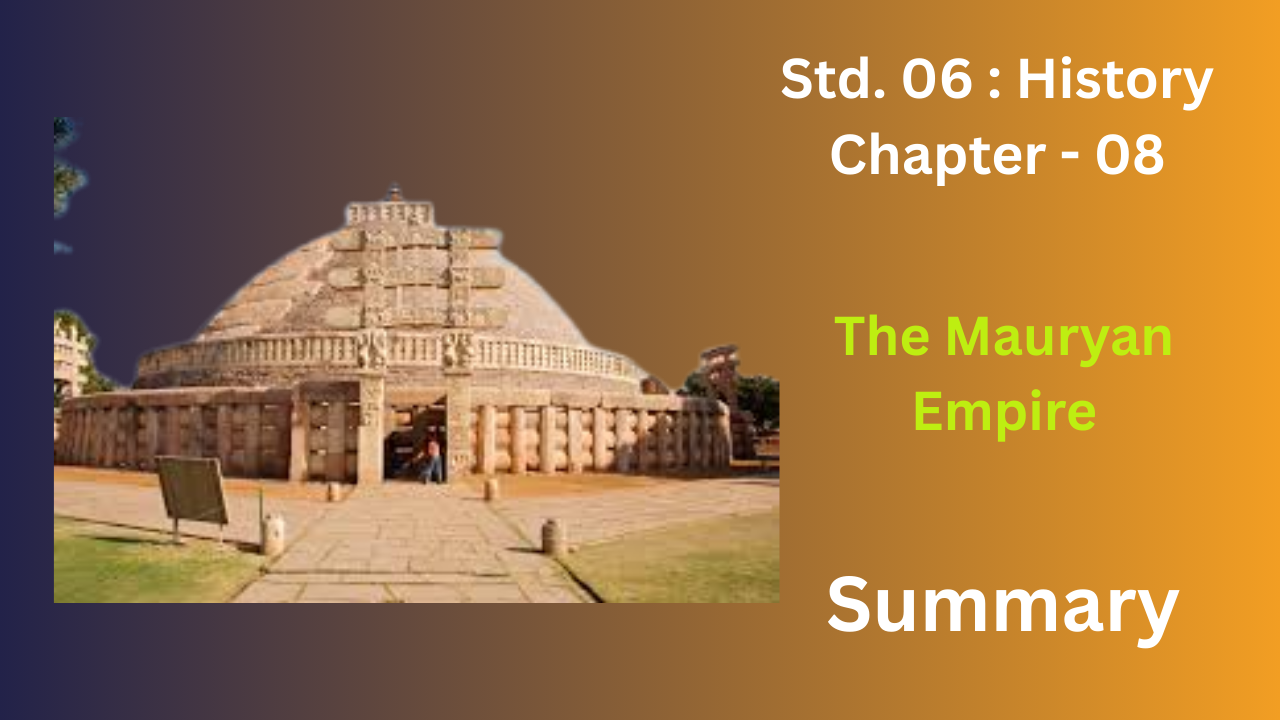
The chapter probably begins by explaining how the Mauryan Empire was the first large empire in India, rising after the Nanda dynasty was overthrown by Chandragupta Maurya with the help of his wise advisor Chanakya (Kautilya).
It would then detail the reign of Chandragupta Maurya, highlighting his conquests and how he established a strong central government. Key aspects would include:
- A well-organized army: Emphasizing its size and efficiency.
- An efficient administration: Describing the system of governors and officials managing different parts of the vast empire.
- A strong emphasis on law and order: Mentioning the efforts to maintain peace and security.
Next, the chapter would likely focus on Bindusara, Chandragupta’s son, and his contributions to expanding the empire further south.
A significant portion of the chapter would undoubtedly be dedicated to Ashoka, Bindusara’s son, and perhaps the most famous Mauryan emperor. Key points about Ashoka would include:
- His early conquests, particularly the Kalinga War, and the immense suffering it caused.
- His commitment to Dhamma, a set of ethical principles based on peace, non-violence, tolerance, and respect for all living beings.
- His efforts to spread Dhamma through edicts inscribed on pillars and rocks throughout the empire.
- His welfare measures for the people, such as building roads, rest houses, and hospitals.
The chapter would then likely discuss the administration under the Mauryas in more detail, covering aspects like:
- The centralized government with the emperor at the top.
- The roles of important ministers and officials.
- The division of the empire into provinces and further into smaller units.
- The system of taxation and revenue collection.
- The importance of spies in maintaining control.
Finally, the chapter would touch upon the decline of the Mauryan Empire after Ashoka’s death, possibly mentioning reasons like weak successors, the vastness of the empire, and internal conflicts.
Exercise
I. Tick (✓) the right answer:
1. Ashoka invaded Kalinga in
(a) 261 BC
(b) 265 BC
(c) 270 BC
2. The first historical empire in India was established by
(a) Ashoka
(b) Bindusara
(c) Chandragupta
3. The Greek General whom Chandragupta defeated was
(a) Megasthenes
(b) Seleucus
(c) Alexander
4. Ashoka appointed special officers to look after the welfare of people. They were called
(a) Sthanika
(b) Senapati
(c) Dhamma Mahamatras
5. The edicts of Ashoka were written in
(a) Sanskrit
(b) Pali
(c) Prakrit
II. Fill in the blanks:
- Chandragupta defeated the last ———— named———- .
Ans : Nanda king , Dhanananda
- Chandragupta was helped by a Brahmin ————in his conquests and administration.
Ans : Chanakya
- The Greek ambassador in Chandragupta’s court was named————.
Ans : Megasthenes
- Ashoka’s father was who ruled for ————- .
Ans : Bindusara, 24
- Ashoka is famous for his policy of———–.
Ans : Dhamma
- The battle of ———— changed Ashoka’s life.
Ans : Kalinga
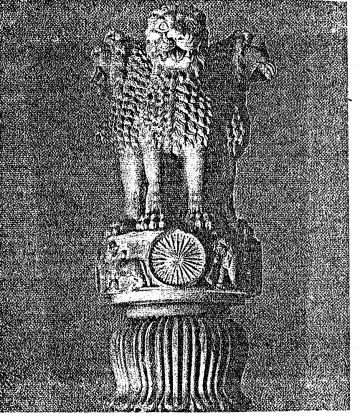
- The National Emblem of India is the Lion ———- of Ashoka.
Ans : capital of Sarnath
- The last Mauryan king was killed by———–.
Ans : Pushyamitra Shunga
III. Match Column A with Column B:
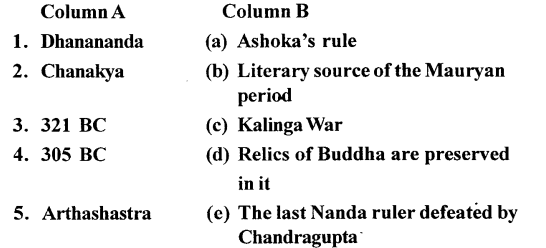
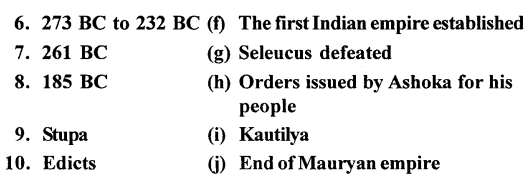
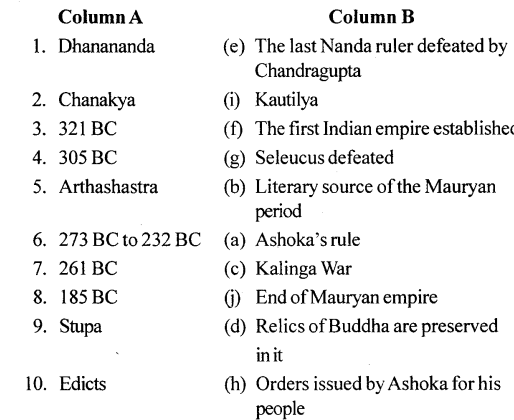
Answer:
IV. Answer the following questions:
Question 1.
Who helped Chandragupta against the Nandas and why?
Answer:Chandragupta’s success in overthrowing the Nandas was largely due to his astute advisor, Chanakya (Kautilya). 1 Fueled by a personal vendetta and a dream of a unified India, Chanakya provided Chandragupta with the crucial strategies and political insights needed to dismantle the Nanda empire.
Question 2.
Describe Chandragupta as a conqueror. What was the extent of his empire?
Answer:
Chandragupta Maurya was a determined and strategic conqueror. 1 With the guidance of Chanakya, he systematically overthrew the Nanda dynasty, demonstrating strong political and military acumen. 2 He then expanded his territories significantly, establishing the Mauryan Empire which, at its height, stretched across a large part of the Indian subcontinent. 3 This included regions from modern-day Afghanistan and Pakistan in the northwest, extending eastward across North India, and reaching down to parts of Central and South India
Question 3.
Name the two literary sources of the Mauryan period. What do they tell us about the administration of the Mauryas?
Answer:
Two key literary sources for the Mauryan period are Kautilya’s Arthashastra and Megasthenes’ Indica.
The Arthashastra provides detailed insights into Mauryan administration, outlining principles of governance, law, taxation, espionage, and military organization. It reveals a highly centralized state with a complex bureaucracy managing various aspects of the empire.
Megasthenes’ Indica, though surviving in fragments through later writers, offers a Greek ambassador’s perspective on Mauryan society, administration, and military. It describes the king’s court, city administration, social classes, and the impressive size of the Mauryan army
Question 4.
How did the battle of Kalinga affect Ashoka?
Answer:
The Battle of Kalinga deeply affected Ashoka, filling him with remorse due to the immense loss of life. 1 This pivotal experience led him to embrace Buddhism and adopt the path of dhamma, transforming him from a conqueror into a compassionate ruler dedicated to peace and the well-being of his people
Question 5.
Write a short note on Mauryan administration.
Answer:
The Mauryan Empire had a well-organized administration. The king was the central figure, with power divided into provinces. Officials collected taxes and maintained order. A network of roads and waterways helped with trade and communication. Spies kept the government informed.
V. Write short notes on:
Question 1.
(1) The measures taken by Ashoka for the welfare of his people.
(2) Mauryan art and architecture.
Answer:
1)It’s truly inspiring how Emperor Ashoka, following the tumultuous Kalinga War, channeled his energies towards the welfare of his people through the principles of dhamma. Imagine a ruler so deeply moved by the suffering of war that he dedicates himself to building a kingdom founded on righteousness and compassion! His actions speak volumes: the construction of roads to ease travel and trade, the provision of rest houses offering respite to weary travelers, and the establishment of hospitals catering to the health of both people and animals – these were revolutionary steps for the time. And the dhamma-mahamattas, these special officers appointed to spread the message of dhamma and ensure the well-being of the populace, highlight Ashoka’s commitment to actively fostering a just and caring society. His advocacy for religious tolerance further underscores his enlightened approach to governance, creating an environment where diverse beliefs could coexist peacefully. The very act of inscribing his edicts on rocks and pillars across the empire served as a powerful and enduring way to communicate his principles of peace and good governance directly to his subjects.
2)The Mauryan era also witnessed a remarkable flourishing of art and architecture, a tangible expression of the empire’s power and evolving cultural landscape. The widespread adoption of stone as a building material marked a significant leap forward from earlier, more perishable wooden structures, lending a sense of permanence and grandeur to their creations. Think of the iconic Mauryan pillars – the Ashokan Pillar at Sarnath with its gleaming polish and the majestic lion capital immediately comes to mind. These weren’t just structural supports; they were statements of imperial authority and artistic mastery. The intricate carvings, often featuring symbolic animals, speak to a sophisticated understanding of craftsmanship and iconography. Then there are the stupas, like the magnificent Great Stupa at Sanchi, which became central to Buddhist practice and stand as enduring examples of early Indian monumental architecture. Even the rock-cut caves, such as those in the Barabar and Nagarjuni hills, carved out meticulously for the use of monks, showcase the architectural innovation and religious patronage of the period. It’s fascinating to see how art and architecture during the Mauryan dynasty not only served practical and religious purposes but also reflected the empire’s values and artistic prowess.
VI. Picture study: The picture shows Ashoka’s pillars at Firoz Shah Kotla. Find out

1. Where was it originally installed ?
Ans.This particular pillar, now at Feroz Shah Kotla, was originally installed in Topra Kalan, a village in the Yamunanagar district of Haryana.
2.Who brought it to Delhi?
Ans:The pillar was moved to Delhi in the 14th century by Sultan Firoz Shah Tughlaq. He was fascinated by such ancient monuments and had this and another Ashokan pillar transported to Delhi as trophies of his reign.
3.How did Ashoka use edicts to spread Dhamma in his kingdom?
Ans:Ashoka ingeniously used these pillars, along with rock edicts strategically placed throughout his vast empire, as a powerful means to communicate his principles of Dhamma to a wide audience. These edicts, inscribed in Prakrit language and Brahmi script (languages and scripts understood by the common people), served several key purposes:
- Public Communication: They acted as public announcements, ensuring that his messages reached a large segment of the population. Imagine these towering pillars standing in prominent public spaces, conveying the emperor’s ideals!
- Moral and Ethical Guidance: The edicts outlined Ashoka’s vision of a righteous life, emphasizing virtues like non-violence (ahimsa), truthfulness, compassion, tolerance, respect for elders and teachers, and the welfare of all beings.
- Governance Principles: Some edicts also detailed Ashoka’s administrative policies and his commitment to just and humane governance. This helped to establish a framework for ethical rule throughout the empire.
- Promotion of Religious Tolerance: Ashoka’s edicts advocated for respect and understanding between different religious sects, fostering an environment of peaceful coexistence.
- Enduring Legacy: By inscribing his messages on such durable materials like stone and these monolithic pillars, Ashoka ensured that his principles would endure for generations to come, continuing to inspire and guide.
Questions Based on The Mauryan Empire
A. Fill in the blanks.
- The main literary sources of information about the Mauryan period are ———-and———-.
Ans : Indika , Arthashastra
- In 323 BCE ———— was overthrown by Chandragupta Maurya.
Ans : Dhana Nanda
- Chandragupta’s success in acquiring the throne of Magadha was largely due to the guidance and training of———-.
Ans : his adviser Chanakya
- In 305 BCE Alexander’s general ———– invaded India.
Ans : Seleucus
- Chandragupta Maurya was succeeded by his son———-.
Ans : Bindusara
- When Ashoka ascended the throne of Magadha, ———-was the only kingdom outside Mauryan control.
Ans : Kalinga
- ———- was the turning point in Ashoka’s life.
Ans : The Kalinga war
- Ashoka replaced the policy of dig vijaya with———-.
Ans : dhamma vijaya
- The word ————- is derived from the Sanskrit word dharma which means———.
Ans : dhamma , religious duty
- Ashoka’s dhamma was based on human values and a ————inspired by the teachings of ———-.
Ans : code of conduct , Buddha
B. Match the following.
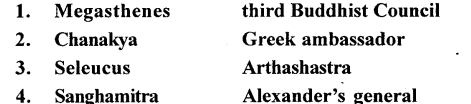

Ans :
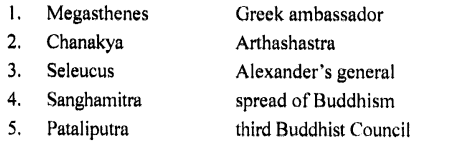
C. Answer the following.
Question 1.
What happened to Alexander’s vast empire after his death?
Answer:
Alexander’s death in 323 BCE kicked off a free-for-all among his generals, the Diadochi. 1 This scramble for power resulted in the formation of significant Hellenistic kingdoms: the Seleucid Empire dominating the Near East, the Ptolemaic Kingdom ruling Egypt, and the Antigonid Kingdom holding sway over Macedon and Greece. 2 These kingdoms became vital in disseminating Greek culture and influence across vast territories for centuries until new powers, like the Roman Republic, eventually absorbed them
Question 2.
Why was Seleucus compelled to sign a treaty with Chandragupta Maurya? Mention two important terms of this treaty.
Answer:
Seleucus was compelled to sign a treaty with Chandragupta Maurya primarily due to a decisive Mauryan victory in the Seleucid-Mauryan War. Chandragupta’s strong military, particularly his elephant corps, seems to have overwhelmed Seleucus.
Two important terms of the treaty were:
- Territorial Cession: Seleucus ceded territories to the Mauryan Empire. These included areas that now comprise parts of modern-day Afghanistan and Pakistan.
- Gift of Elephants: Chandragupta gifted Seleucus a significant number of war elephants (500 are mentioned in some accounts).
Question 3.
What was the extent of Chandragupta’s empire?
Answer:
1 By the time he finished ruling, his empire stretched far and wide, from the Hindu Kush mountains in the northwest all the way to Bengal in the east. It also covered the land from the Himalayas in the north down to the Narmada River in the south. That’s a huge chunk of what we now know as India, Pakistan, and Afghanistan
Question 4.
Why was the Kalinga War a turning point in the life of Ashoka?
Answer:
Witnessing the sheer devastation of the Kalinga War deeply shook Ashoka. 1 Overwhelmed by the loss of life and suffering, he felt profound regret. 2 This experience became a pivotal moment, leading him to adopt Buddhism and commit himself to a path of peace and righteous living (Dharma).
Question 5.
Mention any three principles of dhamma.
Answer:
Ahimsa calls for kindness to all life, in our actions, words, and even thoughts. Satya urges us to live with honesty and truth in everything we do. And Karuna inspires us to feel deeply for others and want their well-being.
Question 6.
What did Ashoka do to spread Buddhism outside India?
Answer:
Ashoka played a pivotal role in spreading Buddhism through several key actions. He strategically dispatched monks and scholars to various countries, including sending his own children to Sri Lanka, establishing it as a Theravada stronghold. Furthermore, he erected pillars and rock edicts inscribed with Buddhist teachings, making these principles widely accessible. His construction of numerous stupas and monasteries fostered centers for Buddhist learning and attracted diverse populations. By supporting the Third Buddhist Council, he ensured the standardization and broader dissemination of Buddhist scriptures. Finally, his rule based on Buddhist ethics served as an example of righteous governance, indirectly encouraging the adoption of these values in neighboring regions.
Question 7.
Mention any three steps taken by Ashoka to propagate dhamma in India.
Answer:
Issued Edicts: Ashoka inscribed the principles of Dhamma on rocks and pillars. This made the teachings accessible to everyone.
Appointed Officials: He appointed special officers called Dhamma Mahamatras. Their job was to spread Dhamma and ensure people followed it.
Sent Missionaries: Ashoka sent his son, daughter, and other monks to various parts of India and even other countries to spread Dhamma.
Question 8.
What was the extent of Ashoka’s empire?
Answer:
Emperor Ashoka’s dominion was a truly remarkable achievement, painting a vast and influential footprint across the Indian subcontinent during its zenith from approximately 268 to 232 BCE. Picture a realm that stretched its arms from the rugged landscapes of present-day Afghanistan in the west to the fertile deltas of Bangladesh in the east. Its northern border met the majestic Himalayas, encompassing parts of Nepal, while its southern reach nearly embraced the entire Indian peninsula, stopping just shy of the southernmost points of today’s Tamil Nadu and Kerala, and notably leaving Sri Lanka outside its embrace.
Within this immense territory lay strategically important regions. In the north, Ashoka’s power held sway over parts of Afghanistan and Pakistan, including the historically rich areas of Gandhara and Taxila, as well as Punjab, Haryana, Uttar Pradesh, Bihar, and sections of Nepal. The central heartlands comprised what we now know as Madhya Pradesh and Chhattisgarh. To the west, Gujarat and Maharashtra were integral parts of the empire, while the east encompassed Bengal and the crucial region of Odisha, anciently known as Kalinga. The southern territories extended across northern Karnataka and Andhra Pradesh.
The vibrant heart of this sprawling empire was Pataliputra, the historical name for modern-day Patna. Serving as crucial administrative anchors were the significant provincial centers of Taxila and Ujjain.
Ashoka’s empire stands as a colossal accomplishment in terms of its sheer geographical scale, placing it among the most extensive empires to have graced the Indian subcontinent. Yet, his enduring legacy extends far beyond mere territorial control. His passionate embrace and promotion of the tenets of Dhamma played a pivotal role in disseminating Buddhism across Asia, leaving an indelible and profound mark on the course of history.
Question 9.
What are edicts? Why were they composed in Prakrit?
Answer:
Edicts are official orders or proclamations issued by a ruler or authority. Emperor Ashoka of the Mauryan Empire famously used edicts inscribed on pillars, rocks, and cave walls to communicate his policies and ideals, collectively known as Dhamma, to his people.
These edicts were primarily composed in Prakrit, the common language spoken by the majority of the population at the time. By using Prakrit, Ashoka ensured that his messages could be widely understood across his vast empire, facilitating direct communication and promoting his principles of social and moral conduct. While some edicts in the northwestern regions were written in Greek and Aramaic to cater to local populations, Prakrit served as the main medium for reaching the masses.
Question 10.
What did Ashoka do for the welfare of his subjects?
Answer:
Ashoka, deeply affected by the Kalinga War, dedicated himself to the welfare of his subjects through his policy of Dhamma. This involved promoting social harmony, ethical conduct, and tolerance. He implemented several measures:
- Public Works: He built roads, rest houses, wells, and planted trees to provide comfort and convenience for travelers and his people.
- Justice and Administration: He appointed officials to ensure fair governance and the well-being of all communities.
- Animal Welfare: He prohibited animal sacrifices and promoted non-violence towards animals.
- Propagation of Dhamma: Through edicts inscribed on rocks and pillars, he spread his principles of compassion, truthfulness, and respect for all.
In essence, Ashoka strived to be a benevolent ruler focused on the moral and material well-being of everyone in his empire.
Question 8.
What was the extent of Ashoka’s empire?
Answer:
Emperor Ashoka’s dominion was a truly remarkable achievement, painting a vast and influential footprint across the Indian subcontinent during its zenith from approximately 268 to 232 BCE. Picture a realm that stretched its arms from the rugged landscapes of present-day Afghanistan in the west to the fertile deltas of Bangladesh in the east. Its northern border met the majestic Himalayas, encompassing parts of Nepal, while its southern reach nearly embraced the entire Indian peninsula, stopping just shy of the southernmost points of today’s Tamil Nadu and Kerala, and notably leaving Sri Lanka outside its embrace.
Within this immense territory lay strategically important regions. In the north, Ashoka’s power held sway over parts of Afghanistan and Pakistan, including the historically rich areas of Gandhara and Taxila, as well as Punjab, Haryana, Uttar Pradesh, Bihar, and sections of Nepal. The central heartlands comprised what we now know as Madhya Pradesh and Chhattisgarh. To the west, Gujarat and Maharashtra were integral parts of the empire, while the east encompassed Bengal and the crucial region of Odisha, anciently known as Kalinga. The southern territories extended across northern Karnataka and Andhra Pradesh.
The vibrant heart of this sprawling empire was Pataliputra, the historical name for modern-day Patna. Serving as crucial administrative anchors were the significant provincial centers of Taxila and Ujjain.
Ashoka’s empire stands as a colossal accomplishment in terms of its sheer geographical scale, placing it among the most extensive empires to have graced the Indian subcontinent. Yet, his enduring legacy extends far beyond mere territorial control. His passionate embrace and promotion of the tenets of Dhamma played a pivotal role in disseminating Buddhism across Asia, leaving an indelible and profound mark on the course of history.
Question 9.
What are edicts? Why were they composed in Prakrit?
Answer:
Edicts are official orders or proclamations issued by a ruler or authority. Emperor Ashoka of the Mauryan Empire famously used edicts inscribed on pillars, rocks, and cave walls to communicate his policies and ideals, collectively known as Dhamma, to his people.
These edicts were primarily composed in Prakrit, the common language spoken by the majority of the population at the time. By using Prakrit, Ashoka ensured that his messages could be widely understood across his vast empire, facilitating direct communication and promoting his principles of social and moral conduct. While some edicts in the northwestern regions were written in Greek and Aramaic to cater to local populations, Prakrit served as the main medium for reaching the masses.
Question 10.
What did Ashoka do for the welfare of his subjects?
Answer:
Ashoka, deeply affected by the Kalinga War, dedicated himself to the welfare of his subjects through his policy of Dhamma. This involved promoting social harmony, ethical conduct, and tolerance. He implemented several measures:
- Public Works: He built roads, rest houses, wells, and planted trees to provide comfort and convenience for travelers and his people.
- Justice and Administration: He appointed officials to ensure fair governance and the well-being of all communities.
- Animal Welfare: He prohibited animal sacrifices and promoted non-violence towards animals.
- Propagation of Dhamma: Through edicts inscribed on rocks and pillars, he spread his principles of compassion, truthfulness, and respect for all.
In essence, Ashoka strived to be a benevolent ruler focused on the moral and material well-being of everyone in his empire.
D. State whether the following are true or false.
- Jmlika was written by Kautilya.
Ans : False - Chanakya was a wise brahmana who had a personal grudge against Dhana Nanda.
Ans : True - Ashoka’s son was named Rahul.
Ans : False - Ashoka’s dhamma was based on the principles of Buddhism.
Ans : True - Bindusara was the son of Ashoka.
Ans : False
E. Picture study
1. This is an outline map of India. Mark the areas under Ashoka’s rule.
Answer:
2. Name one ancient town and one modern town on the map.
Answer:
- Ancient town: Pataliputra
- Modem city Delhi.
Questions Based on The Mauryan Administration
A. Fill in the blanks.
- The Mauryan empire was divided into ———- which were placed under the control of kumaras.
Ans : provinces
- The king had ————- power. He was advised by the———-.
Ans : supreme , mantri parishad
- The provinces were divided into a number of ————– which were further subdivided into ———– and———–.
Ans : districts , nagaras , gramas
- The capital city of Pataliputra was looked after by six committees. Each committee consisted of ———– members.
Ans : five
- Mauryan art was greatly influenced by————.
Ans : Buddhism
- The most famous Ashoka Pillar is at————.
Ans : Sarnath.
- The lion capital was adopted as the ——- of India in the year 1950.
Ans : emblem
- The chief occupation of the people during the Mauryan period was———-.
Ans : agriculture
- Two Western European countries with whom the Mauryans had trade relation were ———— and ———– .
Ans : Egypt , Greece
- The last Mauryan emperor was killed by ———— the founder of the ———dynasty.
Ans : Pushyamitra Sunga , Sunga
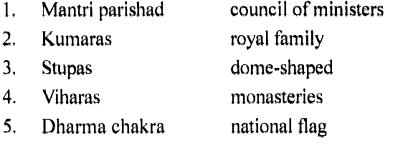
B. Match the following.
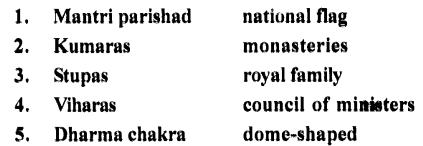
Answer:
D.State whether the following are true or false.
- The Mauryan administration was based on the guidelines laid down in the Indika.
Ans : False - Pataliputra was a magnificent walled city.
Ans : True - The last Mauryan ruler was Pushyamitra Sunga
Ans : False - There was no spy system in the Mauryan empire.
Ans : False