
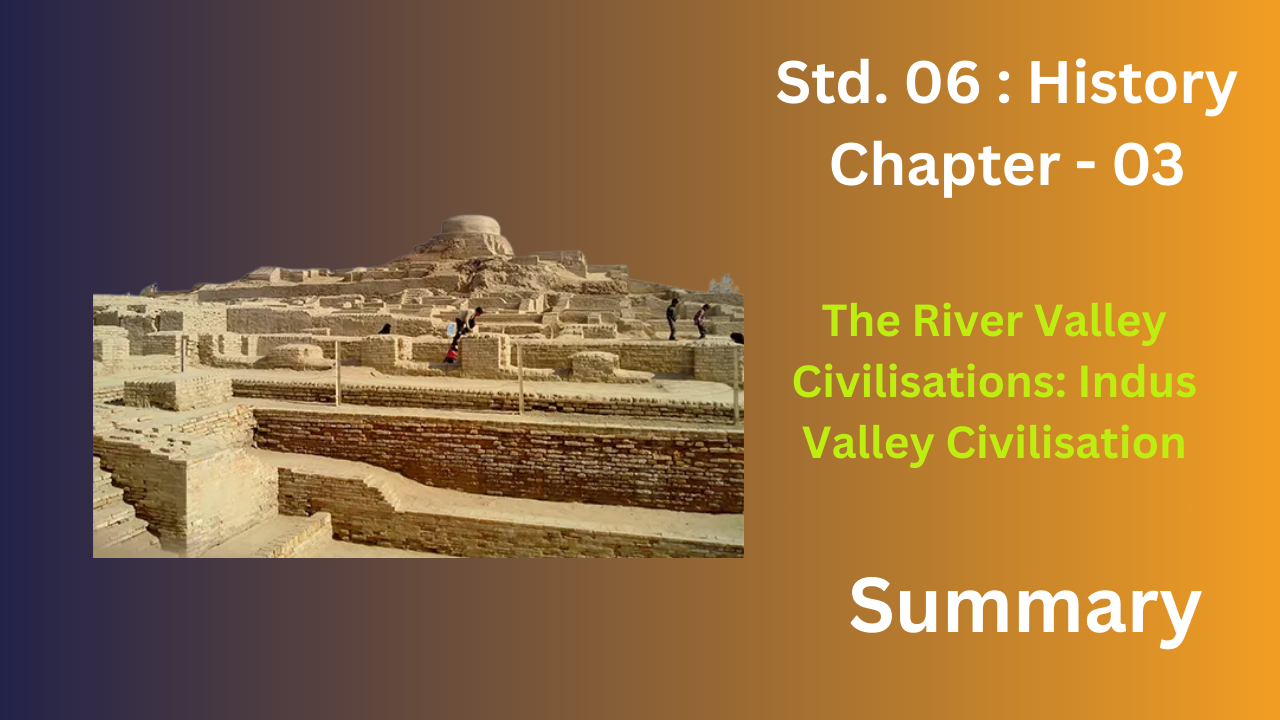
The Indus Valley Civilisation, a truly ancient and impressive society, thrived along the Indus River and its connected waterways in what we now know as Pakistan and parts of northwest India. This remarkable period stretched from roughly 2500 BCE to 1750 BCE, placing it among the earliest great civilisations on our planet.
Several key features paint a picture of this advanced culture:
Streets were straight and orderly, houses were well-constructed, and a sophisticated drainage system efficiently managed wastewater. They even had public baths for communal use and granaries to store their harvested grains, showcasing a high level of organisation and foresight for their time.
Their architecture was equally noteworthy. They built sturdy homes using baked bricks of a consistent size, ensuring durability. Many dwellings were even multi-storied, and the advanced drainage systems highlight their understanding of sanitation.
The Indus people were skilled in both agriculture and trade. They cultivated essential crops like wheat, barley, cotton, and peas, demonstrating their agricultural prowess. Furthermore, they actively engaged in trade with other distant civilisations, such as Mesopotamia, using distinctive seals to identify their merchandise.
Their craftsmanship was exceptional. They produced beautiful pottery, adorned themselves with jewelry made from gold, silver, and precious stones, and crafted practical tools and weapons from materials like copper and bronze. The intricate seals they created, often featuring animal figures and a yet-to-be-understood script, are particularly fascinating.
The Great Bath at Mohenjo-Daro stands as a remarkable structure, a large public bathing tank that hints at the importance of cleanliness and possibly even religious practices within their society.
One of the enduring mysteries of this civilisation is their script. Despite numerous attempts, it remains undeciphered, leaving us with unanswered questions about their language, beliefs, and the full scope of their culture.
Around 1750 BCE, this flourishing civilisation began to decline. The precise reasons for this are still debated by historians, with theories ranging from shifts in the course of the Indus River and devastating natural disasters to potential invasions.
In essence, the Indus Valley Civilisation was an extraordinary early society distinguished by its remarkably well-planned cities, advanced sanitation systems, active trade networks, and impressive artistic skills.
Exercise
I. Fill in the blanks:
- The Indus Valley Civilisation was the ———– civilisation of India.
Ans : Earliest
- Harappa is situated in ———- district in Pakistan.
Ans : Sahiwal
- The Indus Valley Civilisation stood on the bank of river ——– .
Ans : Indus
- The largest building discovered at Mohenjodaro is the——–.
Ans : Great Granary
- ————- metal was used by the people of the Indus Valley Civilisation.
Ans : Bronze
- Indus people used ———— bricks for constructing buildings.
Ans : Burnt
- The Harappan culture came to an end by ———– .
Ans : 1500 BC
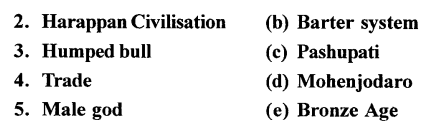
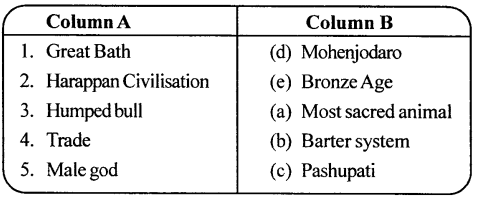
II. Match Column A with Column B
Column A Column B

Answer:
III. Answer the following questions?
Question 1.
Who discovered the Indus Valley Civilisation and when?
Answer:
It all started back in 1921 when Daya Ram Sahni, a pioneering archaeologist, made that initial groundbreaking discovery at Harappa. Imagine the excitement of unearthing the remnants of such a sophisticated urban culture from the distant past!
Then, a few years later, in 1924, Sir John Marshall, who held the important position of Director-General of the Archaeological Survey of India at the time, officially announced this significant find to the world. That announcement truly opened a new chapter in our understanding of ancient history, revealing a civilization that thrived alongside the well-known cultures of Mesopotamia and Egypt. It’s amazing to think about the scale and complexity of the Indus Valley Civilization and how its rediscovery has reshaped our perspective on early human societies
Question 2.
What does civilisation mean? Give four characteristics of a civilisation.
Answer:
A civilization emerges when a society develops sophisticated elements like organized government, urban centers, specialized labor, social hierarchy, and advancements in technology, art, and writingThink of it as a society that’s gone beyond simple survival and built something more elaborate.
Here are four key characteristics:
- Cities: Civilizations have large, densely populated urban centers that act as hubs for trade, culture, and governance.
- Specialized Labor: People in a civilization don’t all do the same thing. There are different jobs, like farmers, artisans, priests, and soldiers.
- Organized Government: There’s a system in place to make rules, maintain order, and manage resources.
- Record Keeping: Civilizations develop ways to keep track of information, often through writing.
Question 3.
Why did the earliest civilisations grow up near rivers?
Answer:
Rivers were truly lifebloods for early civilizations! Their consistent fresh water was a game-changer for growing populations, handling daily needs, and staying healthy. The nearby land was like a natural farm, getting a boost from floods that left behind rich soil – perfect for growing lots of food, especially with river water for irrigation. Plus, rivers acted like natural roads, making it easier to travel and trade goods, connecting different groups of people. And let’s not forget the extra perks – animals drawn to the water for food and materials like reeds and clay found right along the banks.
Question 4.
Name the different sites of the Indus Valley Civilisation.
Answer:The Indus Valley Civilisation boasted a wide network of urban centers! Key sites included Harappa and Mohenjo-Daro (now in Pakistan), renowned for their early discovery and sophisticated planning, including Mohenjo-Daro’s impressive Great Bath. In India, Kalibangan in Rajasthan revealed fire altars and agricultural evidence, while Lothal in Gujarat served as a crucial port with a dockyard. Dholavira, also in Gujarat, stands out for its advanced water management and distinct city layout. Rakhigarhi in Haryana is one of the largest sites discovered. Chanhudaro in Sindh was a hub for crafting beads, and Banawali in Haryana shows a fascinating transition between pre-Harappan and Harappan cultures.
Question 5.
Describe the town planning and the drainage system of the Indus Valley Civilisation.
Answer:the Indus Valley Civilization showcased such sophisticated urban planning so long ago! Their meticulous approach to town layout and sanitation really sets them apart.
Imagine walking through one of their cities. You’d likely notice the clear separation between the elevated citadel, perhaps serving as a center of authority or important public structures, and the more expansive lower town where most people resided. The straight streets, forming a neat grid, would be quite striking – a far cry from the more haphazard layouts of many contemporary settlements. And the consistent use of baked bricks as the primary building material speaks to a level of standardization and engineering prowess.
But perhaps the most impressive aspect is their drainage system. The fact that individual homes had bathrooms connected to a network of covered drains running beneath the streets is truly remarkable for the time period. These brick-lined drains, complete with inspection points for maintenance, highlight a deep understanding of hygiene and public health. It makes you wonder about the level of civic organization they must have possessed to implement and maintain such a system!
Question 6.
Describe the Great Bath. Where has it been found? What was it used for?
Answer:The Great Bath is a really fascinating structure from a very old civilization. Imagine a large, rectangular pool, kind of like a big, ancient swimming pool. It’s not like the ones we have today, though. This one was built with carefully laid bricks, so it could hold water.
You could get into the Great Bath by walking down steps. There were steps on two sides, going down into the pool. The bottom of the pool was made in a way that wouldn’t let water leak out. They even used a kind of tar to make it extra waterproof!
This amazing structure has been found in Mohenjo-Daro, which is an archaeological site in present-day Pakistan.What was it used for? Well, we’re not completely sure, but many experts think it was used for special religious or ceremonial bathing. Water often played a big role in ancient rituals, symbolizing purification and renewal. It’s possible that people gathered there for important events. Some scholars also think it might have been used for important social gatherings. While many homes in Mohenjo-Daro had their own bathing areas, the Great Bath was a public structure, suggesting it had a special significance for the community.
Question 7.
Describe the Great Granary. Where has it been found?
Answer:The Great Granary was a massive brick structure found in the citadel of Mohenjo-daro, one of the largest settlements of the ancient Indus Valley Civilization (now in present-day Sindh, Pakistan).
Imagine a substantial building, likely with a timber superstructure above its brick foundations. Archaeologists believe it was used to store grains, possibly for the entire community. Its sheer size suggests a well-organized system for collecting, managing, and distributing food resources. While the exact nature of its operation and ownership remains a subject of scholarly debate, its presence speaks volumes about the advanced planning and societal structure of the Indus Valley people
Question 8.
Describe the religion of Indus Valley Civilisation
Answer:
The Harappans worshiped the pipal tree and humped bull which have been found on hundreds of seals. They also worshiped Mother Goddess which were beautifully depicted as terracotta figurines. The Harappans also worshiped ‘Shiva’ or ‘Pashupati’. A three-faced figure with horns has been found sitting in the posture of a yogi. He is surrounded by a tiger, a rhinoceros, a buffalo, and an elephant. But no temple or any other religious building has been found so far. The Harappans believed in life after death and buried the dead with his belongings.
Question 9.
Name the three social classes of the Indus Valley Civilisation.
Answer:the Indus Valley Civilisation to name social classes with absolute certainty, archaeological evidence suggests a degree of social stratification. Based on the layout of their cities, the types of dwellings, and the distribution of artifacts, scholars generally infer the existence of at least three broad social groups:
- The Ruling Class/Priests: The well-planned cities with citadels housing large public structures like the Great Bath and granaries suggest a powerful organizing authority. These could have been rulers, priests, or a combination of both, who controlled planning, resource allocation, and possibly religious practices.
- Merchants and Skilled Artisans: The Indus Valley Civilisation was known for its extensive trade networks and sophisticated crafts. This points to a significant class of merchants who facilitated exchange and skilled artisans who produced pottery, jewelry, seals, and other specialized goods. Their relatively comfortable living quarters in the lower towns indicate a degree of prosperity and social standing.
- Laborers and Farmers: The majority of the population likely consisted of agricultural laborers and other workers who supported the urban centers. Their dwellings were generally smaller and simpler, suggesting a less privileged social position. They would have been crucial for food production and other essential tasks
Question 10.
What were the probable causes which could have brought about an abrupt end to the Indus Valley Civilisation?
Answer:Shifting Rivers: Imagine the lifeblood of a civilization is a river. Now imagine that the river changes its course. That’s possibly what happened with the Indus River and the Ghaggar-Hakra River (which some believe was the ancient Saraswati). If these rivers, which were crucial for farming and transportation, changed their flow, it would have been a huge blow.
Climate Change: The climate isn’t always constant, and it seems like the Indus Valley region might have become drier. Less rainfall would have meant tougher times for growing crops. This could have led to food shortages and made it harder to support large cities.
Decline in Trade: The Indus people were big traders, especially with Mesopotamia. If those trade routes were disrupted, maybe because of political problems in Mesopotamia, or changes in sea levels, it would have hurt the Indus economy.
Internal Problems: It’s possible that the civilization faced problems from within. Maybe the cities became too crowded, or the systems of managing them weren’t working as well as they used to. We don’t have a lot of evidence of warfare, but it’s possible that conflicts played a role.
A Combination of Factors: It’s most likely that no single thing caused the decline. It was probably a mix of several of these factors all happening around the same time – a “perfect storm” of problems that made it impossible for the Indus cities to survive in the long run.
IV. Give reasons why we say that the people of the Indus Valley Civilisation —
- Had a good sense of cleanliness
- Carried on trade with Mesopotamia
- Produced surplus grains
- Had an idea of metallurgy
Answer:Had a good sense of cleanliness
Well, if you ask me, those Indus Valley folks were way ahead of their time when it came to keeping things clean. I mean, they had these elaborate drainage systems in their cities. We’re talking about covered drains, sometimes made of baked bricks, that run along the streets. Each house was often connected to this network, so wastewater and, you know, other stuff was carried away. Plus, they had these things called “Great Baths,” which, from what I’ve read, were like large, public bathing areas. Even ordinary houses had their own bathing areas. It’s pretty impressive, considering how long ago it was.
Carried on trade with Mesopotamia
This one’s interesting.Archaeologists have dug up Indus Valley seals in Mesopotamia, which is present-day Iraq and that area. And guess what? They’ve also found Mesopotamian stuff in the Indus Valley cities. These seals, they were like stamps, you know, used to mark goods. So, it looks like they were doing business with each other, exchanging goods. It wasn’t just a little bit of trade, either; it seems to have been quite organized.
Produced surplus grains
You don’t build big cities and have lots of people without a good supply of food, right? They had fertile land, thanks to the Indus River, and they grew stuff like wheat and barley. And they had granaries – like big storage buildings – to keep the extra grain. This surplus meant they had enough to feed everyone, and maybe even trade some of it.
Had an idea of metallurgy
These guys were working with metal – and not just one type. They knew how to work with copper, and they made bronze, which is a mix of copper and tin. They made tools, weapons, and even jewelry. I’ve seen pictures of these bronze figurines, and they’re pretty amazing. So, yeah, they definitely had a handle on metallurgy, which is a fancy way of saying they knew their way around metal.
Additional Questions
A. Fill in the blanks.
- The main river of the Harappan civilization was———- .
Ans : Ravi
- The Great Bath is located in———— .
Ans : Mohenjo Daro
- The main occupation of the Harappan was——— .
Ans : farming
- The rich wore ornaments made of———– and—–.
Ans : gold, silver & ivory
- The Harappan seals are made of———– and——–.
Ans : clay, soapstone & copper
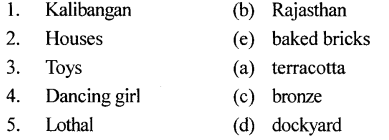
B. Match the following:
Answer:
C. Choose the correct answer:
1. The Harappan civilization belongs to the Mesolithic/ Neolithic/Bronze
Ans. The Harappan civilization belongs to the Bronze Age.
2.Lothal/Ropar/Harappa was the first city to be discovered in the Indus Valley region.
Ans. Harappa was the first city to be discovered in the Indus Valley region.
3. The Assembly Hall is in Mohenjo Daro/Lothal/Harappa.
Ans. The Assembly Hall is in Mohenjo Daro.
4. Wheat/Fish/Barley was the staple food of the Harappans.
Ans. Wheat was the staple food of the Harappans.
5. The neem/banyan/peepal tree was probably regarded as sacred by the Harappans.
Ans. The pipal tree was probably regarded as sacred by the Harappans.
D. State whether the following are true or false.
1. The Harappan cities had an elaborate drainage system.
Ans : False
Correct: The Harappan cities had a well planned system.
2. Domestication of animals was the main occupation of the Harappans.
Ans : False
Correct: Farming was the main occupation of the Flarappans.
3.The Harappans decorated their pottery with various designs.
Ans : True
4.The Harappans built strong boats.
Ans : True
5. The Indus Valley civilization was governed by kings and queens.
Ans : False
Correct: The Indus Valley civilization was not governed by kings and queens
E. Answer the following questions in one or two words/ sentences:
Question 1.
What discoveries proved that India had a 4,500-year old urban civilization?
Answer:The discoveries of well-planned cities like Harappa and Mohenjo-daro with their sophisticated drainage systems, baked brick houses, organized layouts, and artifacts dating back approximately 4,500 years proved the existence of an ancient urban civilization in India.
Question 2.
Why is the Indus Valley Civilization also called the Harappan civilization?
Answer:The reason we often call the Indus Valley Civilization the Harappan Civilization boils down to a pivotal moment in archaeology. Way back in the 1920s, when explorers of the past started digging in what’s now Pakistan, the city of Harappa was the first major urban center of this ancient culture to be found.
Think of it like naming a new comet after the astronomer who first spots it. Since Harappa was the “first sighting,” and as more sites sharing similar features popped up all along the Indus River Valley, it just made sense to give the whole civilization the name of this groundbreaking discovery. So, yes, the Harappan Civilization moniker is directly linked to the unearthing of Harappa as the initial key to understanding this fascinating ancient society.
Question 3.
Why did the Indus Valley people build granaries close to the river bank?
Answer:Transportation: Rivers were the lifelines of the Indus Valley Civilization, serving as major transportation routes. 1 Building granaries close to the river would have made it significantly easier to transport harvested grains from the fields to the storage facilities and then potentially distribute them to other settlements or trading centers via boats. 2 Imagine the effort of carrying large quantities of grain over land compared to moving them along the waterways!
Irrigation: While the granaries themselves wouldn’t directly benefit from being near the river for irrigation, the fertile floodplains alongside the rivers were the primary agricultural areas. Locating the granaries nearby would have minimized the distance for transporting the harvested crops from the fields to the storage.
Water Source (Potentially): While not the primary reason for granary placement, having a readily available water source nearby could have been beneficial for various tasks associated with grain processing or for the people working at the granaries.
Flood Control Measures: Interestingly, some archaeological evidence suggests that the Indus Valley people were skilled in water management and may have even built their settlements and structures, including granaries, with some consideration for potential flooding. Being near the river might have allowed them to integrate the granaries into their broader flood control systems, although this is still a topic of research and debate.
Question 4.
Give one example to prove that the Indus Valley bronze smiths were skilled craftspeople.
Answer:the “Dancing Girl” figurine from Mohenjo-daro really stands out as a fantastic example of the Indus Valley bronze smiths’ skill. 1 Just imagine crafting a small statue like that, entirely out of bronze, thousands of years ago! You can see the delicate features of her face, her arm covered in bangles, and the relaxed posture of her body. It shows they had mastered the complex lost-wax casting technique to create such intricate forms with precision. It wasn’t just a simple, crude object; it was a sophisticated piece of artistry that speaks volumes about their expertise in metalworking
Question 5.How do we know that the Harappans had trade relations with the Mesopotamians?
Answer:The presence of Harappan seals in Mesopotamian cities like Ur and Kish provides direct archaeological evidence of trade and contact. Additionally, Mesopotamian texts mention a land called “Meluhha,” which is widely believed to refer to the Indus Valley Civilization, and describe goods such as carnelian, lapis lazuli, and timber coming from there. 1 The discovery of Harappan weights and measures in Mesopotamia further supports the existence of structured trade relations between the two civilizations. 2
F. Answer the following questions briefly:
Question 1.
How were the Harappan cities planned? Explain briefly the main features of their dwelling houses.
Answer:Harappan cities were well-planned, featuring a grid-like layout with streets intersecting at right angles. They often had a raised “citadel” and a lower town.
Dwelling houses had these main features:
- Built with baked bricks.
- Often multi-storied.
- Had rooms around a central courtyard.
- Included private wells and bathrooms.
- Featured advanced drainage systems.
Question 2.
With reference to the engineering skills of the Indus Valley people, explain briefly the features of
(1)The Great Bath and
(2) the drainage system
Answer:The Indus Valley Civilization was remarkable for its advanced engineering. Here’s a brief look at two key features:
(1) The Great Bath:
. It was made with finely fitted bricks, and a layer of bitumen was used to make it watertight – a very early example of waterproofing! Steps led down into the bath, and there were rooms around it. It’s believed to have been used for special religious or ceremonial bathing.
(2) The Drainage System:
The Indus people had a very well-planned drainage system. Each house had drains that connected to larger street drains. These street drains were often covered and had inspection holes. This shows they cared a lot about cleanliness and sanitation, which was quite advanced for that time.
Question 3.
Give a brief account of
- Great Granary
- Assembly Hall
Answer:Great Granary: This massive structure, found in several Indus Valley Civilization sites like Harappa, was likely used for storing grains. Its presence suggests a well-organized system of agriculture and surplus management, indicating a sophisticated economy. Rows of platforms with brick foundations point towards individual storage units, possibly for different families or communities.
Assembly Hall: Found at Mohenjo-daro, this large pillared hall is believed to have been a public space for gatherings and possibly administrative or religious functions. Its open design and impressive scale suggest the existence of some form of organized social or political structure within the Indus Valley Civilization.
Question 4.
Describe
- The dress and
- Ornaments of the Indus Valley people.
Answer: Based on archaeological evidence, their clothing appears to have been practical and comfortable, well-suited to the climate.
For men, a garment resembling a modern-day dhoti seems to have been common. Women, on the other hand, likely wore skirts. To ward off any chill or perhaps for added style, both men and women probably used shawls as upper coverings.
Beyond just clothing, personal adornment was clearly important to the Indus Valley people. Both genders enjoyed wearing jewelry, showcasing their craftsmanship and perhaps social standing. They worked with a variety of materials, including precious metals like gold and silver, the more readily available copper, and beautiful gemstones. We see evidence of elaborate necklaces, bangles that would have jingled with movement, earrings to frame the face, and anklets that would have adorned the feet of women. Men also participated in this tradition, often wearing armlets and rings. It paints a picture of a society that, while advanced in urban planning and other technologies, also appreciated personal aesthetics.
Question 5.
Describe the occupation and crafts of the Harappan people.
Answer:The Harappan people engaged in a variety of occupations. Agriculture was central, with evidence of wheat, barley, peas, and cotton cultivation. Craft specialization was a hallmark of their society.Metalworking in copper, bronze, and even precious metals like gold and silver was advanced, creating tools, weapons, ornaments, and vessels.
Lapidary work was another important craft, with the Harappans expertly crafting beads and seals from materials like carnelian, steatite, and agate. Their seals, often inscribed with animal motifs and script, are particularly noteworthy. Textile production, evidenced by spindle whorls and impressions on clay, was also likely a significant occupation. Trade, both internal and external, was crucial, suggesting the presence of merchants and related professions
Question 6.
Write short notes on the following:
- Trade
- Seals of the Indus Valley
Answer:Trade:
The Indus Valley Civilization had a well-organized trade system.
- Internal Trade: Cities within the Indus Valley, like Harappa and Mohenjo-daro, traded goods with each other.
- External Trade: They also traded with regions outside, such as Mesopotamia.
- Goods: Traded items included agricultural products (like grains), pottery, metals, beads, and precious stones.
- Transportation: Goods were transported by bullock carts and boats, using both land and river routes.
- Evidence: The presence of standardized weights and measures, along with Indus seals found in other regions, supports the existence of this extensive trade network.
Seals of the Indus Valley
Seals were a distinctive feature of the Indus Valley Civilization.
- Material: They were typically made of steatite (soapstone).
- Shape and Size: Most were square-shaped, but other shapes also existed. They were usually small.
- Inscriptions: Many seals contain inscriptions in the Indus script, which is yet to be fully deciphered.
- Motifs: Common motifs include animals (like the unicorn, bull, and elephant), and sometimes human figures or religious symbols.
- Function: Seals likely served multiple purposes, including:
- Trade: To mark ownership of goods.
- Identification: To indicate the status or affiliation of the owner.
- Religious/Symbolic: Some seals may have had religious or ceremonial significance.
Question 7.
The study of objects and artifacts found in the ruins of the Indus Valley cities help us to form an idea of Harappan religion. Explain.
Answer:The study of objects and artifacts from Indus Valley cities provides insights into Harappan religious beliefs.
- Seals: Some depict figures that might be deities, like the “Pashupati” seal, showing a seated figure surrounded by animals.
- Terracotta Figurines: Many female figurines suggest the worship of a mother goddess of fertility.
- Other objects: Symbols and objects hint at ritual practices, though the absence of large temples makes interpretation challenging.
Question 8.
How did the Harappan civilization end?
Answer:Harappan civilization’s end was likely due to a combination of factors, including climate change (like drying rivers), shifts in river courses, and possibly declining trade..
G Picture study.
This picture on the right-hand side shows a well-planned ancient city located on the banks of a river.
1. Identify the civilization from the ruins in the picture.
Ans. Based on the well-planned layout and the apparent use of brick construction in the ruins, the civilization depicted is indeed the Indus Valley Civilization. This ancient society, which flourished in the basins of the Indus River and the Ghaggar-Hakra River (in modern-day Pakistan and northwest India) during the Bronze Age, is renowned for its sophisticated urban planning, including grid-like street systems, standardized brick sizes, and advanced drainage and water management systems. 1 Sites like Mohenjo-daro and Harappa are prime examples of this remarkable civilization’s achievements
2. When and by whom were these ruins discovered?
AnsThe primary discoveries of these Indus Valley Civilization ruins in the 1920s were indeed spearheaded by pioneering archaeologists like Daya Ram Sahni and R.D. Banerji. Their meticulous work brought to light the existence of this sophisticated ancient urban culture..
3.These ruins are an important source of information about the
(a) town planning and
(b) drainage system of this period. Explain.
Ans.Town Planning: The ruins clearly demonstrate a highly sophisticated and well-organized approach to urban planning. The prominent grid pattern of the streets, intersecting at precise right angles, stands out as a key characteristic of the meticulous urban planning of the Indus Valley Civilization. 1 It speaks volumes about their advanced understanding of town design and organization1 It speaks volumes about their advanced understanding of engineering and town design, showing a deliberate and organized approach to building their cities rather than just letting them develop organically. 2 The presence of what appear to be residential areas with distinct structures indicates a division of space and possibly social organization within the city. Furthermore, the scale of the construction, with seemingly standardized brick sizes, points towards centralized planning and resource management.
(b) Drainage System: The picture also provides compelling evidence of an advanced drainage system. We can observe what appear to be channels and conduits running alongside or beneath the streets. These structures likely served to carry away wastewater and rainwater, indicating a strong emphasis on sanitation and public health. The presence of such a well-developed drainage network in an ancient city is remarkable and speaks to the engineering skills and civic consciousness of the Indus Valley people. 1 This intricate system would have been crucial in maintaining hygiene and preventing the spread of diseases within the urban center