
The Vedic Civilisation, a successor to the Indus Valley, began with the arrival of the Aryans in the land of seven rivers. The early Vedic age, chronicled in the Rig Veda, paints a picture of a tribal society headed by a chief called the Rajan, who was advised by assemblies known as the Sabha and Samiti. While the society was male-dominated, women held a more respected position compared to later times. The initial division of society into Varnas was based on what people did for a living and wasn’t rigid. Their lives were centered on raising cattle and some farming, with goods exchanged through barter. They worshipped the forces of nature as gods, without temples or idols.
As time passed, the Aryans moved eastward into the fertile plains of the Ganges, leading to the formation of larger kingdoms. Rajan’s power grew, and he became more like a king, performing grand ceremonies to show his authority. Socially, the Varna system hardened, becoming a hereditary caste system, and the status of women declined. The practice of child marriage became common, and the concept of the four stages of life (Ashramas) emerged. Farming became the main way people earned a living, with the use of iron tools improving agriculture. Trade grew, and coins started to be used. The gods they worshipped changed, with Brahma, Vishnu, and Shiva becoming important. Religious rituals became more complex, increasing the influence of the priests. This complexity eventually contributed to the rise of new religions like Jainism and Buddhism.
The vast body of Vedic literature, including the Vedas, Upanishads, Brahmanas, and great epics like the Ramayana and Mahabharata, along with their system of education in Gurukuls, gives us a deep understanding of their way of life, beliefs, and values.
Exercise
I. Fill in the blanks:
- The Aryans came to India from ———–.
Ans : Central Asia
- The Aryans settled down first in the region now called the———–.
Ans : Punjab
- The two historical sources of the Vedic Age are ——— and———.
Ans : Literary & Archaeological
- The word Varna means———.
Ans : Fair skin
- The two popular assemblies of the Aryans were called—— , ——–.
Ans : Sabha, Samiti
- The ——— was discovered in the Vedic period which led to development in agriculture and making of implements.
Ans : Iron
- The ———- is the most important Veda.
Ans : Rigveda
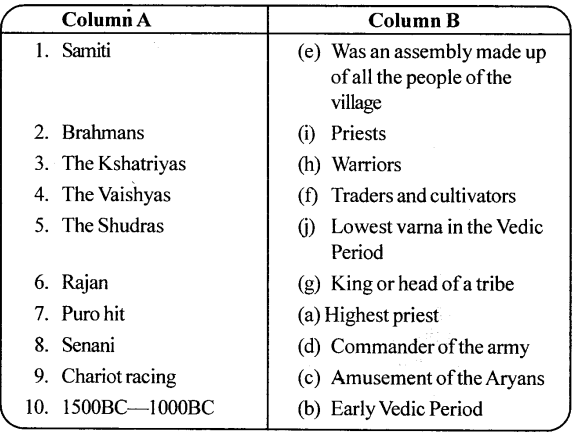
II. Match Column A with Column B:
Answer:
III. State whether the following statements are True or False.
- The Aryans were the original inhabitants of India.
Ans : False - The Aryans called their settlements ‘Arpavaria’.
Ans : True - The knowledge of early Vedic society comes from the two Epics.
Ans : False - The Aryans worshiped nature and believed in
Ans : True - The Upanishads are philosophic works which lay stress on ‘Karma’ and ‘Moksha’.
Ans : True - The ‘Sabha’ was a powerful body which advised the king on all matters.
Ans : True - The Aryans knew mathematics and about its two branches, algebra and geometry.
Ans : True - Mahabharata was written by Valmiki.
Ans : False
IV. Answer the following questions
Question 1.
Which theory about the original home of the Aryans is most popular?
Answer:The most popular theory regarding the original home of the Aryans points towards Central Asia. This theory is supported by linguistic similarities between Indo-Aryan languages and other Indo-European languages spoken in that region, as well as archaeological and literary evidence suggesting migrations from Central Asia towards the Indian subcontinent.
Question 2.
Which gods and goddesses were worshiped by the Aryans during the Early Vedic Period? Describe the changes that took place in their religion in the Later Vedic Period.
Answer:The religion of the Early Vedic Period centered on the worship of powerful nature gods like Indra (thunder), Agni (fire), Varuna (water/cosmic order), and Surya (sun), alongside goddesses like Prithvi and Usha. Over time, during the Later Vedic Period, this shifted. The earlier gods became less significant, and a new trinity of Brahma (creator), Vishnu (preserver), and Shiva (destroyer) rose to prominence. Religious practices grew more complex, emphasizing elaborate rituals and sacrifices conducted by powerful Brahmin priests. Abstract philosophical ideas about Brahman and Atman also emerged, while the importance of female deities generally declined.
Question 3.
On what basis was the Aryan society divided? Mention the functions of each social group.
Answer:The early Aryan society was organized in a structured way, featuring four main social groups called varnas. Your varna essentially determined your place and what you did in the community.
At the top were the Brahmins, who were highly respected for their spiritual understanding. They were the priests, teachers, and scholars. Their roles included performing religious ceremonies, studying and teaching important religious texts like the Vedas, and offering advice on religious and moral matters.
Next came the Kshatriyas, who were the protectors and leaders. This group consisted of warriors, rulers, and administrators. They were responsible for defending the society, governing it, and keeping order.
The Vaishyas made up the third group. They were mainly involved in farming, raising cattle, trading, and business. Their work was crucial for creating wealth and meeting the society’s economic needs.
Question 4.
How did the Aryans amuse themselves?
Answer:The Aryans, during both the early and later Vedic periods, enjoyed a variety of pastimes and forms of entertainment. Here are some ways they amused themselves:
- Music and Dance: Singing and dancing were integral parts of their social and religious life. They had various musical instruments like the vina (a stringed instrument), flutes, and drums. Group dances were common during festivals and gatherings.
- Chariot Racing and Hunting: Physical activities were also a source of amusement. Chariot racing was a popular sport, showcasing skill and speed. Hunting provided both food and entertainment, allowing them to display their bravery and prowess.
- Gambling: Dice games were a popular form of entertainment, though sometimes they could lead to problems due to the excitement and potential for loss.
- Storytelling and Recitation: Oral tradition was strong, and listening to stories, legends, and the recitation of hymns from the Vedas would have been a form of entertainment and education.
- Festivals and Gatherings: Religious ceremonies and festivals were often occasions for social gatherings, where people could meet, interact, and enjoy various forms of entertainment together.
Question 5.
Describe the political organisation of the Aryans during the ‘Later Vedic Period.
Answer:The Later Vedic Period witnessed a shift from smaller tribal units (Janas) to larger territorial kingdoms (Janapadas). Hereditary kings gained power, replacing tribal chiefs, and reinforced their authority through elaborate rituals like the Ashvamedha and Rajasuya. While earlier assemblies (Sabha and Samiti) persisted, their influence decreased, becoming more advisory. A more structured administration with officials and the early stages of a standing army developed, indicating a move towards centralized monarchy from a more equal tribal system.
Question 6.
Compare the position of women during the Early Vedic Period and the Later Vedic Period.
Answer:Here’s a comparison of the position of women in the Early and Later Vedic periods:
- Early Vedic Period: Women enjoyed a more respected position. They had access to education, could participate in tribal assemblies (Sabha and Samiti), and some even composed hymns (like Apala, Lopamudra).
- Later Vedic Period: The status of women declined. They were increasingly confined to the household, lost their right to participate in public assemblies, and were generally seen as subordinate to men.
Question 7.
What difference do you find in the position of the King of the Early Vedic Age as compared to the King of the Later Vedic Age?
Answer:During the Early Vedic Age, the King, or Rajan, wasn’t the all-powerful ruler we might imagine. Think of him more like a respected tribal leader, often picked by the community, the jana. Groups like the sabha and samiti had a real voice, keeping his decisions in check. It wasn’t always a given that his son would take over; his main job was leading in battle and looking out for the tribe.
Fast forward to the Later Vedic Age, and the King’s role went through a major upgrade. Suddenly, kingship became a family affair, passed down through generations. The idea of ruling a specific chunk of land became more important than just leading a tribe. Those old tribal assemblies lost their clout, and the King’s power ballooned. Priests and fancy rituals stepped in to boost his image, even suggesting he had divine connections. He transformed from a tribal head to a territorial ruler with much more control.
Picture study:
This is the picture depicting an institution of Vedic Period.
1. Identify and name it
Ans: The image beautifully captures the essence of a Gurukul. You can see students seated on the ground, likely learning from a Guru. The serene, natural setting with simple dwellings further reinforces this idea of a traditional educational environment where students lived closely with their teacher, fostering a deep connection and holistic learning. 1 The presence of what appears to be livestock in the background also hints at the self-sufficient nature of these ancient learning centers
2. Describe this system/institution.
Ans. The image beautifully depicts a traditional gurukul setting. A respected guru is seated at the center, his presence commanding attention from the group of students gathered around him on the ground. Their posture and expressions suggest deep engagement in the learning process, some with books in hand, others listening intently to their teacher. The natural backdrop, with trees providing shade and simple huts dotting the landscape, evokes a sense of a close-knit community dedicated to knowledge. This open-air classroom highlights the intimate bond between the guru and his disciples, a hallmark of the ancient gurukul system where holistic learning and living alongside the teacher were integral to education. 1
3. Which Ashrama did it belong to ?
Ans: Based on the image, it appears to depict a scene from the Brahmacharya Ashrama.
Here’s why:
- We see young students gathered around a teacher. This setting of learning and acquiring knowledge is characteristic of the Brahmacharya stage of life.
- The students seem to be in a simple environment, perhaps away from the hustle and bustle of family life, which aligns with the traditional practice of a student residing with their guru.
The image strongly suggests a period focused on education and spiritual development under the guidance of a teacher, which is the essence of the Brahmacharya Ashrama.
Questions Based on Early Vedic Civilization
A. Fill in the blanks.
- The Aryans who settled in India were called———.
Ans : Indo-Aryans
- Labourers who served people and did menial jobs were the———–.
Ans : Shudras
- The region of seven river is called the———–.
Ans : Sapta Sindhu
- The four Vedas are ———– , ——— , ———-, & ———-.
Ans : Rig Veda, Atharva Veda, Sama Veda, and Yajur Veda
- The two councils, the ———— and the ————- exercised control over the king.
Ans : Sabha , Samiti
- The most important god of the early Aryans was——– .
Ans : Indra
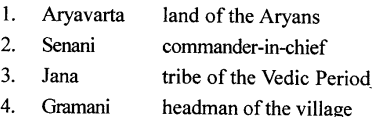
B. Match the following.
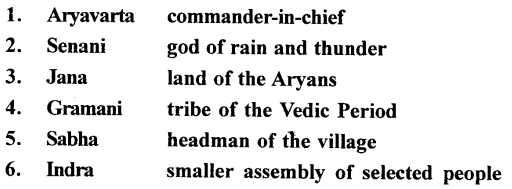
Answer:

following questions.
Question 1.
When did the Aryans arrive in India?
Answer:the arrival of the Aryans in India is a nuanced subject that historians and archaeologists continue to explore. The prevailing understanding, built upon careful analysis of linguistic patterns and archaeological findings, suggests a migration period roughly between 1800 BCE and 1500 BCE.
These Indo-Aryan peoples, speakers of languages belonging to the vast Indo-European family, are thought to have gradually moved into the northwestern areas of the Indian subcontinent, tracing routes from Central Asia. 1 This wasn’t a swift takeover, but more likely a centuries-long process of movement and settlement. As they established themselves in regions encompassing the Indus Valley and extending towards the fertile Ganges Plain, they brought with them their unique linguistic heritage, a distinct set of religious beliefs, and their own social organization. 2 These elements profoundly shaped the subsequent Vedic period of Indian history, laying down cultural and societal frameworks that would have long-lasting impacts. 3
Question 2.
Describe the various stages in which the Aryans entered India.
Answer:So, after the Harappan civilization’s decline, Indo-Aryan speakers likely entered the northwest through mountain passes. They first settled in the Sapta Sindhu region, which kicks off the early Vedic period and the Rigveda. Slowly but surely, they moved eastward into the fertile Ganges plains and then further east and south across northern India, mixing with the local folks along the way.
Question 3.
Name the four Vedas. How have they come down to us?
Answer:The Vedas, namely the Rigveda, Samaveda, Yajurveda, and Atharvaveda, boast a remarkable history. 1 Transmitted orally across generations with incredible care, these foundational scriptures were only documented in written form much later.
Question 4.
Who was a rajan? What were his duties?
Answer:In the early Vedic period, the Rajan wasn’t a king ruling over land, but more like a tribal leader. 1 Think of them primarily as protectors of the tribe and their precious cattle. They were responsible for the tribe’s safety and well-being, guiding them, and probably helping sort out disagreements. 2 Their authority wasn’t unlimited, and tribal gatherings had a voice in decisions. 3 So, the Rajan’s focus was really on the tribe’s immediate survival and needs
Question 5.
The rajan did not have absolute power. Explain.
Answer: Rajan’s authority wasn’t absolute. Tribal assemblies such as the Sabha and Samiti played a role in advising him and keeping his power in check.
Question 6.
How did the caste system start in Early Vedic society?
Answer: Early Vedic society saw divisions based on what people did for a living. The term “varna” started with a meaning of “color,” probably setting apart the Indo-Aryans and local folks. Over time, these job roles became more set in stone and passed down through families. The four varnas we know – Brahmins, Kshatriyas, Vaishyas, and Shudras – likely grew out of these initial work-based groups and the early distinctions between communities, gradually hardening into the hierarchical caste system.
Question 7.
Name the four classes in the Rig Vedic Period. Who were the members of each of these classes?
Answer:During the Rig Vedic period, society featured four main classes: the Brahmanas (priests and scholars), the Rajanyas or Kshatriyas (rulers and warriors), the Vaishyas (agriculturalists, traders), and the Shudras (laborers). Importantly, this early social division was more flexible than in later times.
Question 8.
What were the main occupations of the Aryans?
Answer:Engaging primarily in herding and farming, the Aryans also became skilled in pottery, weaving, and metal crafts. 1 Warfare was another important facet of their life
Question 9.
What were the main forms of recreation of the Aryans?
Answer:The Aryans enjoyed several forms of recreation. 1 Chariot racing and hunting were popular activities that showcased their skill and strength. 2 Music and dancing also played a significant role in their social gatherings and religious ceremonies. 3 Additionally, they engaged in games and gambling.
Question 10.
Name the gods worshiped by the Rig Vedic Aryans. How did they worship their gods?
Answer:The Rig Vedic Aryans revered nature’s power, with Indra, Agni, Varuna, Surya, and Prithvi holding key positions in their pantheon. Their worship centered on rituals and sacrifices, where offerings like milk, ghee, grains, and animals were poured into the sacred fire, accompanied by Rig Vedic hymns. These practices aimed to secure blessings, well-being, safety, and uphold the balance of the universe.
Question 11.
What was the position of the women in the Rig Vedic Period?
Answer:In the Rig Vedic period, women held a significant place, participating in public life and even composing hymns. 1 While there were early signs of patriarchy, their status was notably higher than in later Vedic times.
Question 12.
Mention two important differences between the Aryans and the people of the Indus Valley.
Answer:The Indus Valley Civilization showcased sophisticated urban life centered on agriculture and trade, leaving behind impressive material evidence of their planning.1 In contrast, the early Aryans lived a more nomadic, pastoral life, gradually adopting agriculture and prioritizing their oral traditions over material culture
D. State whether the following are true or false.
- Rice was the staple diet of the Aryans.
Ans : False - The Aryans drank intoxicating drinks like soma and sura.
Ans : True - The dress of the Aryans consisted of a three-piece garment.
Ans : False - Both men and women wore jewellery.
Ans : True - The Aryans believed in one supreme God.
Ans : True
Questions Based on Early Vedic Civilization
A. Fill in blanks.
- The Later Vedic Period is also known as the————.
Ans : Epic Age
- The two Indian epics of this period are ———- and the———–.
Ans : Ramayana , Mahabharata
- In ancient times, Varanasi was known as ———–and Awadh was known as ———
Ans : Kashi , Kosala
- When a king ascended the throne, the purohita performed the ————.
Ans : Rajasuya
- During the first stage of his life an Aryan stayed in a gurukul and received education from a ———- .
Ans : guru
- A guru treated his students like his ———— and the students regarded the guru as their ————
Ans : own children , spiritual father
- ———— and ——– were two highly educated women of the Early Vedic Period.
Ans : Maitreyi , Gargi
- In the Later Vedic Age, the classification of society into four varnas became ——— and ———-.
Ans : rigid & hereditary
B. Match the following.
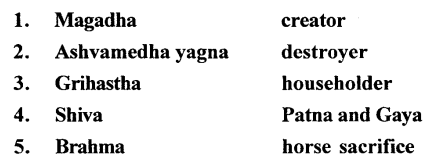
Answer:
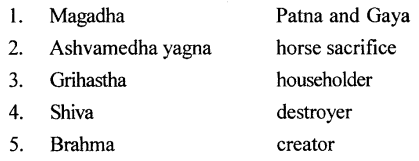
C. Answer the following questions.
Question 1.
Name the four kingdoms that developed from small tribal organizations.
Answer:The four kingdoms that developed from small tribal organizations were the Pratiharas, the Palas, the Rashtrakutas, and the Cholas.
Question 2.
How did the king become more powerful during this period?
Answer:During this period, kings often consolidated power through various means. They frequently strengthened their armies and administrative systems, allowing for better control over their territories and the ability to enforce their will. Strategic alliances and successful military campaigns also expanded their domains and resources, further enhancing their authority. Moreover, some kings asserted greater control over religious institutions or legal systems, reducing the influence of potential rivals and centralizing power in their own hands.
Question 3.
How did the society get sharply divided during the Later Vedic Period?
Answer: During the Later Vedic Period (roughly 1000-600 BCE), society became sharply divided due to the solidification of the varna system. This hierarchical system, initially more flexible, transformed into a rigid social stratification based on birth.
The Brahmanas (priests) gained significant power and prestige, occupying the top rung. Below them were the Kshatriyas (warriors and rulers), followed by the Vaishyas (traders and agriculturalists). The Shudras (laborers and servants) occupied the lowest position and faced increasing restrictions and social disabilities.
This hereditary and increasingly inflexible varna system led to a sharp division within society, with limited social mobility and unequal access to resources and opportunities
Question 4.
Briefly describe the four ashramas.
Answer: Brahmacharya: Student life, focused on learning and discipline.
Grihastha: Family, work, and fulfilling societal responsibilities – the heart of life.
Vanaprastha: Gradual detachment and a shift towards spiritual pursuits.
Sannyasa: Complete renunciation and the final quest for spiritual liberation.
Question 5.
What was the position of women during the Later Vedic Period?
Answer:During the Later Vedic Period (1000-600 BCE), women’s standing gradually decreased. Their involvement in public assemblies lessened, and while some women were educated, broader access to higher learning became restricted. The focus shifted towards their domestic responsibilities, and patriarchal norms solidified, placing them under the authority of male family members. Early limitations on their freedom started to emerge during this time.
Question 6.
At what age was a boy sent to gurukul? What was the relationship between the guru and his students?
Answer:During the Later Vedic Period (1000-600 BCE) in India, women experienced a gradual decline in their social standing. 1 Their participation in public life reduced, and while some women received education, opportunities for advanced learning narrowed. Domestic duties became their primary focus as patriarchal values strengthened, placing them under male authority within the family. This era marked the beginning of restrictions on their freedoms. 2
Question 7.
What did the students do during their stay in the gurukul?
Answer: During their time at the gurukul, students immersed themselves in a holistic education. They diligently studied scriptures and philosophy, honing their intellect. Alongside academic pursuits, they actively engaged in physical training, fostering strength and discipline. Serving their guru with devotion was an integral part of their learning, instilling humility and respect. Their days were filled with learning, physical activity, and selfless service.
Question 8.
What was the method of teaching in a gurukul?
Answer:In ancient gurukuls, education was primarily oral and experiential. 1 Students resided with the guru, learning through observation, practical work, and direct interaction. 2 Knowledge was absorbed by listening to the guru, participating in discussions, and applying lessons in daily life. 3 Memorization and recitation were key learning methods
Question 9.
What were the main occupations of the people of the Later Vedic Period?
Answer:During the Later Vedic Period, people primarily worked in agriculture, raising animals, and various crafts. 1 They grew barley, rice, and wheat. 2 Cattle, sheep, goats, and horses were vital for their way of life. 3 Skilled craftspeople in carpentry, pottery, metalworking, and weaving were also important to the economy
Question 10.
Mention the important features of the religion of the Later Vedic Period.
Answer:
During the Later Vedic Period (roughly 1000-600 BCE), significant shifts occurred in religious practices and beliefs in India. Here are some key features:
- Rise of Prominent Deities: While Indra and Agni were important in the Early Vedic period, new gods like Brahma (the creator), Vishnu (the preserver), and Shiva (the destroyer) gained prominence, forming the early stages of the Hindu pantheon.
- Elaborate Rituals and Sacrifices: Yajna (sacrifices) became increasingly complex and central to religious life. Detailed procedures and specific mantras were emphasized, often requiring the expertise of specialized priests (Brahmins).
- Growing Power of the Priesthood: The Brahmin class solidified its position as the primary interpreters of religious knowledge and the performers of rituals. Their role became crucial for maintaining cosmic order and ensuring societal well-being.
- Development of Philosophical Ideas: The Upanishads, which are philosophical texts attached to the Vedas, began to emerge. They explored concepts like Brahman (the ultimate reality), Atman (the individual soul), karma, and moksha (liberation), laying the groundwork for later Hindu philosophical schools.
- Shift in Focus: The focus of religious concern moved from primarily seeking material prosperity and progeny to understanding the deeper meaning of life, the nature of reality, and the cycle of birth and death.
- Emergence of the Varna System: The four-tiered social hierarchy (Brahmin, Kshatriya, Vaishya, Shudra) became more rigid and was increasingly linked to religious duties and social standing.
Question 11.
What is the impact of the Aryan civilization on India?Answer:The arrival of the Aryans brought pivotal changes to India, laying the groundwork for Hinduism. Their sacred texts, the Vedas, written in Sanskrit, continue to hold immense religious and philosophical significance. While also associated with the early development of the caste system, their religious rituals and pantheon of gods formed the seeds of Hindu practices. This period also gifted India with profound literature and philosophical works like the Upanishads.
State whether the following are true or false.
- The Upanishads were composed during the Later Vedic Period.
Ans : False - Excavations indicate the use of iron during this period.
Ans : True - The sabha and samiti became very powerful during this period.
Ans : False - The caste system became flexible in the Later Vedic Period.
Ans : False - Education in a gurukul was very expensive.
Ans : False