
What is Agriculture? The chapter will likely start by defining agriculture as the practice of cultivating land to grow crops and raise livestock for food and other products. It will emphasize its importance for human survival and the economy.
Factors Influencing Agriculture: It might briefly touch upon the factors that determine the type of agriculture practiced in a region, such as climate, soil type, availability of water, technology, and economic conditions.
Main Types of Agriculture: The core of the chapter will likely be the different categories of agriculture:
- Subsistence Agriculture: This is farming primarily for the farmer’s own consumption and their family’s needs. There’s usually little surplus to sell. It might be further divided into:
- Intensive Subsistence Agriculture: Practiced in densely populated areas where farmers cultivate small plots of land using simple tools and labor to produce enough for their local consumption (e.g., rice cultivation in parts of Asia).
- Extensive Subsistence Agriculture: Practiced in sparsely populated areas with large landholdings. Farmers may clear forests or grasslands and move to new areas when the soil fertility decreases (e.g., shifting cultivation or nomadic herding).
- Commercial Agriculture: This is farming primarily for selling the produce in the market to earn profit. It often involves large-scale cultivation, the use of modern machinery, fertilizers, pesticides, and high-yielding varieties of crops. Examples include:
- Plantation Agriculture: A type of commercial farming where single cash crops like tea, coffee, rubber, or sugarcane are grown on large estates (plantations). It often involves significant capital investment and a large labor force.
- Extensive Commercial Agriculture: Practiced in regions with large land areas and low population density, focusing on crops like wheat or raising livestock on vast ranches (e.g., wheat farming in the prairies of North America, cattle ranching in Argentina).
- Mixed Farming: A system where farmers grow crops and raise livestock on the same farm. This allows for efficient use of land and resources.
Other Types of Agriculture (Potentially): The chapter might also briefly introduce other specialized types of agriculture, such as horticulture (cultivation of fruits, vegetables, and flowers) or dairy farming.
Importance of Different Agricultural Types: The chapter will likely conclude by highlighting how different types of agriculture meet varying needs and are influenced by geographical, economic, and social factors.
EXERCISES
A. Fill in the blanks
- ———— are the most important products that come from agriculture.
Ans : Food grains
- Farmers who practised subsistence farming depend on the ———— for water for the crops.
Ans : monsoon rains
- ————- farming requires a lot of labour on a small piece of land.
Ans : Intensive
- Extensive farming is practised in areas of ——— population.
Ans : low
- ———- cultivation is generally practised in forested areas.
Ans : Shifting
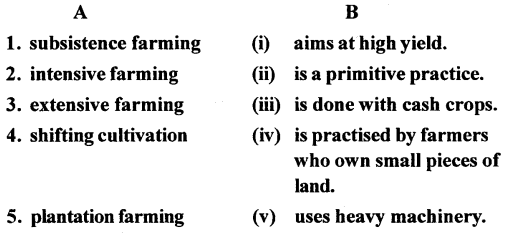
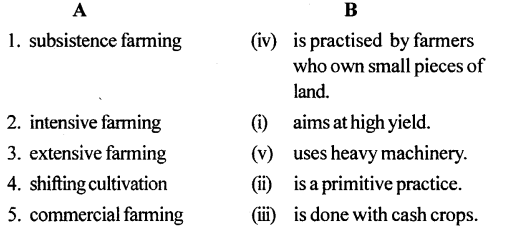
B. Match the columns
Answer :
C. State whether the following are true or false
1. Agriculture is not an important occupation anymore.
Answer. False.
Correct — Agriculture is an important occupation anymore.
2. Farmers who practised subsistence farming use modern methods of irrigation.
Answer. False.
Correct— Farmers who practise subsistence fanning use old methods of irrigation or depend on the monsoon rains.
3. Intensive farming requires very little labour to work on the farm.
Answer. False.
Correct— Extensive farming requires little labour to work on the farm.
4. Extensive farming is practised in countries like India, China and Japan.
Answer. False.
Correct— Intensive farming is practised in countries like India, China and Japan.
5. Shifting agriculture is wasteful and harmful to forests and wildlife.
Answer. True.
D. Answer the following questions in brief
Question 1.
What do you understand about agriculture ?
Answer:Agriculture is fundamentally about growing food crops from the land and raising animals. It’s how we primarily get our food and, sometimes, other products. It’s the practical skill and understanding of farming – nurturing the earth and livestock for what we need.”
Question 2.
Name any three types of agriculture practised around the world.
Answer:“Globally, you see lots of different ways people farm, but three big ones to know are: subsistence farming, where it’s mostly about growing enough food for the farmer and their family to eat; commercial farming, which is all about growing crops or raising animals to sell and make money; and then there’s plantation farming, where they grow huge amounts of just one type of crop, like coffee or bananas, on big farms.”
Question 3.
Define subsistence agriculture.
Answer:“Subsistence agriculture is basically when farmers grow food mainly to feed themselves and their families. It’s all about producing enough to eat and get by, rather than growing crops to sell for a profit. Think of it as farming for survival and local needs, with usually not much left over to take to the market.”
Question 4.
Why is intensive farming expensive ?
Answer:”Well, the name ‘intensive’ kind of gives it away – it means putting a lot into a small area to get a lot out. This usually involves spending more money on things like high-yield seeds that are specially bred to produce more crops. Farmers often need to use a good amount of fertilizers to keep the soil rich and pesticides to protect the plants from pests and diseases, and these aren’t cheap. Plus, to really maximize production on limited land, they often invest in machinery like tractors and irrigation systems. All those inputs and equipment add up, making intensive farming a more expensive way to grow food compared to methods that use more land and fewer resources.”
Question 5.
Name the crops grown by extensive farming.
Answer:Wheat: Especially in vast regions like the prairies of North America or the steppes of Russia and Ukraine.
Barley: Similar to wheat, often grown in large, open areas.
Rye: Another grain that can be grown extensively in certain climates.
Corn (Maize): In some large agricultural regions with lower population density.
Soybeans: Increasingly grown in large, mechanized farms.
Cattle and Sheep (for meat and wool): While not crops, raising livestock on large ranches with extensive grazing land is a key part of extensive agriculture.
Question 6.
Why is shifting cultivation not productive in the long run?
Answer:“Well, the thing about shifting cultivation is that it relies on the soil naturally recovering its nutrients after a few years of farming. When you keep coming back to the same patch too soon – before the forest or vegetation has properly grown back and enriched the soil again – the land just gets worn out. It loses its fertility, and you end up with poor harvests. Plus, with more and more people needing land to farm, the cycles of leaving land fallow (unplanted) get shorter and shorter, which doesn’t give the soil enough time to bounce back. So, in the long run, it just isn’t a productive way to grow food because the soil gets exhausted.”
Question 7. In which parts of India is shifting cultivation practised?
Answer:Shifting cultivation is mainly found in the northeastern states of India, like Arunachal Pradesh, Meghalaya, Mizoram, and Nagaland. You also see it in some hilly and tribal areas of other states such as Odisha, Madhya Pradesh, and Andhra Pradesh. These are regions with dense forests and a traditionally tribal population.
Question 8. Mention any two features of commercial farming.
Answer: If we’re talking about commercial farming, two key things that stand out are:
- It’s all about growing crops or raising animals to sell for profit in the market. The main goal isn’t just to feed the farmer’s family.
- It usually involves using modern technology and inputs to get higher yields. Think of things like tractors, combine harvesters, chemical fertilizers, pesticides, and high-yielding varieties of seeds or breeds of livestock.
E. Answer the following questions in one or two paragraphs
Question 1.
Briefly explain subsistence agriculture.
Answer:Subsistence agriculture is a farming system where farmers primarily grow crops and raise livestock to meet the basic needs of their families, with little or no surplus for sale or trade. It’s often characterized by small landholdings, reliance on family labor, and the use of traditional, low-input farming methods. The main goal is self-sufficiency in food production rather than generating profit.
There are different types of subsistence agriculture, including intensive subsistence farming (cultivating small plots with high labor input), shifting cultivation (clearing and farming a patch of land until fertility declines, then moving to a new patch), and pastoral nomadism (raising livestock and moving them to find pasture). These systems are often found in developing countries and remote areas where access to markets and modern agricultural technologies is limited.
Question 2.
Distinguish between intensive and extensive farming.
Answer:tensive farming: Get the most out of a small area by putting in a lot (labor, money, tech). Think high effort, high reward per unit of land.
Extensive farming: Farm a big area with less input. Rely more on the land’s natural ability. Think big scale, lower effort per unit of land.
Question 3.
What do you understand about shifting agriculture ?
Answer:Shifting agriculture, also known as slash-and-burn, is a farming method where land is cleared (often by burning vegetation), cultivated for a short time, and then abandoned. Farmers then move to a new plot, allowing the old land to naturally recover its fertility over time.
Question 4. What crops are grown by commercial farming? What are the methods that are employed?
Answer: Commercial farming focuses on growing crops for profit, often on a large scale. Common crops include wheat, rice, maize, sugarcane, cotton, and various fruits and vegetables. Methods employed involve using high-yielding varieties, modern machinery for plowing, sowing, and harvesting, chemical fertilizers, pesticides, and irrigation techniques to maximize production.
Question 5. Write a short note on plantation farming.
Answer: Plantation farming is large-scale commercial agriculture centered on a single valuable crop like rubber, tea, or coffee. It requires significant investment, modern methods, and strong processing and sales systems, often with on-site processing and careful management.
Question 6. Write a short note on mixed farming.
Answer: Mixed farming involves cultivating crops and raising livestock simultaneously on the same farm. This integrated approach allows farmers to earn income from both sources. Animal manure contributes to soil fertility, reducing the need for chemical fertilizers. Common practices include growing fodder crops to feed animals, which in turn provide milk, meat, and other products.
F. Picture study
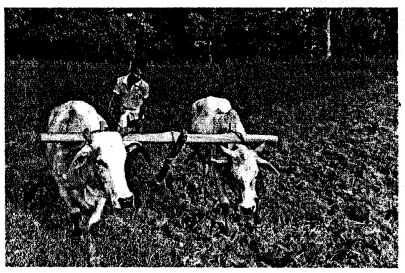
The photograph here shows a farmer tending to his field.
Question 1.
What type of farming is he practising ?
Answer:To figure out what kind of farming “he” is doing, I need a tiny bit of information about what’s happening on his farm. What’s he growing or raising? What methods is he using? Just a quick hint will do!
Question 2.
What are the difficulties that he might face ?
Answer:Farmers commonly grapple with a range of interconnected challenges. The unpredictable nature of weather poses a constant threat, with droughts, floods, and extreme temperatures capable of devastating harvests and livestock. Furthermore, the persistent issues of pests and diseases can decimate crops and animal populations, demanding continuous vigilance and costly interventions. The volatile market prices for agricultural goods add another layer of uncertainty, as sudden drops can erode profits. Rising input costs for essentials like seeds, fertilizers, and fuel further strain their financial resources. Finally, access to sufficient water remains a critical concern in many regions, particularly with increasing environmental pressures. These factors collectively contribute to the complex and often demanding realities of farming.