
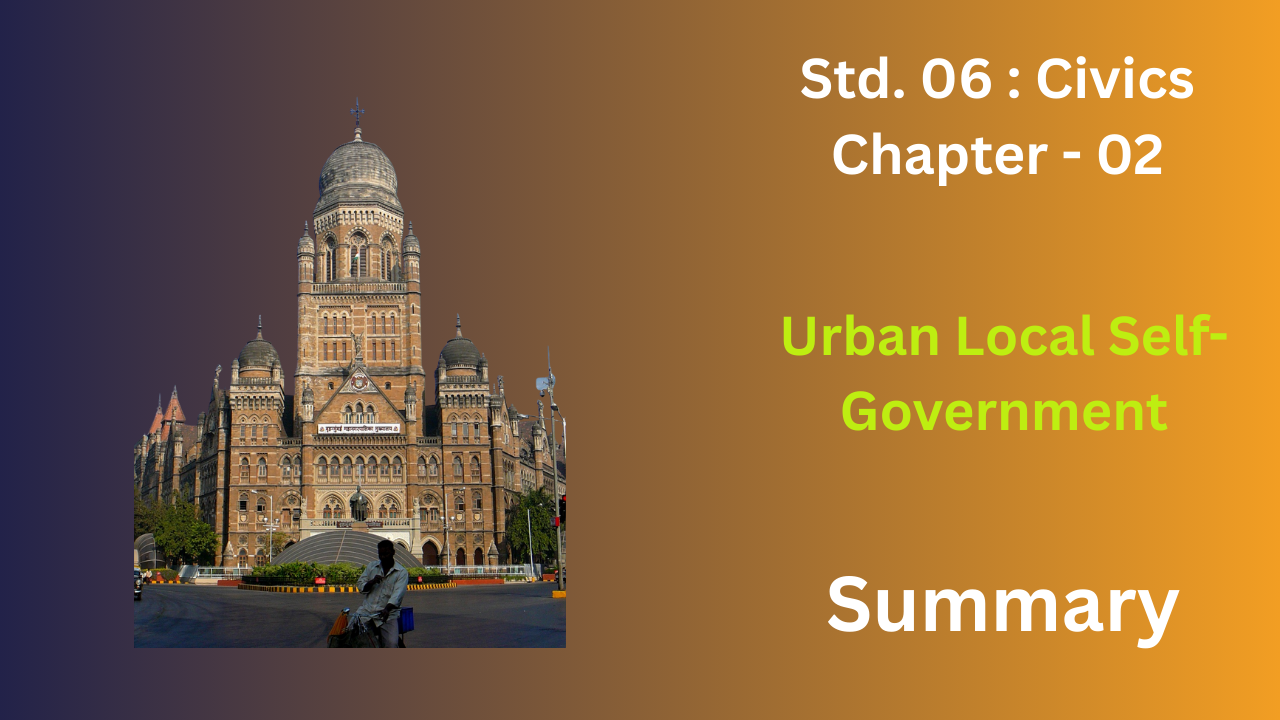
Urban Local Self-Government, as explained in the 6th-grade civics chapter, is all about how cities and towns in India manage their own affairs. Because urban areas have lots of people and unique challenges compared to villages, they need their own governing bodies.
Here’s the gist of it:
- Why Urban Local Bodies are Needed: Cities and towns are packed with people doing all sorts of jobs. This creates complex issues like getting water and electricity to everyone, keeping things clean, and looking after people’s health. Having local elected groups helps tackle these problems effectively and lets the people who live there have a say.
- Different Types of City Governments: The kind of local government a place has depends on how big it is and how many people live there. The chapter mainly talks about:
- Nagar Panchayats: For areas that are becoming more like towns than villages.
- Municipal Councils (Nagar Palikas): For smaller towns and cities.
- Municipal Corporations (Mahanagar Palikas): For the really big cities.
- How They’re Set Up:
- Wards: Cities and towns are divided into smaller areas called wards, and the people in each ward elect a ward councillor (or corporator in big cities).
- Elected Leaders: These councillors form the main governing group.
- The Head: Each type of city government has a leader: a Chairperson/President for Nagar Panchayats and Municipal Councils, and a Mayor for Municipal Corporations.
- Time in Office: Elected officials usually serve for a set period, like five years.
- Reserved Seats: Just like in village governments, some seats are set aside for women and people from Scheduled Castes and Scheduled Tribes.
- What They Do: These city governments do a lot to make urban life work, including:
- Must-Do Jobs: Making sure there’s water, keeping roads and bridges in good shape, handling garbage and drainage, providing streetlights, running hospitals and clinics, offering basic education, planning how the city grows, and keeping track of births and deaths.
- Optional Jobs: They might also set up libraries, museums, and parks, provide transportation, organize events, and do other things to help the community.
- Where the Money Comes From: City governments get money in a few ways to pay for all this:
- Fees: For things like water connections and licenses.
- Grants: Money from the state government.
- Their Own Income: From things they own.
- Why They’re Important: Having Urban Local Self-Government means that the specific needs and problems of cities and towns are handled by people who are elected and answerable to the people who live there. It encourages people to get involved in making their city or town better and helps with planning and managing the services and infrastructure that urban areas need.
Basically, this chapter explains that having local governments in cities and towns – like Nagar Panchayats, Municipal Councils, and Municipal Corporations – is crucial for managing these busy places, providing essential services, and helping them grow in a way that meets the needs of their residents.
Exercise
I. Fill in the blanks
- Big cities have ————- as local self-government.
Ans : Municipal Corporation
- The head of a corporation is called ———.
Ans : Mayor
- The municipality arranges for checking food———.
Ans : adulteration
- Towns having ten to twenty thousand people have small 1 bodies known as———-.
Ans : Municipalities
- Tax on goods and animals brought into or taken out of the town is known as———–.
Ans : Octroi Duty
II. Tick mark (✓) the right statements and cross (x) the wrong ones:
- Municipal corporations have more powers than the municipalities.
Answer:True – - A person who has attained the age of 25 can vote in a municipal election.
Answer:True - The Mayor and the Deputy Mayor are elected for one year.
Answer:True - Records of births and deaths in a city are kept by the state government.
Answer:False - The municipalities receive grants from the state government.
Answer:True
III. Answer the following questions:
Question 1. Differentiate between a municipal corporation and a municipality. Answer:Think of it this way: both are set up to govern urban areas, but the main difference comes down to the size and population of the place.
- A Municipal Corporation is for the really big cities – the ones with large populations and more complex needs. They have more resources and a larger administrative structure to manage these sprawling areas. You might find these in major metropolitan centers.
- A Municipality (also sometimes called a Municipal Council or Nagar Palika) is for smaller towns and cities. They handle similar tasks as a Municipal Corporation but on a smaller scale, fitting the needs of their less populous areas.
So, it’s essentially a matter of scale and the complexity of managing a larger versus a smaller urban center.
Question 2. How are the two types of urban local bodies constituted? Answer:
Both Municipal Corporations and Municipalities are formed through a similar democratic process:
- The urban area is divided into smaller areas called wards.
- These elected representatives then come together to form the governing body.
- They also elect a head: a Mayor in the case of a Municipal Corporation and a Chairperson or President for a Municipality.
Essentially, both are made up of people chosen by the residents of their respective urban areas through elections, ensuring local representation in their governance.
Question 3. List five main compulsory functions performed by a municipality or a municipal corporation.
Answer:Towns and cities rely on their local governments to handle several essential tasks. Five key things that municipalities and corporations must do are:
- Making sure there’s a good supply of water for everyone.
- Building and looking after the roads and bridges within the city or town.
- Setting up and maintaining systems for cleanliness and proper drainage.
- Providing street lighting so people can move around safely at night.
- Running public health services like clinics and hospitals.
Question 4. How do the municipalities get funds?
Answer:Municipalities and corporations get the money they need from a few different places. They collect taxes, like property tax and sometimes taxes on water usage. They also charge fees for certain services, such as building permits. Additionally, they receive grants of money from the state government to help fund their activities.
Question 5. Describe the relationship between the state/central government and the urban local bodies.
Answer:The state government creates the laws that establish these local bodies and defines their powers and responsibilities. It also provides financial assistance through grants and may guide their activities. While the urban local bodies are meant to be self-governing, the state government has the authority to supervise their work and ensure they are functioning properly and according to the law. The central government’s role is generally more about setting broad national policies and sometimes providing funding for specific urban development projects.
Additional Questions
Additional Questions
A. Fill in blanks:
- The local self-governing bodies which look after the needs of big cities and towns are ————– and ————- corporations.
Ans : Municipalities , Municipal
- A mayor holds office for a term varying between ———— and.
Ans : 1 year , 5 years
- The ————- supervises the working of municipal corporations.
Ans : state government
- Some seats in the municipal corporation are ———– for Scheduled Castes and Scheduled Tribes.
Ans : reserved
- The municipal corporation establishes and maintains ———- and education centers.
Ans : public parks
B. Match the following:
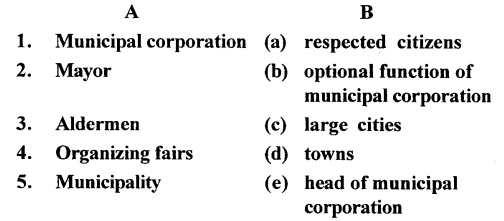
Answer:
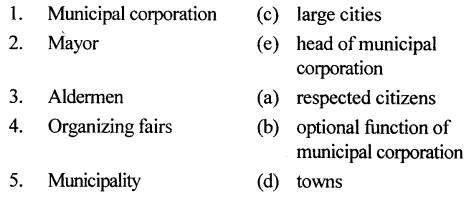
C. Choose the correct answer:
- Big cities like Delhi and Mumbai have town area committees/municipalities/municipal corporations.
Ans. Big cities like Delhi and Mumbai have municipal corporations. - The mayor/municipal commissioner/alderman presides over the meetings of the municipal corporation.
Ans. The mayor presides over the meetings of the municipal corporation. - The chief executive officer of a municipal corporation is known as the mayor/municipal commissioner/sarpanch.
Ans. The chief executive officer of a municipal corporation is known as the municipal commissioner. - The total number of members of a municipal corporation of a city depends on the population of the city/state/country.
Ans. The total number of members of a municipal corporation of a city depends on the population of the city. - A municipal corporation is elected for a period of 2/10/5
Ans. A municipal corporation is elected for a period of 5 year
D. State whether the following are true or false.
- Port trust is an urban local self-governing body.
AnswerTrue. - The members of the corporation are directly elected by the adult citizens of the city.
AnswerTrue. - Some seats are reserved for women in municipal corporations.
AnswerTrue. - The municipal corporation is not responsible for the supply of safe drinking water.
AnswerFalse.
Correct: The municipal corporation is responsible for the supply of safe drinking water. - Municipality is the local self-governing body for smaller cities and towns.
AnswerTrue.
E. Answer the following questions in one or two words/ sentences:
Question 1. Name the local self-governing bodies that look after the urban areas.
Answer:Nagar Panchayats, Municipal Councils, and Municipal Corporations.
Question 2. Who is mayor?
Answer:The elected head of a Municipal Corporation.
Question 3. What are the functions of the mayor?
Answer:Presides over meetings and acts as the first citizen.
Question 4. Who are aldermen?
Answer:Experienced individuals with special knowledge, co-opted into the municipal body.
Question 5. What are municipalities?
Answer:Local self-governing bodies for towns and smaller cities.
F. Answer the following questions briefly:
Question 1. How is a municipal corporation composed? Who are its members?
Answer:People who live in each ward directly elect a ward councillor (sometimes called a corporator) to represent them. These elected councillors form the main body of the Municipal Corporation. It also has a Mayor, who is the head of the corporation, and often a Deputy Mayor. Additionally, the corporation usually has various committees to look after specific areas of work.
Question 2. Mention five functions of the municipal corporation related to public health and sanitation.
Answer:keeping a city healthy and clean is a major responsibility for the Municipal Corporation! Here are five ways they work on this:
- They set up and run systems for collecting and properly disposing of all the city’s garbage.
- They look after public restrooms, making sure they are clean and usable.
- They check on the quality of food sold in the city to make sure it’s safe for everyone to eat.
- They manage the city’s crematoriums and burial grounds.
Question 3. The municipal corporation is responsible for the maintenance of public works and services in the city. Give any five examples to explain this.
Answer:The Municipal Corporation works hard to keep the city’s infrastructure running smoothly. Here are five examples:
- Looking after the construction and repair of roads, bridges, and flyovers.
- Ensuring there is a good supply of clean drinking water for all citizens.
- Maintaining the streetlights so that the city is well-lit at night.
- Developing and taking care of parks and gardens for people to enjoy.
- Providing and maintaining public transportation like city buses in some areas.
Question 4. List the optional functions of the municipal corporation.
Answer:Besides the essential tasks, the Municipal Corporation can also choose to do other things if it has the resources. Some of these optional functions include:
- Building and running libraries and museums.
- Organizing fairs and festivals to promote culture.
- Providing housing for low-income groups.
- Running public transport services.
- Setting up and maintaining markets and slaughterhouses.
G Picture study:
This is the picture of Mumbai Municipal Corporation headquarters. With reference to the picture of the municipal corporation, answer the following questions:
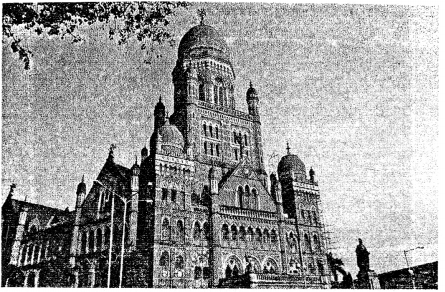
Question 1. Who is the head of the municipal corporation? How is he or she elected?
Answer:The Mayor holds the position of head in the Mumbai Municipal Corporation. This individual is chosen by the elected councillors (also called corporators) after they have won their respective ward elections. So, the people of Mumbai directly elect the councillors, and then these councillors, in turn, elect the Mayor.
Question 2. For which categories of community are seats of the corporation reserved?
Answer:To make sure different groups have representation, seats in the Mumbai Municipal Corporation are set aside for:
- Women: A specific number of seats are reserved exclusively for female candidates.
- Scheduled Castes (SCs): Seats are reserved for individuals belonging to Scheduled Castes.
- Scheduled Tribes (STs): Similarly, seats are also reserved for people from Scheduled Tribes.
This system of reservation aims to ensure that historically marginalized communities have a voice in the city’s governance.